How Does the RBI Control Inflation? Repo Rate, CRR, SLR & Monetary Policy Explained
Learn how the RBI controls inflation in India using Repo Rate, CRR, SLR, OMO, and monetary policy. Explained with examples, tables, and FAQs for students.

Do you see that sometimes the cost of vegetables/milk/school bags increases? An increase in the price of goods and services is referred to as inflation.
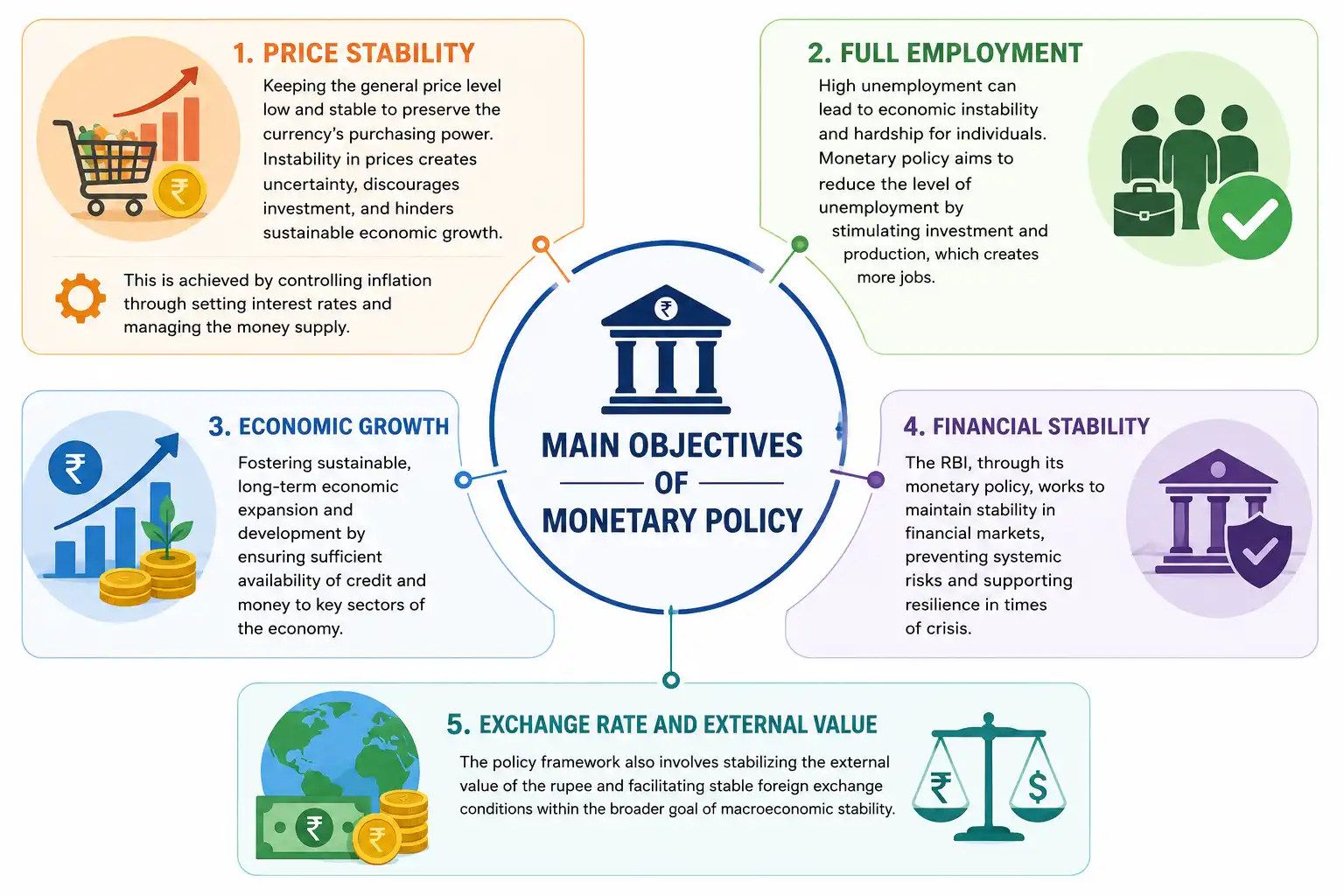
In India, the Reserve Bank of India (RBI) is responsible for maintaining the inflation rate within a tolerable limit to ensure people can purchase the necessary items. The primary aim of the RBI is to maintain price stability while also promoting economic growth.
Quick Highlights
| Aspects | Information |
| What is Inflation? | A rise in the prices of goods and services |
| Who controls inflation in India? | Reserve Bank of India (RBI) |
| Main method used | Monetary Policy |
| Decision-making body | |
| Inflation Target | 4% (with an increase or decrease of 2%) |
| Current Repo Rate | 5.25% |
The RBI has adopted a flexible inflation-targeting policy as laid down in the RBI Act.
What is Inflation?
Inflation is the rise in the prices of everyday items over time.
Example:
Last Year
This Year
1 kg apples = ₹120
1 kg apples = ₹140
It is now sold at the price of ₹20 per unit. An example of inflation is this.
What is the RBI?
The Reserve Bank of India (RBI) is the Central bank of India. It deals with the country's finance and banking system.
It is one of its main tasks to ensure that prices are not subject to excessive increases and inflation is kept under control.
Why is it important to control inflation?
If prices start to escalate:
-
The family needs to increase its earnings.
-
Individuals have to purchase less.
-
Making saving money harder.
-
Higher expenses are also experienced by businesses.
For this reason, the RBI attempts to keep the level of inflation constant.
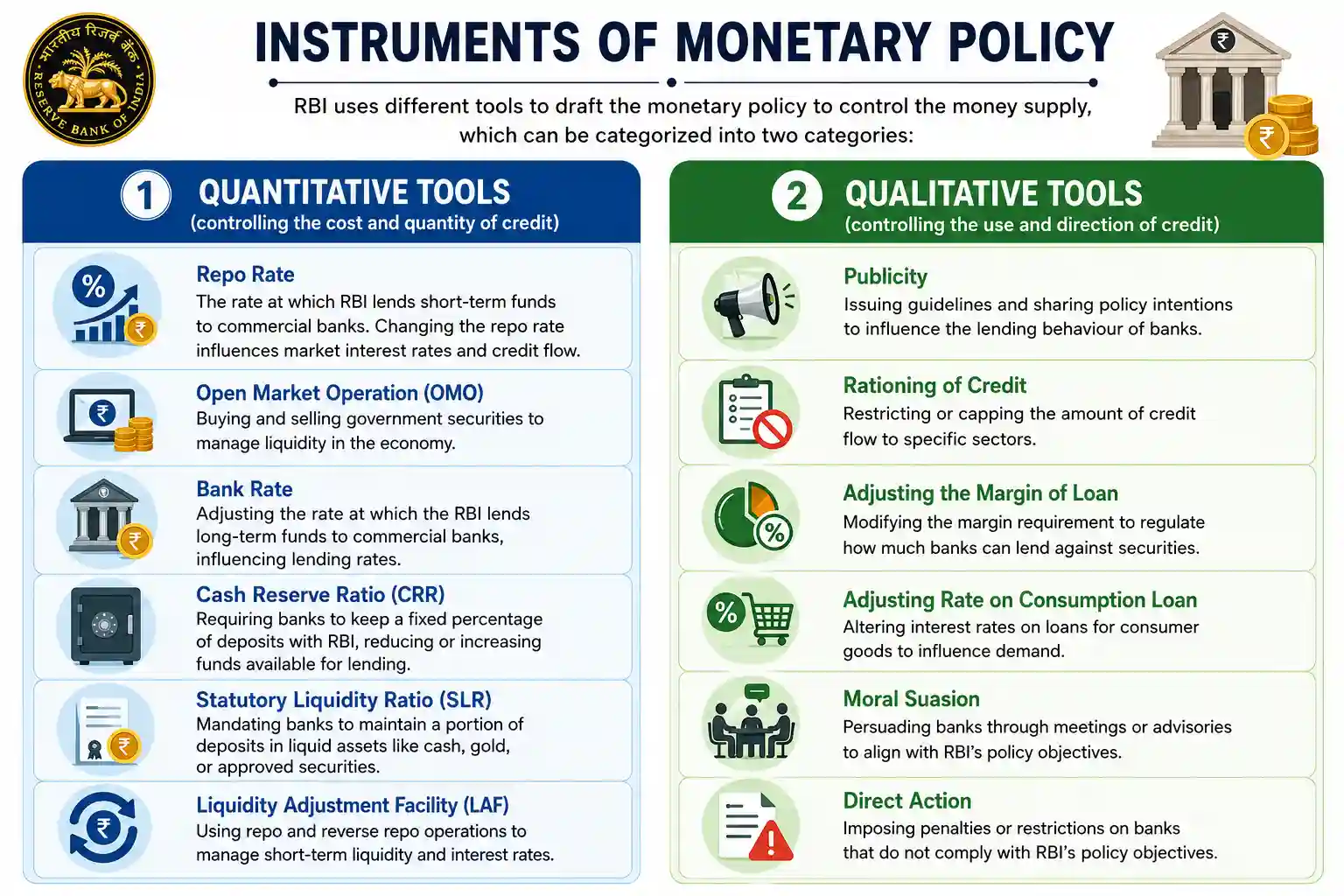
How Does the RBI Control Inflation?
The RBI mainly controls inflation by changing the amount of money available in the economy. It uses several monetary policy tools.
1. Repo Rate
The repo rate is the interest rate at which commercial banks borrow money from the RBI.
When Inflation Is High
-
RBI increases the Repo Rate.
-
Loans become more expensive.
-
People borrow less.
-
Spending decreases.
-
Prices rise more slowly.
When Inflation Is Low
-
RBI lowers the Repo Rate.
-
Loans become cheaper.
-
Businesses invest more.
-
People spend more.
-
Economic activity increases
2. Cash Reserve Ratio (CRR)
The Cash Reserve Ratio (CRR) is the percentage of deposits that banks must keep with the RBI as cash.
If RBI Increases CRR
-
Banks have less money to lend.
-
Fewer loans are given.
-
Money supply decreases.
-
Inflation comes down.
If RBI Decreases CRR
-
Banks can lend more money.
-
Money supply increases.
-
Spending rises.
| Higher CRR | Lower CRR |
| Less lending | More lending |
| Less money in economy | More money in economy |
| Helps reduce inflation | Supports growth |
3. Statutory Liquidity Ratio (SLR)
The Statutory Liquidity Ratio (SLR) is the percentage of deposits that banks must keep in safe assets such as government securities, gold, or cash.
When the RBI increases the SLR:
-
Banks have less money available for loans.
-
Credit growth slows.
-
Inflationary pressure reduces.
4. Open Market Operations (OMO)
In open market operations, the RBI buys or sells government securities.
RBI Sells Government Securities
-
Banks purchase these securities.
-
Money moves from banks to RBI.
-
Liquidity decreases.
-
Inflation is controlled.
RBI Buys Government Securities
-
RBI pays money to banks.
-
Liquidity increases.
-
Lending becomes easier.
5. Standing Deposit Facility (SDF)
The Standing Deposit Facility (SDF) allows banks to park surplus money with the RBI.
When banks keep excess money with the RBI instead of lending it:
-
Liquidity reduces.
-
Excess demand falls.
-
Inflation can be controlled.
Who takes the decisions of these changes?
RBI has a dedicated committee known as the Monetary Policy Committee (MPC).
The MPC:
-
Meets regularly.
-
Researches the economy and inflation.
-
Determines what to do with the repo rate, whether it should be lowered, raised or left unchanged in order to hit the inflation target.
Real-Life Example
Suppose there is a school canteen.
When everyone has a lot of pocket money, a lot of students purchase snacks.
The more people demand, the more quickly the snacks will be used up, which may lead to price hikes.
The lower the demand, the lower the price.
A similar concept is used by the RBI for the entire economy through its actions on borrowing and spending.
Inflation vs Stable Prices
| Situation | What Happens? |
| High Inflation | Prices rise very fast |
| Low Inflation | Prices rise slowly |
| Stable Prices | People can plan their spending better |
Did You Know?
The RBI adopts the Flexible Inflation Targeting (FIT) framework.
It is geared towards maintaining Consumer Price Index (CPI) inflation in the range of 2% to 6%, with a target of 4%, if necessary.
Fun Facts
-
RBI is India's central bank.
-
Inflation is a rate of change in prices over time.
-
The Repo Rate is one of the most crucial rates that are set by the RBI.
-
The Monetary Policy Committee (MPC) with six members plays a pivotal role in determining changes in the key policy rate.
Important Key Terms
| Word | Meaning |
| Inflation | Rise in prices of goods and services |
| RBI | Reserve Bank of India |
| Repo Rate | Interest rate at which RBI lends money to banks |
| Monetary Policy | RBI's plan to manage money and inflation |
| MPC | Committee that decides monetary policy |
Frequently Asked Questions (FAQs)
1. What is inflation?
Inflation is the rising of the prices of goods and services over time.
2. Who is responsible for inflation in India?
The Reserve Bank of India (RBI) uses monetary policy to regulate inflation.
3. What is Repo Rate?
Interest rate at which RBI lends money to commercial banks.
4. When the RBI hikes the Repo Rate what will happen?
The cost of loans increases, spending slows and this contributes to lower inflation.
5. What is meant by Monetary Policy Committee (MPC)?
MPC is a committee of six members who are responsible for determining the policy interest rate to manage the inflation rate of India within its target.

Prabhat Mishra is a Subject Matter Expert and digital journalist with an extensive background in the competitive exam landscape and over 4 years of experience in education, national and international news, and current affairs. Over his tenure with top knowledge platforms like Mentorship India, IAS BABA, IAS SARTHI, and now Jagran Josh, he has a deep understanding of government exams like UPSC and State PCS, including UP and Bihar, as he has already qualified for the UPPCS 2022 Mains and Bihar 68th Mains. With his core expertise in history, polity, geography & current affairs, he specialises in creating well-researched, aspirant-centric content and simplifying complex topics for competitive examinations.