Gold Rates Weekly, September1-3: Gold Prices Fall Below 1.55 Lakhs, Check Weekly Movement of Precious Metal and Why
Gold Rates recorded strong gains this week. Check the latest 24K, 22K and 18K gold rates and understand the global and Indian factors driving the rally.

Gold has certainly been on a wild ride lately. After breaking recaords and claiming the ₹1,64,000 mark per 10 grams in late August, the yellow metal has retraced and is now between ₹1,52,000-₹1,54,000. All that gold traders and investors need to ask themselves, is this a temporary decline or gold is losing its shine.
The answer is not as simple as the price chart. Gold is driven by many factors such as global interest rates, inflation, the US dollar, geopolitics, and investor demand. So, before you make any predictions about where the price of gold could be headed next, let’s explore the major forces driving gold’s performance.
Gold Price This Week 1 September: 24K, 22K and 18K Gold Prices
Gold opened in domestic markets at approximately ₹1,52,500 to ₹1,55,350 per 10 grams for 24K gold (MCX spot indicative rate around ₹1,52,544).
Recent Gold Trends
| Period / Date | 24K Gold Price (per 10g) | Market Context |
| August 17 | ₹1,55,660 | Mid-month opening rate |
| Late August Peak | ₹1,64,000 (Approx | Record rally driven by global rate-cut expectations |
| August 31 | ₹1,54,081 | End-of-month profit booking |
| Today | ₹1,52,500-₹1,55,350 | Consolidating in a tighter band |
Gold trends This Week
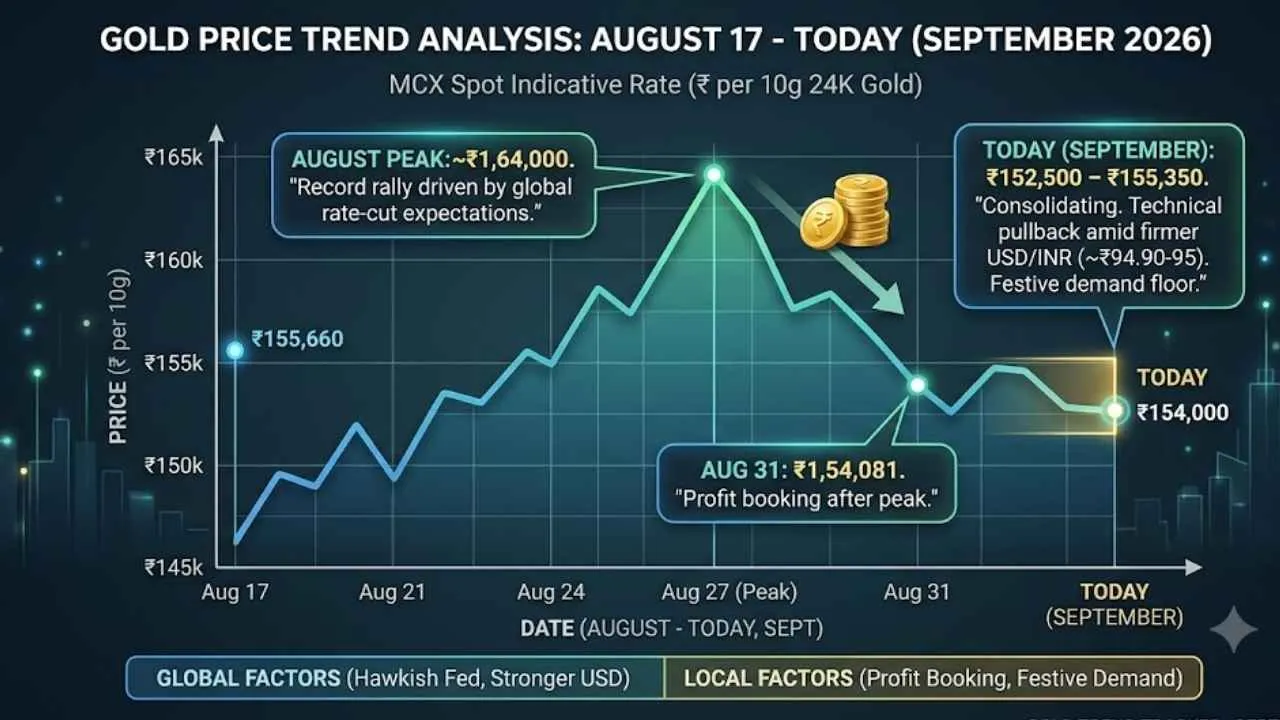
Domestic gold prices have come down from their late-August highs and have now found some stability. Daily price swings are smaller, keeping gold within a tighter range. 24K gold is around ₹1,52,500–₹1,55,350 per 10 grams. This is a calmer period compared with the sharp highs and lows seen in mid-August.
Why Is Gold Prices Falling This week?
The biggest factor in the poor performance of gold over the past week has been the hawkish stance of the US Federal Reserve, coupled with higher bond yields. The remarks of Fed Chair Kevin Warsh that interest rates may have to stay higher for longer to bring inflation down have certainly not helped gold. Gold doesn’t pay interest. When rates and bond yields go up, investors want other assets that can pay them, and so demand for gold falls. That can put pressure on the price of gold. In other words, higher interest rates and bond yields have made gold less attractive to investors, thereby explaining gold’s recent poor performance.
Gold Prices In Last 7 Days
| Date | 24K Gold Rate (per gram) | 22K Gold Rate (per gram) | Market Context |
| 27 Aug (Thu) | ₹16,151 | ₹14,805 | Opening baseline for the week |
| 28 Aug (Fri) | ₹16,162 | ₹14,815 | Week High: Peak demand driven by rate-cut expectations |
| 29–30 Aug (Sat–Sun) | ₹15,873 | ₹14,550 | Weekend consolidation |
| 31 Aug (Mon) | ₹15,725 | ₹14,415 | Early profit booking |
| 1 Sep (Tue) | ₹15,595 | ₹14,295 | Downward trend amid stronger US Dollar |
| 2 Sep (Wed) | ₹15,251 | ₹13,980 | Week Low: Bottoming out after multi-day drop |
| 3 Sep (Today) | ₹15,584 | ₹14,285 | Slight Recovery: Physical festive buying floor kicks in |
Why Did Gold Price Rise Last Week: Possible Market Triggers
Global Factors Influencing Gold Prices
- Geopolitical Factors: The tension between Iran and the other Middle Eastern countries has heightened. The Strait of Hormuz continues to be a major concern for crude oil movement. The uncertainty created drove the investors towards gold as a safe haven or hedge against inflation linked to trade uncertainties.
- Federal Reserve Uncertainty: A lot of uncertainty was created due to concerns about the US inflation and the possible interest rate cuts. In such scenarios investors tend to shift to relatively safer assets like Gold because bullion is a commodity priced as per existing reserves.
Indian Factors Influencing Gold Price
- Import Duties and Taxes: Import duties and GST is applicable on gold imports in India. The import duties and other taxes etc. increase the end price of gold. Hence, one can expect a higher price of gold in India when the import duty and other taxes are increased. While there was no change in the same over the past few months (last revision was done in January 2026), the increased demand could possibly trigger a fear of increased taxes to curb the same. Anticipation of this leads to bullish trends.
- Rupee and Dollar movement: As gold is globally traded in US Dollars, As the Indian currency, rupee is weak against the dollar, it is expensive to import gold. The relation is directly proportional to the price trends in the nation. Like that the end price of gold is impacted for consumers.
- Pre festive buying: The Jewellery stores buy and keep more gold before the festive and wedding season. As rakshabandhan and diwali are coming up, the demand will increase. Higher physical demand for gold from Indian jewellers could also push the gold price higher.
- MCX Futures movement: The gold prices on MCX follow the global trends and influence the physical gold price in India.
- Gold ETF Movement: Because of the rising interest of people in ETFs, the inflows into Gold ETFs has raised. That is why, the demand in Gold is increasing to support the overall Gold market.
Interestingly, people all over the world not only buy gold, they invest in gold religiously. The quantity of gold in hand of a country so often determines its position in the world economy as well. Global investors are fondly known to call gold as a 'safe-haven asset', as gold can provide a lot of help to an economy, if all other assets continue to fall. That is why even a slight change in gold prices can have an impact on an economy as well as individual investors.
Gold has a time-honored relationship with Indians This relationship can be called as a traditional love. Gold varies in many forms in our country, like jewellery, ETFs or bullion. Also when the festive seasons come in, demand for gold rises inside the country, immediately influencing the price of gold.
Disclaimer: Gold prices are subject to market volatility and may change due to global, domestic, and economic factors. This article is for informational purposes only and not investment advice.

Aishwarya Samant is a journalist with over 4 years of experience navigating the fast-paced corporate media landscape. She specializes in decoding business news, world economy, personal finance, and stock market trends, often adding a subtle touch of political perspective to keep things interesting.
Having worked with reputed organizations like ZEE, TV9, News24, and NewsX, she is no stranger to the newsroom hustle and the demands of real-time storytelling. Her writing style is fast-paced, engaging, and crafted to connect seamlessly with diverse audiences across platforms. She approaches every story from the reader’s point of view, breaking down complex topics into clear, relatable narratives backed by solid facts and credible sources. While she’s confident in expressing strong viewpoints, she ensures balance with insights. Sharp, fact-driven content that informs, engages, and keeps readers coming back for more.