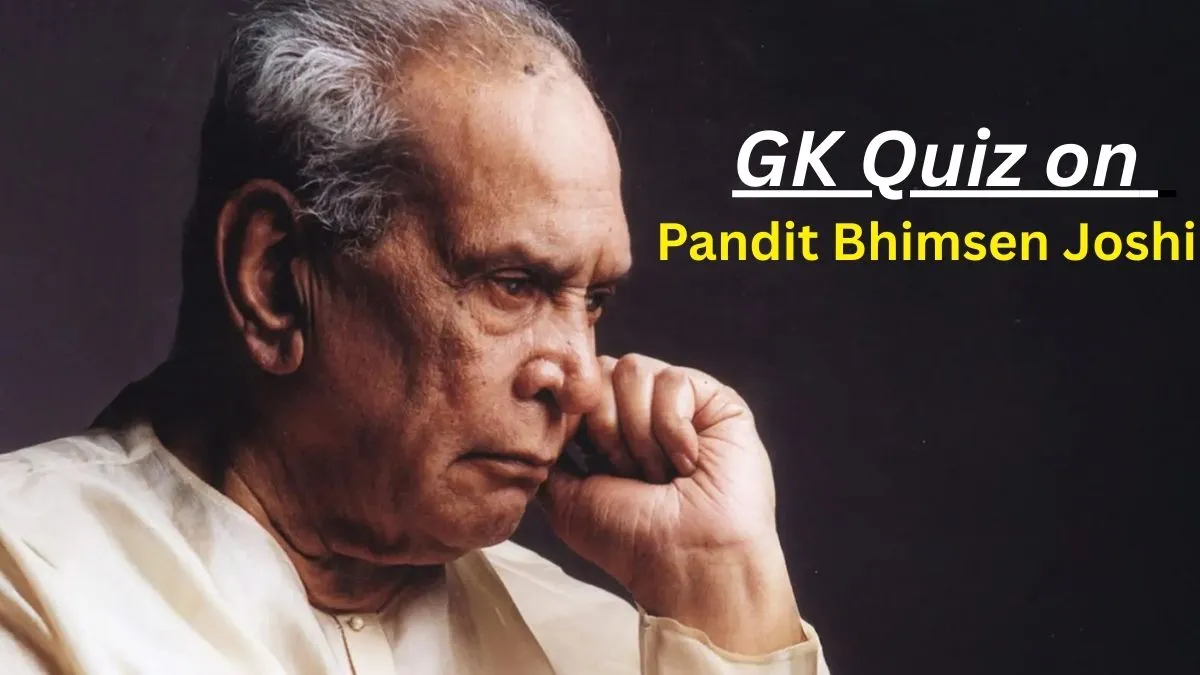
Pandit Bhimsen Joshi, who was born on 4 February 1922 and died on 24 January 2011. He was a legendary hundustani vacalist, and was a hallmark of the Kirana Gharana. Below in the table, more details are given about Pandit Bhimsen Joshi:
| About Pandit Bhimsen Joshi | |
| Category | Detail |
| Title | Bhimsen Joshi |
| Date of Birth | February 4, 1922 |
| Place of Birth | Ron, Bombay Presidency, British India |
| Date of Death | January 24, 2011 |
| Place of Death | Pune, Maharashtra |
| Music Genre | Hindustani classical music |
| Spouse(s) | Sunanda Katti, Vatsala Mudholkar |
| Children | Raghavendra, Anand, Usha, Sumangala, Shubhada, Jayant and Shrinivas Joshi |
| Father | Gururaj Joshi |
| Mother | Godavaraibai |
| Awards | Bharat Ratna, Sangeet Natak Akademi Fellowship, Lifetime achievement award |
Data: culturalindia
Now, let’s understand more about him from the following quiz, which tests both factual knowledge and conceptual understanding of his life, musical journey, and lasting cultural legacy.
GK Quiz on Pandit Bhimsen Joshi
1. Bhimsen Joshi is best known for excellence in which form of Hindustani classical music?
A. Dhrupad
B. Thumri
C. Khayal
D. Tarana
Answer: C
Explanation: Bhimsen Joshi was given the status of legends of excellence because he perfected the art of singing the Khayal of music, infusing it with the purveanee (kirana gharana) of fundamentals and organisations, as well as the optical brilliance of emotions and colour.
2. Which performance of Bhimsen Joshi became a symbol of national integration?
A. Bhagyadalakshmi Baaramma
B. Mile Sur Mera Tumhara
C. Ramya Hi Swargahun Lanka
D. Ankahee
Answer: B
Explanation: ‘Mile Sur Mera Tumhara’ was among the legendary songs of Bhimsen Joshi, and the song brought about the unity and cultural harmony throughout India through his strong voice.
3. At the age of eleven, Bhimsen Joshi decided to become a musician after listening to whom?
A. Ustad Amir Khan and Bade Ghulam Ali Khan
B. Abdul Karim Khan and Sawai Gandharva
C. Kesarbai Kerkar and Begum Akhtar
D. Pandit Jasraj and Balamuralikrishna
Answer: B
Explanation: Abdul Karim Khan and Sawai Gandharva were two of the legendary Indian classical vocalists, and they are known as the founders of the Kirana gharana. Performances by these two legends deeply inspired young Bhimsen Joshi at the age of 11, motivating him to leave home in pursuit of music.
4. Which organisation released Bhimsen Joshi’s first album in 1942?
A. All India Radio
B. Saregama
C. HMV
D. Prasar Bharati
Answer: C
Explanation: Bhimsen Joshi originally appeared in HMV in the year 1942 and the initial commercial recording of his musical career was made.
5. In which year did Bhimsen Joshi receive India’s highest civilian award, Bharat Ratna?
A. 1999
B. 2002
C. 2005
D. 2008
Answer: D
Explanation: Bhimsen Joshi was honoured with the highest civilian award in India, the Bharat Ratna, in the year 2008 due to his contribution to classical music, which he had made incomparable.
6. What were the reasons for starting the Sawai Gandharva Music Festival by Bhimsen Joshi?
A. Promote young musicians
B. Popularise devotional music
C. Honour his guru
D. Celebrate Kirana gharana
Answer: C
Explanation: The Sawai Gandharva Music Festival was established in 1953 to honour his guru Sawai Gandharva, and eventually became a large classical music institution in the form of a yearly festival.
7. The significance of Bhimsen Joshi’s song ‘Mile Sur Mera Tumhara’ lies primarily in its:
A. Use of Carnatic musical structure
B. Promotion of linguistic and cultural unity
C. Introduction of Kirana gharana to films
D. Association with the freedom movement
Answer: B
Explanation: The song represented national integration because a single united musical presentation was made to celebrate the linguistic and cultural diversity in India.
8. Which of the following awards were received by Bhimsen Joshi in chronological order?
-
Padma Shri
-
Padma Bhushan
-
Padma Vibhushan
-
Bharat Ratna
Select the correct answer using the code below:
A. 1–2–3–4
B. 2–1–3–4
C. 1–3–2–4
D. 3–2–1–4
Answer: A
Explanation: Bhimsen Joshi was honored with Padma Shri (1972), Padma Bhushan (1985), Padma Vibhushan (1999) and Bharat Ratna (2008), and so the national acknowledgment came progressively.
9. With reference to Bhimsen Joshi, consider the following statements:
-
He initially learned music from Agasara Channappa.
-
He mastered the Kirana gharana under Sawai Gandharva.
-
He learned harmonium under Pandit Shyamacharya Joshi.
Which of the statements given above are correct?
A. 1 and 2 only
B. 2 and 3 only
C. 1 and 3 only
D. 1, 2 and 3
Answer: D
Explanation: Bhimsen Joshi started with Agasara Channappa, studied harmonium with Shyamacharya Joshi and mastered Kirana gharana with Sawai Gandharva.
10. Consider the following statements regarding Bhimsen Joshi’s early musical journey:
-
He left home at the age of eleven.
-
He travelled to Pune and later to Gwalior.
-
He was trained in sarod by Hafiz Ali Khan.
Which of the statements given above is/are correct?
A. 1 and 2 only
B. 2 only
C. 1, 2 and 3
D. 1 only
Answer: A
Explanation: Bhimsen Joshi himself went away for home at eleven and went on his journey involving the states of Pune and Gwalior; Hafiz Ali Khan was able to assist him in getting himself enrolled in music school, not in the sarod training.
In conclusion, Pandit Bhimsen Joshi is one of the greatest representatives of Hindustani classical music, who represents the ideal of the Kirana Gharana.
His skills in Khayal, serving his guru (Sawai Gandharva), and such iconic pieces as Mile Sur Mera Tumhara were what established his heritage, with the Bharat Ratna award being his final award.



Comments
All Comments (0)
Join the conversation