7 Chemical Elements Named After Scientists
Did you know several chemical elements are named after legendary scientists? Explore 7 elements and the remarkable stories behind their names.
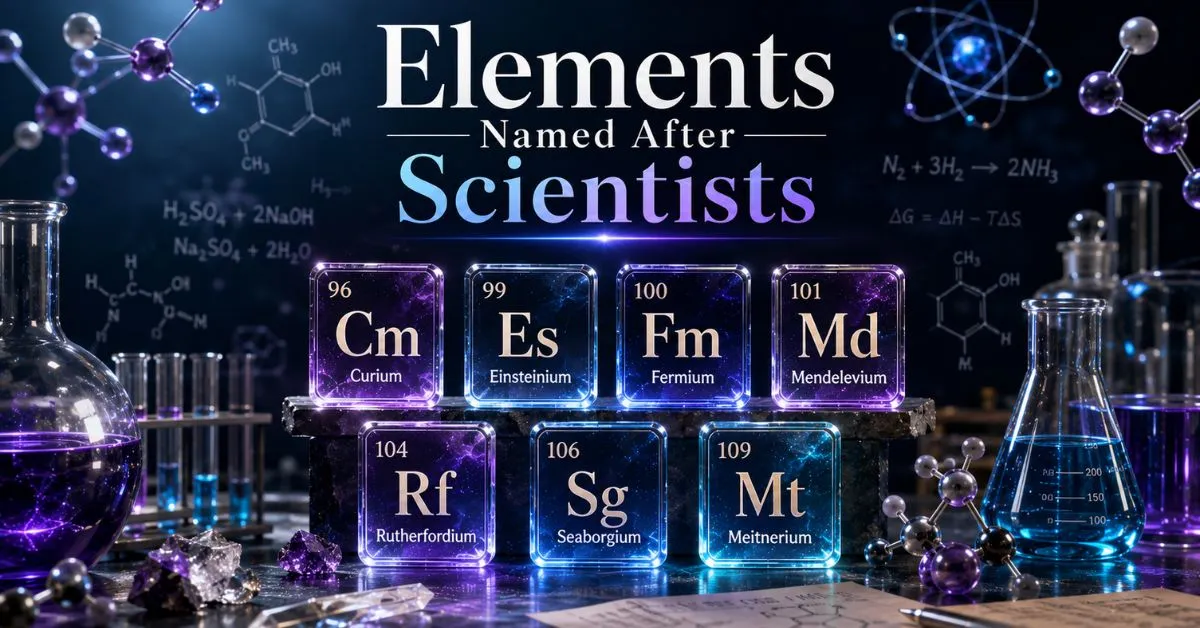
The periodic table has 118 elements. Most of them are named after places, minerals, or mythological figures. But a small group of elements carry a very different kind of name. They are named after scientists who changed the world through their contributions.
This is one of the rarest honours in science. Out of 118 elements, only 16 scientists have had an element named after them. Their names are now a permanent part of chemistry.
In this article, we will be looking at 7 such elements that were named after a scientist and what they did to earn this honour.
Chemical Elements Named After Scientists
| Element | Symbol | Atomic Number | Named After |
| Curium | Cm | 96 | Marie Curie and Pierre Curie |
| Einsteinium | Es | 99 | Albert Einstein |
| Fermium | Fm | 100 | Enrico Fermi |
| Mendelevium | Md | 101 | Dmitri Mendeleev |
| Rutherfordium | Rf | 104 | Ernest Rutherford |
| Seaborgium | Sg | 106 | Glenn T. Seaborg |
| Meitnerium | Mt | 109 | Lise Meitner |
1. Curium (Cm)
Named after: Marie Curie and Pierre Curie
Curium is the only element which is named after two people at the same time. It was discovered in 1944 by a team of American scientists who were working in Chicago and California. They were studying plutonium when they found this new element.
Marie Curie was the first woman to win a Nobel Prize. She won it twice. Once in Physics in 1903 and once in Chemistry in 1911. Both prizes were for her work on radioactivity, which is the process by which certain atoms give off energy. Her husband Pierre Curie shared the Physics prize with her.
Since their entire life's work was about radioactivity, naming a radioactive element after them was the perfect tribute.
2. Einsteinium (Es)
Named after: Albert Einstein
This element has one of the most unusual discovery stories in science. In 1952, the United States tested the world's first hydrogen bomb in the Pacific Ocean. After the explosion, scientists collected samples from the debris and brought them to the laboratory. Hidden inside that debris were traces of a completely unknown element. That was Einsteinium.
Albert Einstein is one of the most famous scientists who ever lived. His equation E=mc² showed that a tiny amount of matter can release an enormous amount of energy. This idea became the foundation of nuclear physics. Without Einstein's work, much of modern science would not exist.
3. Fermium (Fm)
Named after: Enrico Fermi
Fermium was found in the same hydrogen bomb debris as Einsteinium in 1952. Scientists from three different American laboratories worked together to identify it.
Enrico Fermi was an Italian-American physicist. In 1942, he built the world's first nuclear reactor in Chicago. This was the first time in history that a controlled nuclear chain reaction was achieved. He won the Nobel Prize in Physics in 1938.
4. Mendelevium (Md)
Named after: Dmitri Mendeleev
Mendelevium was discovered in 1955 at the University of California, Berkeley. Scientists used a particle accelerator to bombard a tiny sample of Einsteinium with particles. From that, they created atoms of a brand new element.
Dmitri Mendeleev was a Russian chemist who created the periodic table in 1869. What made him special was not just that he organised the known elements. He also left blank spaces for elements that had not been found yet and predicted exactly what their properties would be. Scientists later discovered those elements and found that Mendeleev's predictions were almost perfectly correct.
5. Rutherfordium (Rf)
Named after: Ernest Rutherford
Rutherfordium was first created in 1969. It does not exist in nature. Scientists had to make it in a laboratory using specialised machines.
Ernest Rutherford was a New Zealand scientist and is often called the father of nuclear physics. In 1911, he conducted a famous experiment where he fired tiny particles at a thin sheet of gold. The results showed that atoms have a small, dense centre called a nucleus. This discovery changed everything we thought we knew about the structure of matter. He won the Nobel Prize in Chemistry in 1908. Element 104 was named in his honour.
6. Seaborgium (Sg)
Named after: Glenn T. Seaborg
Seaborgium was created in 1974 at Berkeley, California. What makes this element special is that Glenn T. Seaborg was still alive when it was named after him. Seaborg is one of only two people in history to have an element named after them while still living.
Glenn Seaborg co-discovered ten elements during his career, more than any other scientist in history. He also won the Nobel Prize in Chemistry in 1951. He reorganised a section of the periodic table that we still use today.
7. Meitnerium (Mt)
Named after: Lise Meitner
Meitnerium was created in 1982 at a research laboratory in Darmstadt, Germany. Scientists produced it by crashing one type of atom into another at very high speed.
Lise Meitner was an Austrian physicist who discovered nuclear fission. In simple terms, she was the first to explain that a uranium atom could be split into two smaller atoms, and that this split would release a huge amount of energy. This discovery is what made nuclear reactors and nuclear weapons possible.
Despite this, when the Nobel Prize in Chemistry was given in 1944 for fission research, Lise Meitner was left out. Only her male colleague Otto Hahn received it. Scientists still consider this one of the biggest oversights in Nobel Prize history.
In 1997, element 109 was officially named Meitnerium in her honour. It was a recognition that was long overdue.
These seven elements show that science remembers its greatest minds. From Marie Curie's work on radioactivity to Lise Meitner's discovery of nuclear fission, each of these scientists left behind something the world still uses every day.

Nikhil is a dedicated digital journalist and communications professional with more than five years of experience, currently working within the General Knowledge section at Jagran Josh. He has established himself as a subject matter expert in Finance, Economy, History, Technology, and Trending News, consistently delivering accurate, engaging, and easy-to-read content for a wide global audience.
Over the course of his career, Nikhil has developed deep expertise in crafting informative listicles, viral trending stories. His editorial portfolio also spans finance, historical research, and technology reporting, making him a versatile and well-rounded content professional. Every piece he produces reflects a strong balance between factual accuracy and reader engagement.


