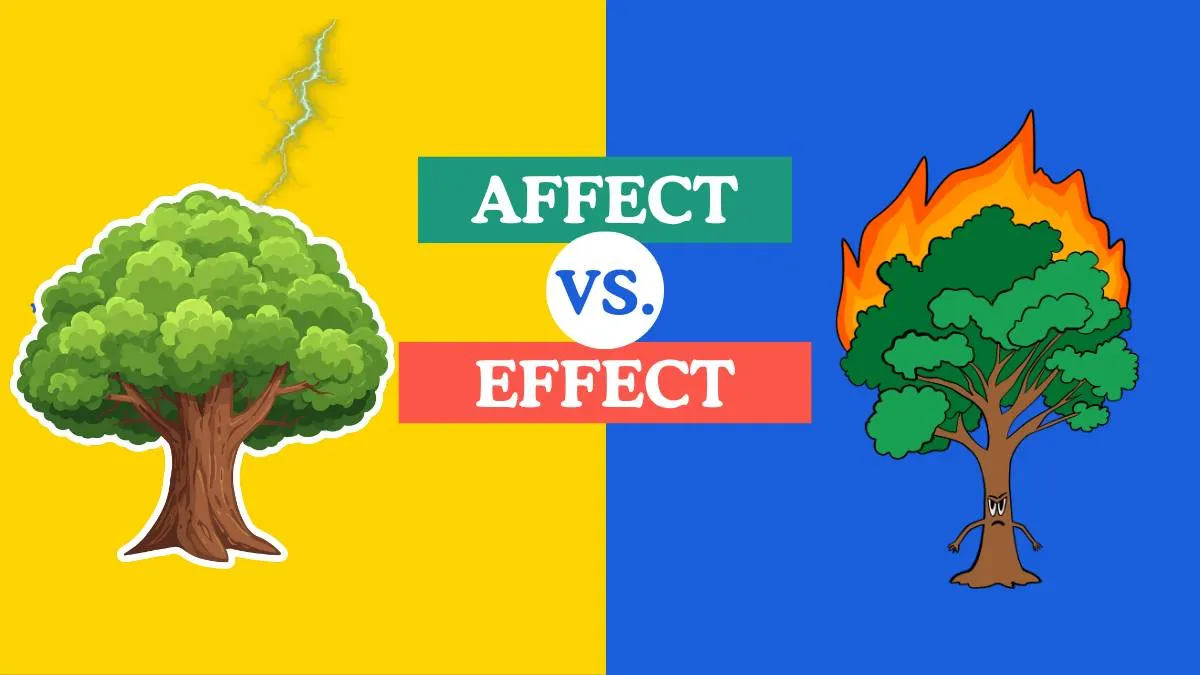
The main difference between affect and effect is in their grammatical role. The most common use of affect is as a verb, to have an effect on something or to cause it to change. The most common application of effect is as a noun, which is the outcome or consequence of a course of actions. Understanding this action and result relationship is the key to determine the correct usage.
Differences Between Affect and Effect
| Parameter | Affect | Effect |
| Primary Part of Speech | Verb | Noun |
| Basic Meaning | To influence or produce change | The result or outcome |
| Grammatical Role | Describes an action | Names a thing or result |
| Position in Sentence | Usually follows the subject | Often follows an article (a, an, the) |
| Core Function | Shows the process of changing | Shows the finished consequence |
| Common Example | The cold weather affects the crops. | The effect of the cold was a poor harvest. |
| Memory Aid | A is for Action | E is for End result |
What is Affect?
The verb of inducing a change is known as affect. In processing something, you are influencing it, or acting on it. It is derived from the Latin term affectus, which is associated with a condition of the mind or an influence.
Affect presents a dynamic process in the majority of the sentences. To illustrate, "Sleeplessness impairs your concentration power. In this case, the brain is being directly affected by the sleep deprivation.
There is one exceptional condition when affect is a noun. In psychology, an affect or response is a facial expression or emotion. A psychologist may say that a patient has a flat affect, i.e., they do not display any emotion. But this will be seldom applied in everyday writing.
What is Effect?
Effect is a noun that recognizes the outcome of a cause. It refers to the "thing" that happens after an action takes place. Its name has its roots in Latin effectus, which means completion or performance.
Effect can be readily recognized, whether they come before or after words such as the, an, any or some. As an example, The effect of the medicine was instant. The name of the outcome is the effect in this case.
Similar to its counterpart, effect is a verb with a rare exception. To "effect change" means to bring something about or to execute a plan. When a leader causes a new policy to happen, he/she is literally making it happen. This form is more formal and rarely used, noun form is the most commonly used form.
Affect vs Effect: Key Differences
The first difference is the difference between the process and the product. Affect is the influence while effect is the outcome of the influence.
A distinction between the two can be made through sentence structure. As affect is a verb, it typically requires a subject to take the action. Because effect is a noun it commonly serves as an object of a sentence, or as the preceding adjective.
For example: The soil is (verb) impacted by the rain. The effect (noun) is mud. The initial word is what the rain is doing. The second word gives what the rain brought about.
Where Are They Used or Applied?
These words are used in virtually all areas of profession and academia. In science, researchers explore how one variable affects another to note the effect.
New rules have an affect on the community in law and governance. The validity of a contract is dependent on the legal effect of the contract. When we talk on a daily basis, we talk about the affect of movies on our feelings or the long-term effects of a healthy diet on the human body.
Common Misconceptions
It is a misconception that these two words can be used interchangeably as they are very close to each other in sound. This is a mistake. Misuse of words may alter the meaning of your sentence or it may be grammatically wrong.
To avoid confusion, use the RAVEN mnemonic:
R = Remember
A = Affect is a
V = Verb
E = Effect is a
N = Noun
You can replace the word effect in case of doubt. When the word impact is used as a verb (e.g. This will impact me), affect is to be used. When impact is used as a noun (e.g., This had impact), use effect.
Check out some more interesting articles from the general knowledge section to boost your knowledge of national and international topics. Stay connected with Jagran Josh for more topics like this.
ALSO READ:



Comments
All Comments (0)
Join the conversation