Show Key Points
The Kerala SSLC Chemistry exam for 2026 was successfully conducted today, March 25, 2026. This year's paper followed the standard SCERT pattern, challenging students with a blend of direct conceptual questions and application-based problems. The Chemistry paper is a crucial component of the SSLC Science group. The exam was held for a total of 40 marks with a duration of 1.5 hours (90 minutes), plus an additional 15 minutes of "cool-off time" for reading and planning.
This article provides the complete Kerala SSLC Chemistry 2026 Question Paper with a detailed Answer Key. These resources are highly beneficial for students to estimate their scores, understand their mistakes, and for future aspirants to practice with the latest authentic board material.
SSLC Chemistyr Exam 2026: Key Highlights
| Feature | Details |
| Exam Name | Kerala SSLC Chemistry Examination 2026 |
| Board Name | Kerala Board of Public Examinations (KBPE) |
| Exam Date | March 25, 2026 |
| Total Marks | 40 Marks |
| Total Questions | 18 Questions (including sub-parts and choices) |
| Exam Duration | 1 Hour 30 Minutes (+ 15 Min Cool-off) |
| Difficulty Level | Moderate |
Kerala SSLC Chemistry Question Paper 2026 PDF
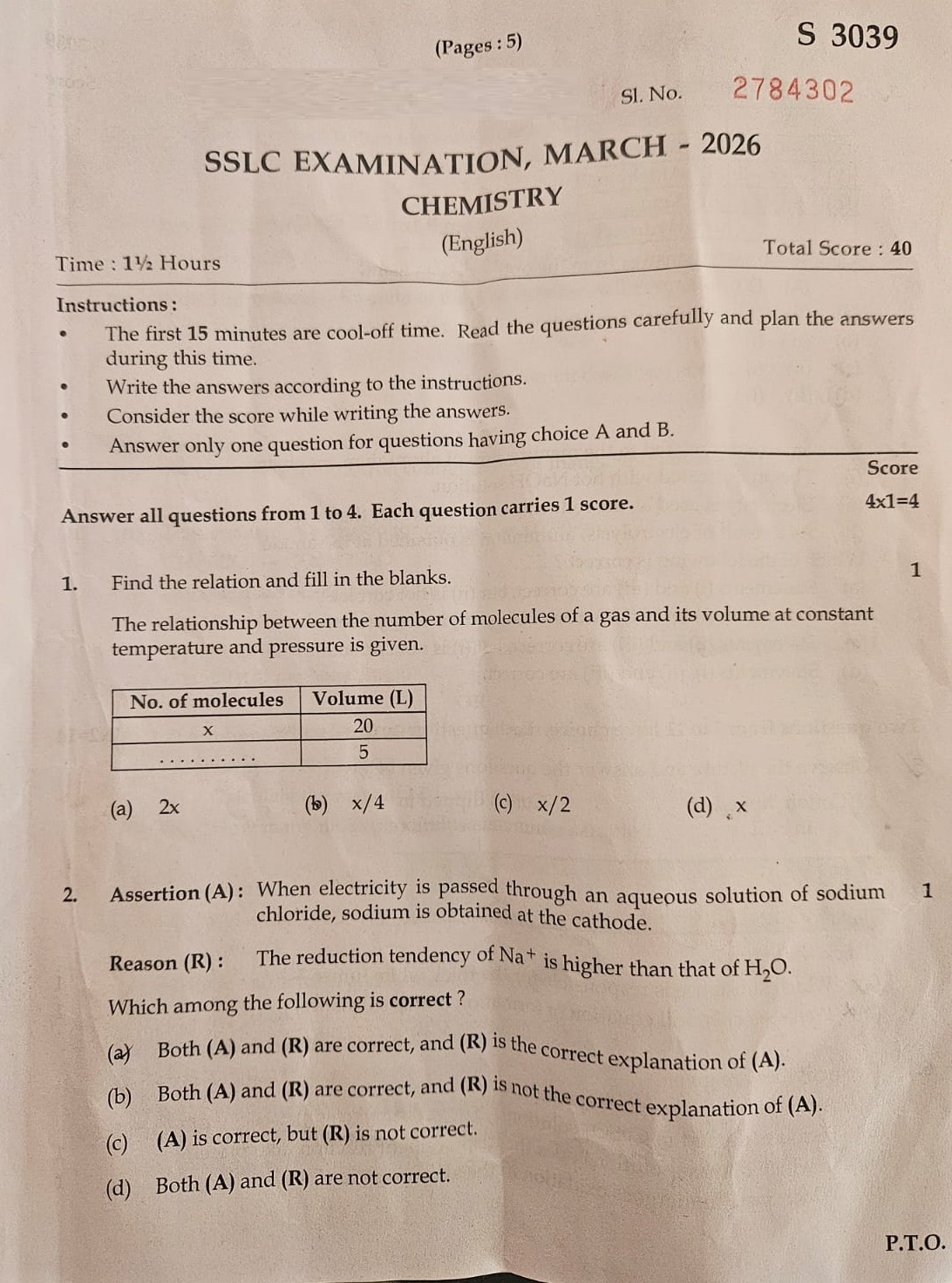
You can view and download the official question paper for the Kerala SSLC Chemistry Exam 2026 held on March 25 by clicking the link below. This PDF includes all sections and diagrams as presented in the examination hall.
| Download Kerala SSLC Chemistry Question Paper 2026 PDF |
The questions and answers provided in the following table are based on the content of this official document.
Kerala SSLC Chemistry 2026: Answer Key & Solutions
This section provides the comprehensive answer key for the Kerala SSLC Chemistry exam held on March 25, 2026. These solutions cover all objective-type questions and short-answer questions to help students evaluate their performance accurately.
| Question No. |
Answer / Solution |
| 1 |
(b) x/4. |
| 2 |
(d) Both (A) and (R) are not correct. |
| 3 |
(d) (X)-(ii), (Y)-(i), (Z)-(iv). |
| 4 |
(b) Statements (i) and (ii) are correct, but (iii) is not correct. |
| 5 (a) |
Ammonium chloride (NH4Cl). This substance forms the thick white fumes when HCl and Ammonia react. |
| 5 (b) |
NH3+HCl→NH4Cl. |
| 6 (a) |
(ii) Fe rod dipped in CuSO4 solution. |
| 6 (b) |
Iron (Fe). Iron is more reactive than Copper and undergoes oxidation. |
| 7 (a) |
Froth Floatation. This is the standard method for concentrating sulphide ores like Zinc blende. |
| 7 (b) |
Roasting. Roasting is the process of heating the ore in the presence of excess air to convert it to oxide. |
| 8 (a) |
C6H10. The homologous series follows the general formula CnH2n−2 (Alkynes). |
| 8 (b) |
CH≡C−CH2−CH2−CH3 (Pentyne-1). |
| 9 (a) |
+4. Calculation: x+2(−2)=0⇒x=+4. |
| 9 (b) |
1s22s22p63s23p63d3. The Mn4+ ion is formed by losing two 4s electrons and two 3d electrons. |
| 10 (A)(a) |
640 g. 16g CH4 reacts with 64g O2; so 160g CH4 requires 10×64=640g O2. |
| 10 (A)(b) |
112 L. 80g CH4 is 5 moles (80/16). Volume = 5×22.4L=112L at STP. |
| 11 (A) |
P: Vinyl Chloride (CH2=CHCl), Q: PVC. |
| 11 (B) |
A: Methanol (CH3OH). Reaction: CH3OH+CO→CH3COOH. |
Kerala SSLC Chemistry Paper Analysis 2026
The 2026 Kerala SSLC Chemistry paper was well-balanced. The focus on Organic Chemistry (Nomenclature and Isomerism) and Electrochemistry was evident, carrying significant weightage as predicted in the blueprints. While the first few objective questions were straightforward, the analytical questions involving the reactivity series required students to apply their knowledge of electrode potentials. Overall, a student who thoroughly studied the SCERT textbook could easily score above 35 marks.
The completion of the Chemistry exam marks a major milestone for Kerala SSLC 2026 students. By reviewing the answer key provided above, students can gain clarity on their performance before the results are announced in May 2026.
Check
Kerala SSLC Social Science uestion Paper 2026 with Solutions
Kerala SSLC Maths uestion Paper 2026 with Solutions
Enter your Blink text here...


Comments
All Comments (0)
Join the conversation