While we refer to substances by their common names in everyday life, all these substances have a chemical name and a chemical formula that scientists and researchers use.
The system of chemical naming of a chemical compound was developed by IUPAC. It is a systematic set of rules to give each chemical compound an unambiguous name that reflects its composition and structure. Scientists use the chemical name, unlike the commonly known names of these compounds.
Today, the chemical names of elements and compounds are governed by the International Union of Pure and Applied Chemistry (IUPAC), which was established in 1919.
In this article, we will learn the chemical name of vinegar. 'Vinegar' is the everyday common name used for thousands of years. In our previous articles, we have shared the chemical name for Epsom salt.
What is the chemical name and formula for vinegar?
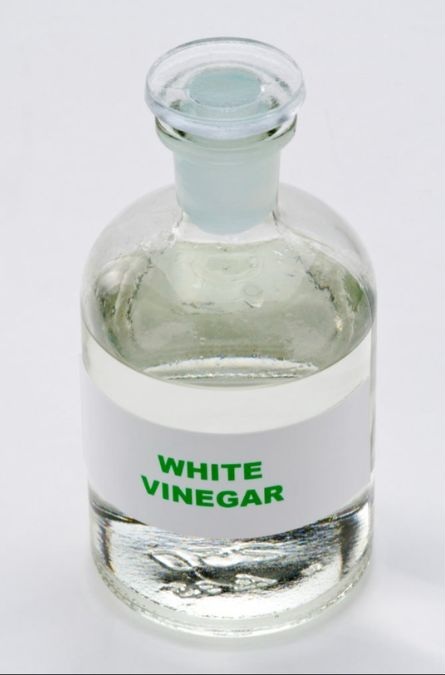
The chemical name for vinegar is acetic acid, also known as ethanoic acid.
Vinegar is basically a mixture of water and about 4 to 20 per cent acetic acid.
The chemical formula of vinegar (acetic acid) is CH₃COOH / C₂H₄O₂.
Properties of Vinegar
Vinegar is an aqueous solution of acetic acid (around 4 to 20 per cent). It is known for its pungent sour taste, corrosive nature, and distinct odour.
Physical properties
Appearance: Colourless to yellowish liquid.
Odour: Pungent
Taste: Sour
Density: Around 1.05 g/mL
Melting Point: Around 16 degrees Celsius (62 degrees Fahrenheit)
Boiling Point: Around 118 degrees Celsius (244 degrees Fahrenheit)
Solubility: Highly soluble in water
Chemical properties
Composition: Acetic Acid (CH₃COOH)
Nature: Corrosive to metals and tissues, if in higher concentration
Flammability: It is flammable
Reactivity: It can react with bases (like baking soda) to produce carbon dioxide. It also reacts with phosphorous chlorides.
pH: Acidic
Uses of Vinegar
Vinegar is a household staple used for cooking, cleaning, laundry, gardening, and health and personal care.
Cooking: It adds tang to dressings, sauces, and chutneys. It is used for tenderising meat and fish. It is used for preserving pickles and other food items.
Cleaning: It is used to clean windows and stainless steel, tackle hard stains, clear drains, and remove limescale on showerheads or faucets. It is also used as an odour neutraliser (a bowl of vinegar can absorb smells in rooms or refrigerators).
Laundry and home: Vinegar is used as a fabric softener and brightener and also to de-wrinkle clothes. Vinegar is used in DIY flytraps to repel ants and flies in homes, etc.
Gardening: Vinegar is also used for keeping plants and flowers fresh for a longer duration, treating mildew, and killing weeds.





Comments
All Comments (0)
Join the conversation