Scandinavian vs Nordic Countries
Scandinavian vs Nordic countries. Discover the real difference between Scandinavian vs Nordic countries. Learn which nations belong to each region based on official geographical, linguistic, and political definitions.
-1779185647503.webp)
While the terms "Scandinavian" and "Nordic" are frequently used as interchangeable synonyms in everyday English, they represent distinct cultural, linguistic, and geopolitical boundaries. Scandinavia is a restrictive term referring to three historically and linguistically linked nations: Denmark, Norway, and Sweden.
The Nordic region known locally as Norden is a broader, formalized geopolitical concept encompassing all three Scandinavian nations, plus Finland, Iceland, and three autonomous territories Greenland, the Faroe Islands, and the Åland Islands.
What is Scandinavia?
Scandinavia is a trio of three countries which is based on their common historians and geographers. Scandinavian countries consist of Denmark, Norway and Sweden. Their classifican is decided by
The Ethno-Linguistic
Scandinavia countries' languages like Danish, Norwegian, and Swedish share a mutual intelligibility; all three originated from the North Germanic language branch, descending from Old Norse. Approximately 21 million people speak a Scandinavian language as their mother tongue.
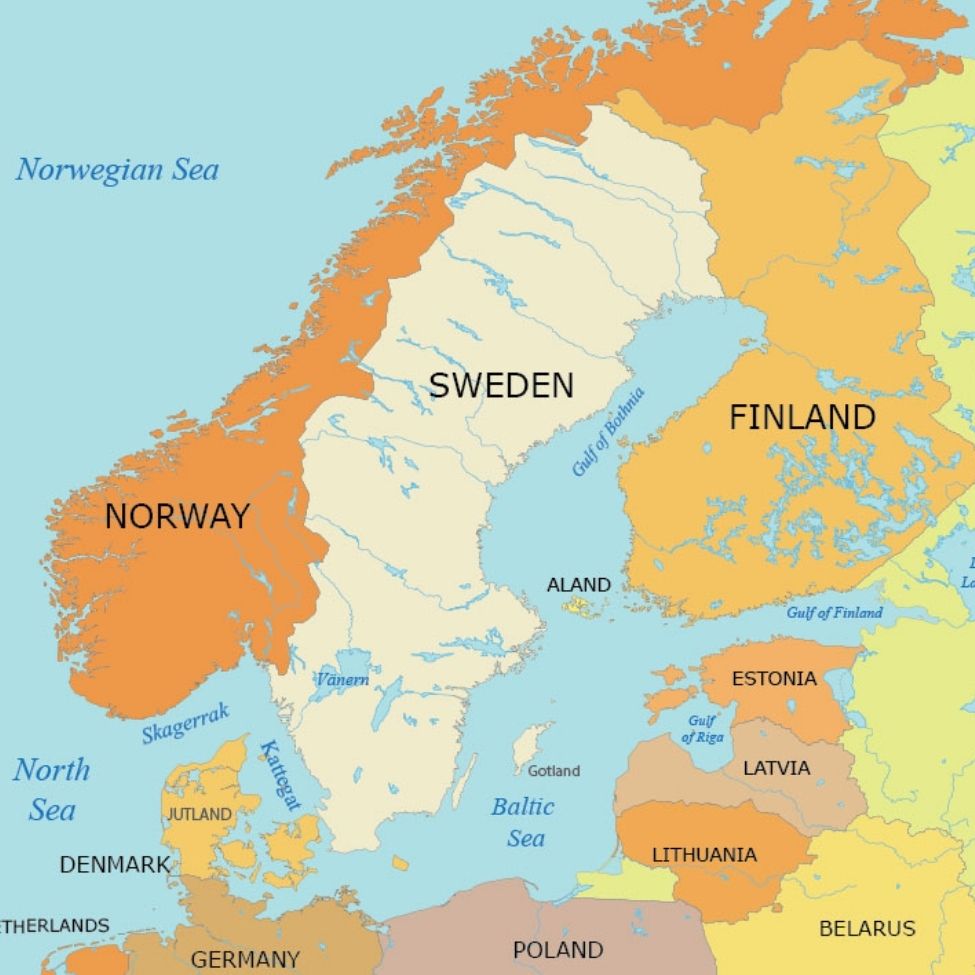
The Geographical
The physical Scandinavian Peninsula is a landmass occupied by Norway, Sweden, and a northern sliver of Finland. Denmark is physically located on the Jutland Peninsula, detached from this landmass. Yet, Denmark is unconditionally considered part of Scandinavia due to its deeply intertwined history, royal alliances, and shared language.
All three traditional Scandinavian nations are constitutional monarchies. They still feature active royal families (the House of Glücksburg in Denmark and Norway, and the House of Bernadotte in Sweden).
Sweden is the largest Scandinavian country by both land area approx. 450,295 km2 and population approx. 10.5 million. The highest point in Scandinavia is Galdhøpiggen 2,469 meters, located in the Jotunheimen mountain range of Norway.
What are the Nordic Countries?
The term "Nordic’ comes from the local word Norden, which translates literally to "The North." The Nordic region explicitly defined a geopolitical framework. According to the official statutes of the Nordic Council the inter-parliamentary body established in 1952, the Nordic region comprises five sovereign nations and three autonomous territories:
The 5 Sovereign Countries:
-
Denmark (Scandinavian)
-
Norway (Scandinavian)
-
Sweden (Scandinavian)
-
Finland
-
Iceland
The 3 Autonomous Territories:
-
Greenland (An autonomous territory of Denmark)
-
The Faroe Islands (An autonomous territory of Denmark)
-
The Åland Islands (An autonomous, Swedish-speaking province of Finland)
Finland is distinct from its neighbors. The majority of its population speaks Finnish, a Finno-Ugric language entirely unrelated to the North Germanic languages. However, it shares centuries of shared history, having been a part of the Swedish Kingdom for nearly 600 years.
Iceland settled by Norse Vikings, Iceland retains strong ethnolinguistic ties to Scandinavia. However, because its language (Icelandic) has remained isolated and unchanged for centuries, it is not mutually intelligible with modern continental Scandinavian languages. Geographically, it sits isolated in the North Atlantic.
| Country / Territory | Part of Scandinavia? | Part of the Nordic Region? | Primary Language Family |
| Denmark | Yes | Yes | North Germanic (Indo-European) |
| Norway | Yes | Yes | North Germanic (Indo-European) |
| Sweden | Yes | Yes | North Germanic (Indo-European) |
| Finland | No (Except culturally) | Yes | Finno-Ugric (Uralic) |
| Iceland | No (Except ethnically) | Yes | North Germanic (Isolated) |
| Greenland | No | Yes | Eskimo-Aleut (Inuit) |
| Faroe Islands | No | Yes | North Germanic |
| Åland Islands | No | Yes | North Germanic (Swedish) |
The Nordic Council an Institutional Cooperation
There is no official Scandinavian Council or Scandinavian Passport Union. There is, however, a Nordic Council to separate the two concepts is to look at formal governance.
Nordic Council formed in the wake of World War II in 1952. The Nordic Council and the subsequent Nordic Council of Ministers (1971) formalised cooperation between these northern states long before the European Union expanded across Europe under the Helsinki Treaty of 1962. These countries established:
-
The Nordic Passport Union by allowing citizens to move, live, and work freely across borders without passports.
-
Shared environmental initiatives and economic policy coordination.
-
The ‘Nordic Model’ a shared socioeconomic system characterized by a robust welfare state, collective bargaining, and high trust in public institutions.
Important Facts About the Nordic Countries
-
These data points represent the entirety of the Nordic Council's territory (the 5 sovereign nations + 3 autonomous zones).
-
Geographically the total landmass of the Nordic region is over 3.4 million square kilometers. However, the combined population of all these countries is only around 27.5 million people.
-
Roughly half of the entire Nordic region’s landmass is completely uninhabitable, covered by the massive glaciers and ice sheets of Greenland.
-
Denmark is the most densely populated Nordic country about 130 people 2. Conversely, Iceland is one of the sparsest nations on Earth, with just over 3.5 people km square.
-
Economic The "Nordic Model" despite relatively small populations, the combined GDP of the Nordic countries positions them collectively as a top-12 global economy.
-
They do not share a single currency. There are five different currencies used across the region: Danish Krone (DKK), Norwegian Krone (NOK), Swedish Krona (SEK), Icelandic Króna (ISK) and The Euro (EUR) is used strictly by Finland and the Åland Islands.
-
According to the UN World Happiness Report Nordic countries are Global Leaders in Happiness, consistently sweep the global Top 5 spots, with Finland frequently claiming the title of the world's happiest country.
-
Historically divided into military and political unions, all five Nordic nations are members of NATO (following Finland and Sweden's recent accessions).
-
All Nordic countries are not members of the European Union (EU) such as Denmark, Sweden, Finland are the members of EU but Norway, Iceland are Non-EU members but both countries are heavily in the European economic framework via the EEA/EFTA).
All Scandinavian countries are Nordic, but not all Nordic countries are Scandinavian.
Also Read: Which Country has the Most Guinness World Records?

Manisha Waldia is an accomplished content writer with 4+ years of experience dedicated to UPSC, State PCS, and current affairs. She excels in creating expert content for core subjects like Polity, Geography, and History. Her work emphasises in-depth conceptual understanding and rigorous analysis of national and international affairs. Manisha has curated educational materials for leading institutions, including Drishti IAS, Shubhara Ranjan IAS, Study IQ, and PWonly IAS. Email ID: manisha.waldia@jagrannewmedia.com


