Kitchen Cabinet vs Cabinet Committees in India: Major Differences Explained with Examples
The Kitchen Cabinet and Cabinet Committees are two important but distinct decision-making mechanisms in India. Explore their roles, powers, examples and major differences in this detailed explainer.
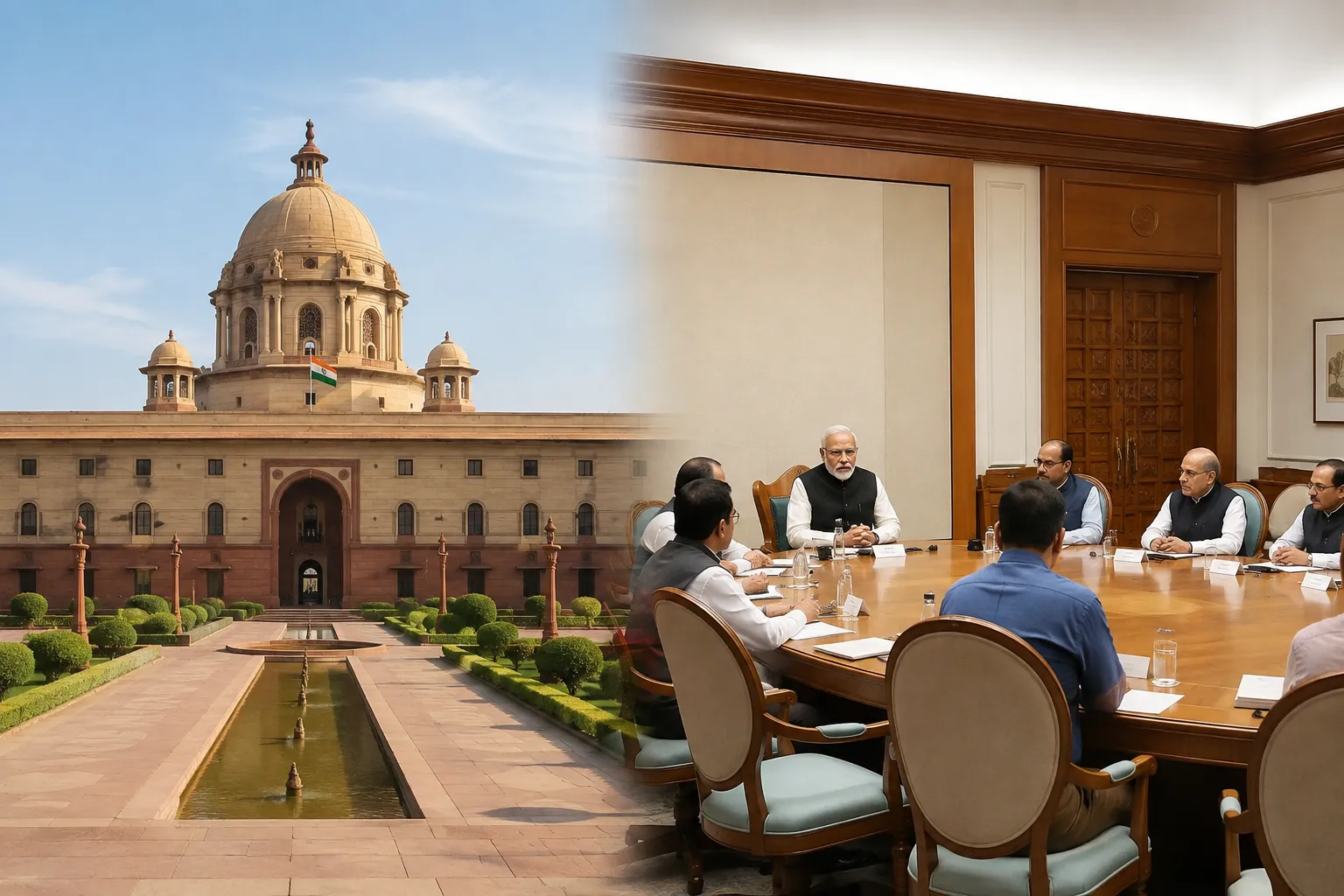
The Indian parliamentary system is based on the principle of parliamentary democracy, wherein the executive power is exercised by the Council of Ministers which is headed by the Prime Minister. The constitutional basis for the system lies in Articles 74 and 75 of the Constitution of India. Article 74 provides for the establishment of the Council of Ministers to assist and advise the Prime Minister while Article 75 contains provisions regarding the appointment duration and collective responsibility of the ministers.
The Constitution of India acknowledges the Cabinet but does not mention either Kitchen Cabinet or Cabinet Committees. In order to ensure effective administration and quick decision-making by the government different Modus operandi are used.
Cabinet Committees are formal bodies created by the Prime Minister in accordance with the Government of India (Transaction of Business) Rules, 1961 which are meant to look into certain matters of policy such as defence, economy, Parliament functioning and appointments.
Kitchen Cabinet on the other hand consists of an informal group of close advisors which may include senior ministers, civil servants, politicians or confidants who give their advice to the Prime Minister regarding delicate matters of policy.
What are Cabinet Committees in India and how do they function?
-
Cabinet Committees are formal and organized committees that form to manage the many of the Union Cabinet.
-
Legal basis: These committees are not provided for in the Constitution but are set up by the Prime Minister under the Government of India (Transaction of Business) Rules, 1961 which have been formulated under Article 77(3) of the Constitution.
-
Function: Due to the inability of the Cabinet to discuss every nitty-gritty matter (from economic packages to border security). These committees deal with the issues which involve thorough examination of policy measures and can take final decisions unless the Cabinet reviews them.
-
Structure: These committees consist of a small number of ministers (3 to 8). They may be Standing (permanent) or Ad Hoc (temporary in nature formed to deal with specific issues).
-
Some notable examples are the Appointment Committee of the Cabinet (ACC) and the Cabinet Committee on Security (CCS). More detail about the state structure is available from the Cabinet Secretariat of India.
What is a Kitchen Cabinet? Why Do Prime Ministers Rely on It?
Unlike the official committees, the "Kitchen Cabinet" or "Inner Cabinet" refers to the informal, non-constitutional facet of authority.
-
Nature: This informal body comprises the Prime Minister and a small group of loyal advisers, who may be chosen among the senior Cabinet ministers and political allies, friends and even members of the family without an official position in the Cabinet.
-
Reasons for its Existence: Prime Ministers need this circle of close people to give them honest and confidential advice on political and administrative issues. Its main advantage is that it helps them make the necessary decisions fast and secretly.
-
Constitutional Status: The Kitchen Cabinet has neither constitutional status nor legal standing.
Kitchen Cabinet vs Cabinet Committees
| Feature | Cabinet Committees | Kitchen Cabinet |
| Nature | Formal and organizational | Informal and personal |
| Legal Basis | Transaction of Business Rules, 1961 | None (Extra-constitutional) |
| Composition | Ministers (Cabinet/MoS) | Trusted confidants, ministers, or outsiders |
| Purpose | Reducing Cabinet workload, detailed policy scrutiny | Confidential advice, quick strategic decisions |
Are Kitchen Cabinets Constitutional?
From a legal and constitutional perspective. It can be stated that the Kitchen Cabinet is a non-existent entity with the Indian Constitution recognizing only post of the Prime Minister, the Council of Ministers and the Cabinet itself keeping silent on the existence of some informal inner groups or advisory committees.
On the contrary, the Cabinet Committees possess a legal basis grounded in the Government of India (Transaction of Business) Rules, 1961, the President having promulgated them in accordance with the Prime Minister's advice under Article 77(3). Thus, while Cabinet Committees are built on a stable institutional basis. The Kitchen Cabinet can only be viewed as based on personal trust and political relations of members of the Cabinet.
Examples: How Kitchen Cabinets and Cabinet Committees Influence Major Government Decisions
-
Cabinet Committees at Work: When some big reforms in the economy infrastructure works or activities in international security are to be implemented, organizations like the Cabinet Committee on Economic Affairs (CCEA) or the Cabinet Committee on Security work out the corresponding plans of such undertakings.
-
Kitchen Cabinet at Work: Historically and actually during the time of important political turns unexpected changes in policy or during dealing with crises. The government plans have been worked out in the close cohort of the Prime Minister before being put forward to Cabinet or Parliament.
Quick Exam-Relevant Facts on Cabinet Committees
-
The Prime Minister is the one who forms the Cabinet Committees as per the requirement of the time and need for effective governance.
-
Cabinet Committees can also include Non-Cabinet Ministers as members.
-
The Prime Minister is the chairman of most of the important Cabinet Committees.
-
There is no mention of either the Kitchen Cabinet or Cabinet Committees in the Constitution of India. Both these institutions are mentioned in the Constitution and have no legal status.
-
The Kitchen Cabinet is described as a group of close friends, advisers, or well-wishers of the Prime Minister. It has no legitimacy from the Constitution.
-
Cabinet Committees were created under the Government of India (Transaction of Business) Rules, 1961 framed under Article 77(3) of the Constitution.
-
It is the Prime Minister who decides how many Cabinet Committees should be formed, who should be their members and how they function.
-
There are two types of Cabinet Committees, that is, Standing Committees (permanent) and Ad Hoc Committees (temporary).
-
The Cabinet Committee on Political Affairs (CCPA) is popularly referred to as the Super Cabinet because it tackles very important political and policy matters.
-
Cabinet Committee on Security (CCS) is considered the strongest Cabinet Committee which looks after defence, national security and strategic affairs
-
Article 74 and Article 75 provide the constitutional basis for the Council of Ministers, but not for the Kitchen Cabinet or Cabinet Committees.

Manisha Waldia is a distinguished content strategist with 5 years of experience crafting premium educational content for UPSC and State PCS, with a focus on deep conceptual analysis across Polity, Geography, History, and Environment. She currently brings this expertise to Jagran Josh, where she covers major national and international events, current affairs, and static general knowledge. Over her career, Manisha's specialized insights have led her to curate high-impact materials and serve as a UPSC Mains answer-evaluator for India’s top institutes—including Drishti IAS, Shubhra Ranjan IAS, Study IQ, GS Score, and PWonlyIAS. She has also worked alongside leading NGOs like Oxfam India and Avani Kumaon.
Contact: manisha.waldia@jagrannewmedia.com







![[OUT] UGC NET Answer Key 2026: Download June Session Response Sheet PDF at ugcnet.nta.nic.in - Direct Link Here](https://img.jagranjosh.com/images/2026/August/1682026/NTA-UGC-NET-June-Answer-Key-2026.jpg)