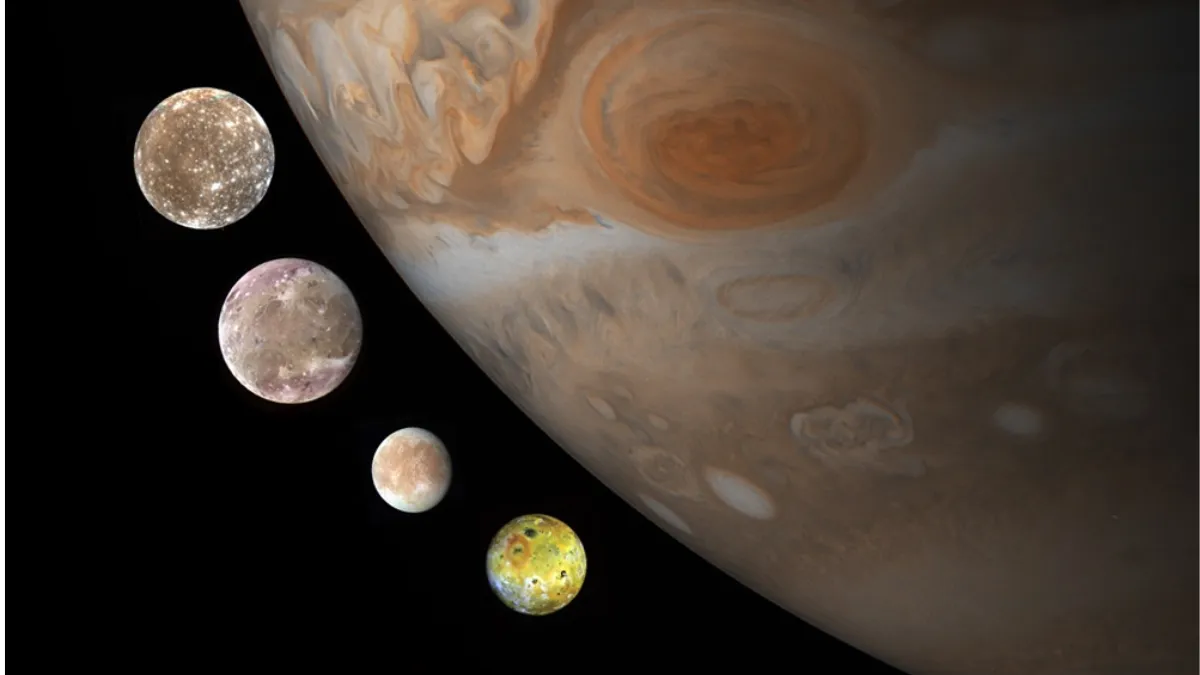
The largest planet of the solar system, Jupiter, has a rather large family of moons that make up the complex Jovian system.
Recent official lists contain names of 95 moons that orbit Jupiter, but this is the number of moons that are presently known to have well-defined orbits and which have been approved by the IAU.
This increasing number of satellites turns Jupiter into a major natural laboratory to study the formation and evolution of planets and their moons as well as their interactions.
What Counts as a Moon?
A natural satellite (also known as a moon) is a solid object that rotates around a planet, but is not bound to the Sun.
In the case of Jupiter, these objects could be giant Galilean moons that are as large as planets or small irregular bodies that are just a few kilometers in diameter.
The official lists (like the USGS Gazetteer and lists compiled by NASA) list only those objects the orbits of which are reliably known and the validation and naming of these moons is done by the International Astronomical Union (IAU).
Due to this process, the officially accepted list of Jovian moons more frequently lags behind the ongoing discovery efforts, as astronomers tentatively follow up more candidates until they become formally recognized by the IAU.
It is the reason why various sources can momentarily provide various totals, despite them eventually relying on the same underlying observations.
Why Are There So Many Moons on Jupiter Today?
Existing instructional and outreach materials related to NASA indicate that Jupiter possesses 95 known moons, which is identical to IAU-recognized satellites with confirmed orbits.
These moons are very variable in size and orbital period, with the inner moons skimming the tops of the clouds of Jupiter, and the outer moons being irregular objects on highly inclined or retrograde orbits.
During the last ten years, extensive imaging surveys and close observance of orbital movements have consistently increased the number of moons around Jupiter, as sometimes it surpassed Saturn in the list of the most moons.
This official total is likely to keep growing, probably to more than 100 in just a few years, as more and more faint objects are followed up and confirmed.
Shortest History of the Discovery of the Moons of Jupiter
Jupiter and its moons start with the discovery made by Galileo Galileo, in the year 1610, when he used the telescope and discovered four bright points of light-Io, Europa, Ganymede and Callisto, orbiting the planet.
These Galilean moons presented some of the earliest yet strong arguments that not all things in the universe centers around Earth, which essentially bashes the idea that geocentric models.
New moons were discovered in the centuries that followed but the discovery boom occurred in the 20th and 21st centuries with the introduction of photographic surveys, digital detectors and the spacecraft exploration.
Missions like Voyager, Galileo followed by Juno have brought close-up shots of the largest moons, with surface surveys by large telescopes on the ground revealing dozens of small, far-flung, irregular satellites.
How did Astronomers Discover and Confirm New Moons?
Detection of new Jovian moons can normally be through large ground-based telescopes and they are able to image large portions of the sky very deeply.
To find out whether they are bound to Jupiter, astronomers take a series of images with several nights and trace minute moving points of light and calculate orbits.
When the orbit of a given object has been sufficiently well determined, it can be discovered and registered at the Minor Planet Center, IAU where it is confirmed and then listed as a proper satellite and may eventually obtain an official name under IAU naming rules.
This is a multi-step process, and the reason that news of new moons can be published earlier than new official figures would be reflected in consolidated lists of the moons, like NASA lists of moons or the websites of nomenclature codes.
The Juno mission of NASA, which was initially planned as a mission to learn about the atmosphere and interior of Jupiter, has also been extended to close flyovers of some of the larger moons and examine the rings and magnetosphere of Jupiter.
Also Read - When will NASA Launch Artemis II Moon Mission to Orbit the Lunar Surface?
With the advent of new telescopes and surveys, astronomers believe that more small moons will be listed and as more are discovered, official lists will likely revise the number of moons that Jupiter has beyond the 95 that it has today as early as next year.
The 95 known moons of Jupiter include planets and ice globes as well as small captured objects that make up a well-organized system of satellites.
Future missions and current findings mean that the official list of moons, as well as the scientific knowledge about these moons, will keep expanding, making Jupiter remain the focus when discussing the planetary system and the possible habitable environments outside of planet Earth.
Check Out - Sunita Williams Retires After a Record-Breaking Career at NASA



-1769661806843.jpg)

Comments
All Comments (0)
Join the conversation