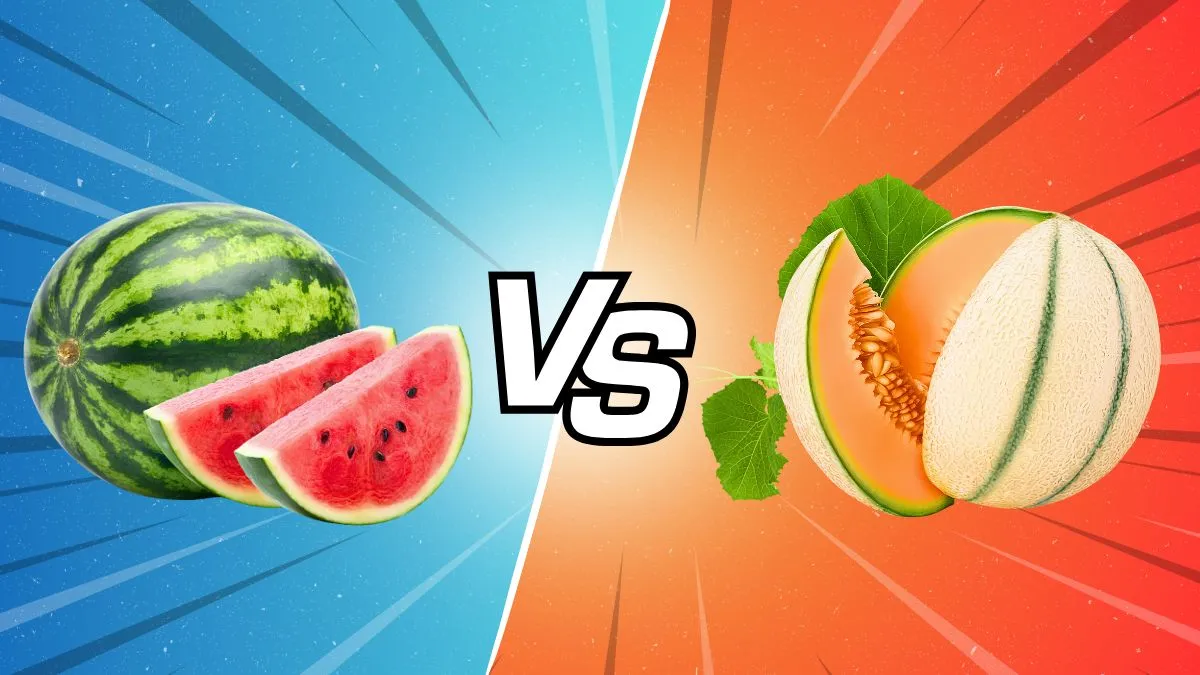
The summer season is synonymous with the two most commonly eaten fruits: watermelon and muskmelon. Although they are members of the same family, they vary in terms of nutritional content, flavor, and texture. This article discusses the key differences between watermelon and muskmelon so you can better understand these fruits.
What is the main difference between Watermelon and Muskmelon?
The key difference between watermelon and muskmelon is the colour of the flesh and the way the seeds are distributed. Watermelon (Citrullus lanatus) flesh is red in colour with seeds embedded in the flesh. Muskmelon (Cucumis melo) has yellow or orange flesh and a central cavity that contains all the seeds. Watermelon has a higher water content (92%) but muskmelon is higher in Vitamin A and fiber.
Differences Between Watermelon and Muskmelon
| Parameter | Watermelon | Muskmelon |
| Botanical Name | Citrullus lanatus | Cucumis melo |
| Flesh Color | Typically deep red or pink | Pale orange, yellow, or green |
| Seed Placement | Scattered throughout the flesh | Concentrated in a central cavity |
| Water Content | Approximately 92% | Approximately 90% |
| Primary Nutrient | Lycopene (Antioxidant) | Beta-carotene (Vitamin A) |
| Skin Texture | Smooth, thick, and striped | Reticulated (net-like) or ribbed |
| Caloric Value | Around 30 calories per 100g | Around 34 calories per 100g |
What is Watermelon?
A watermelon is a vine-growing, juicy fruit of the Cucurbitaceae family. It's believed to have first come from tropical Africa. It is well known for its watery taste. It's thus good for hydration.
The skin of a watermelon is green. It is sometimes marked with dark green stripes. The flesh of the fruit is about 90% water and sugar. Its red flesh is due to the presence of lycopene, an antioxidant which helps keep your heart healthy and skin safe.
Watermelons come in large sizes. Some varieties weigh over 15 kilograms. The seeds are generally black or brown. They are embedded directly in the edible flesh.
What is Muskmelon?
Muskmelon is a species of melon which has been cultivated for millennia. It is believed to be native to Southwest Asia or Africa. It is rounder and smaller than most watermelons. Its name is derived from its "musky" smell when ripe.
A muskmelon's skin is generally tan or green. It often has a "netted" or "webbed" skin. The inside is different to a watermelon. It has a cavity in its centre. It is filled with slimy, brown seeds.
Muskmelons are rich in Vitamin A. They have high amounts of beta-carotene. It is transformed into Vitamin A for the benefit of vision and immunity. They're also high in Vitamin C and potassium.
Key Differences Between Watermelon and Muskmelon
The key differences between watermelon and muskmelon are as follows:
1. Seed Arrangement and Edibility
When eating watermelon, you remove seeds. In a muskmelon, you remove the seed mass and enjoy the flesh. Although watermelon seeds are dried and consumed as snacks, muskmelon seeds are used in traditional Indian desserts and gravies.
2. Nutritional Highlights
Watermelon is the better option for hydration. It has slightly more water and electrolytes. And it's one of the best natural sources of lycopene. Muskmelon is higher in fibre and Vitamin A.
3. Taste and Texture
Watermelons are crunchy and have a gritty texture. They are refreshing and sweet. Muskmelons are creamier when ripe. They are sweeter and more flavourful.
4. Harvesting and Ripeness
You can test if a watermelon is ripe by knocking on it. If you get a thump, it's full of water. To tell if a muskmelon is ripe, sniff it. If the stem end is fragrant, it is ripe.
Common Misconceptions
The words "Muskmelon" and "Cantaloupe" are often interchanged. In India, the fruit commonly known as muskmelon is a type of Cucumis melo. The true North American cantaloupes are netted and non-ribbed. European cantaloupes have ribbed skin but no netting.
Also, the sweeter the watermelon, the redder it is. The colour reflects the lycopene content, but sweetness is determined by the sugar content. This is known as the Brix level. A lightly colored watermelon may be sweeter than a dark one if it grew in perfect growing conditions.
Watermelon and muskmelon are summertime staples, choose watermelon if you want a lot of water and lycopene. If you want more Vitamin A and fibre in your diet, choose muskmelon. The only thing to keep in mind is that watermelons have seeds throughout the fruit and muskmelons have seeds in their core.
Check out some more interesting articles from the general knowledge section to boost your knowledge of national and international topics. Stay connected with Jagran Josh for more topics like this.


-1777381970313_t.webp)
-1777379649512_t.webp)
