What is the difference between Vote and Poll?
UP Election Results 2027: Voting is an essential part of any democracy. Citizens participate in the democratic process by voting. Do you know the difference between vote and Poll? Let us find out!
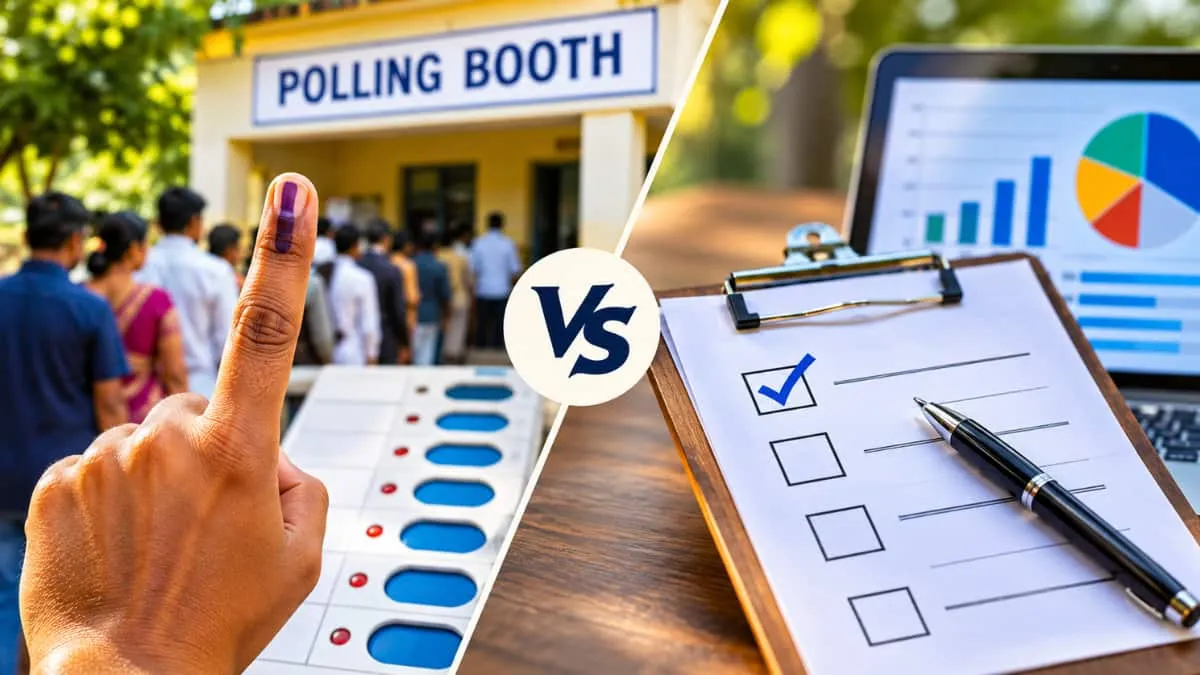
UP Election Results 2027: Voting and polling are two important terms associated with democracy, elections and public opinion. Although people often use these words interchangeably, they have different meanings. A vote is a formal expression of a person's choice in an election or decision-making process, whereas a poll is a method of collecting or measuring people's opinions on a particular subject.
In India, voting plays an important role in the democratic system. Every eligible citizen has the right to participate in elections and choose their representatives through a secret ballot. Section 94 of the Representation of the People Act, 1951, protects the secrecy of voting by stating that no person can be required to disclose whom they voted for in an election, subject to the provision concerning open ballots.
On the other hand, polls are generally conducted through surveys and sampling to understand public opinion or predict election outcomes. Opinion polls and exit polls are two common examples.
Understanding the difference between a vote and a poll is important, especially during election seasons, when political parties, news organisations and survey agencies publish different predictions about election results.
READ| What is the difference between an Opinion Poll and an Exit Poll?
What is Vote?
A vote refers to a choice for or against someone or something by casting a ballot, raising a hand, speaking about the choice aloud, etc. or we can say that it is a method of deciding something by asking people to express their choice and finding out what most people want.
Who can Vote?
India follows the principle of universal adult suffrage, which means eligible adult citizens have the right to participate in elections.
The following conditions generally apply to voters in India:
-
Citizenship: The individual must be a citizen of India.
-
Minimum Age: The individual must be at least 18 years old.
-
Electoral Registration: The person's name must be included in the electoral roll of the relevant constituency.
-
No Legal Disqualification: The individual must not be disqualified from voting under the applicable election laws.
The voting age in India was reduced from 21 years to 18 years through the 61st Constitutional Amendment Act, 1988.
The right to vote is not restricted on the basis of caste, religion, gender or economic status.
What is the electoral roll?
The electoral roll of a constituency is a list of all those people who are registered to vote in elections in that constituency. Only those people are allowed to vote as 'electors' whose names are mentioned in the electoral rolls. Normally, the electoral roll is revised every year to add the names of those who are not less than 18 on a qualifying date years as on the first day of January of that year, who have moved into the constituency, and to remove the names of those who have died or moved out of the constituency. Therefore, electoral roll updation is a continuous process. It is interrupted only at the time of elections, during the period from after the last date of filing nominations till the completion of the elections.
READ| Election Commission of India: Composition, Tenure and Functions
What is a poll?
It is a kind of inquiry or survey which is done to find out the opinion of people about a topic or a range of topics. Polls can be of several types, including exit polls, opinion polls, etc. Generally, they are conducted before an election to predict the votes of people or after the casting of votes. It is said that polls are a great way to predict the result of elections. However, they cannot be blindly trusted and are also not accurate at times.
READ| What Is The Difference Between Postal Ballot and EVM?
Difference between Vote and Poll
| Parameters | Vote | Poll |
| Definition | It is a formal way of knowing the opinion of the public. | It is an informal way of predicting the opinion of the public. |
| How is it conducted? | The Election Commission has undertaken the computerisation of all electoral rolls throughout India. | Various agencies carry out exit polls throughout the method of sampling, and to predict more accurate results, some may also go for systematic sampling. Agencies ask various people of different age groups, genders, castes, religions, and regions whom they voted for. Therefore, polls can be conducted in various ways. |
| How many people are involved? | The entire population that is registered to vote will participate in the election process. | It is conducted informally with a small sample of the population. |
| Accuracy | It leads to improvements in the accuracy and speed with which the electoral roll can be updated. In terms of the election, the vote does not have any margin of error. Therefore, 100% accurate. | There is a margin of error in the poll as it is a prediction based on a population sample. Therefore, the scope of inaccuracy is there. |
| Seriousness among people | People take the vote seriously | Those people who are involved in a poll do not take it as seriously as a vote. |
While concluding, the vote and poll appear similar, but when viewed closely, there are several differences between the two. Voting plays a crucial role in a democracy as it can make or break the results of an election. And on the other hand, when a poll is conducted, it just provides a prediction before and after casting a vote in an election process. It has been seen that in an organisation, to make some important decisions, voting is preferred instead of polling, because people have more thoughts while casting votes than when doing a poll.
READ| What Is EVM? How is Counting of Votes Done Through EVM?

Prabhat Mishra is a Subject Matter Expert and digital journalist with an extensive background in the competitive exam landscape and over 4 years of experience in education, national and international news, and current affairs. Over his tenure with top knowledge platforms like Mentorship India, IAS BABA, IAS SARTHI, and now Jagran Josh, he has a deep understanding of government exams like UPSC and State PCS, including UP and Bihar, as he has already qualified for the UPPCS 2022 Mains and Bihar 68th Mains. With his core expertise in history, polity, geography & current affairs, he specialises in creating well-researched, aspirant-centric content and simplifying complex topics for competitive examinations.