Difference Between Merger and Acquisition
A merger combines two companies into one new entity by mutual agreement. An acquisition is one company buying and absorbing another. Here's how to tell them apart.
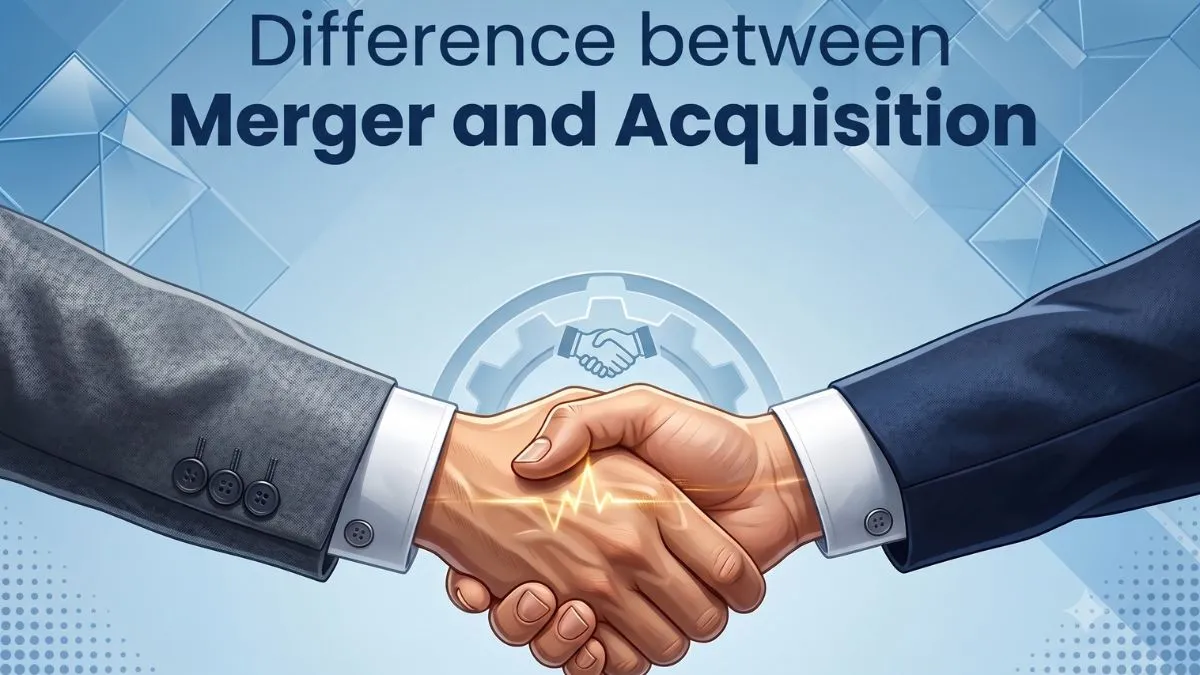
Unacademy was acquired by upGrad in an all stock deal worth $200 million as reported by Unacademy CEO Gaurav Munjal on September 1. Now, often you have heard the terms merger and acquisition in news, both are denoted with the term "M & A". But while the two sound same, the two are completely different. Let us explore the difference between merger and acquisition in today's article.
What is a Merger?
Mergers occur when two companies agree to combine for forming a single company. In mergers shareholders exchange their old shares for shares in the combined entity. Mergers are usually presented as partnership between equals, even when the two companies aren't exactly the same size, and both boards have to approve the deal before it can go through.
A well known example of a merger is the 1999 merger of Exxon and Mobil, where the merger of the two major oil companies resulted in the formation of a single entity known as ExxonMobil.
What is an Acquisition?
An acquisition on the other hand happens when one company buys another company and gains control of it. It does so by purchasing all or majority of the shares or assets of the company, the acquired company either functions as a subsidiary or is fully absorbed into the acquiring company. It does not form a new combined entity as it happens in case of a merger.
The most recent example of acquisition is that of Unacademy by upGrad in an all stock deal worth $206 million, which is 94% below the company's peak valuation of $3.44 billion which it achieved in 2021. Gaurav Munjal is expected to continue as the CEO of Unacademy.
Merger vs Acquisition: Key Differences at a Glance
| Feature | Merger | Acquisition |
| Outcome | Forms a new combined company | The exisiting company is either dissolved or functions as a subsidiary of the acquiring company |
| Company size | Happens between similar sized companies | It is mostly a bigger company buying out the smaller one. |
| Agreement | The terms of merger need to agreed by both the boards | Acquisitions can either be friendly where both boards agree or it can be hostile where the shareholders are approached directly. |
| Branding | Old brands dissolve ti form a new brand | The acquired company's brand may survive or disappear, depends on the buyer |
| Shareholder impact | Shareholders of both companies get shares in the new entity | Target company's shareholders are usually bought out in cash or stock |
Friendly and Hostile Acquisitions: What Sets Them Apart
Mergers are, by definition, mutual since both companies have to agree to dissolve into a new one. Acquisitions don't require that same mutual agreement. A friendly acquisition happens when the target company's board approves the deal, similar to a merger.
A hostile acquisition on the other hand happens when the acquiring company goes directly to shareholders, or buys shares on the open market, without the target's board agreeing to the sale. This distinction, agreement versus takeover, is one of the sole reasons why acquisitions are legally more complex.
Do employees usually keep their jobs after a merger or acquisition?
The structure of the company will invariably be changed once a merger or acquisition has taken place, and workforce restructuring occurs more in mergers, while in the case of acquisitions there is a chance of less restructuring when the acquired company is allowed to function as a subsidiary.
Which is more common, mergers or acquisitions?
Acquisitions are far more common than mergers. Very few true mergers have occured in businesses, since it is difficult for two companies to agree on equal terms.
Check out other interesting articles from the general knowledge section to boost your knowledge of national and international topics. Stay connected with Jagran Josh.

Mriganka Chakraborty is a seasoned digital journalist and communications professional who is currently working as Deputy Manager at Jagran Josh, where he leads the General Knowledge Section. As a subject matter expert with 8+ years of editorial experience, he has created authoritative content that is trusted by millions of readers around the world in Science, History, Geography, Polity, Economy, Sports, and Technology. His extensive expertise in these subjects enables him to present complex topics in an engaging, accurate, and reader-friendly manner to a global audience, making learning addictive and fun.
His background in a wide range of content areas and his ability to move between them make him a trusted voice to readers who want reliable, well-researched content across a variety of disciplines.
In his leisure time, Mriganka enjoys reading fiction novels and watching action and thriller movies, and cricket, which not only hone his storytelling skills but also keep his editorial vision fresh and dynamic.





![[Out] UGC NET June 2026 Result Live: यूजीसी नेट रिजल्ट ugcnet.nta.nic.in जारी, डायरेक्ट लिंक से करें चेक](https://img.jagranjosh.com/images/2026/August/2782026/UGC-NET-Result-2026-Marksheet-link-pdf.jpg)