Most people approach optical illusion puzzles with confidence until the image refuses to cooperate. You stare, scan, and feel certain the answer should be obvious. Then as the time passes, and the hidden object still hasn’t appeared, it makes you question what exactly you are missing.
That tension between certainty and confusion is exactly what makes these puzzles memorable.
Optical illusions lie on a core principle which is defined by the American Museum of Natural History where it mentions: “Seeing is believing, right? Well, actually… What you see and what you think you see are different things. Your senses gather information and send it to your brain. But your brain does not simply receive this information—it creates your perception of the world. This means that sometimes your brain fills in gaps when there is incomplete information, or creates an image that isn’t even there!”
We shared this giraffe themed optical illusion within our team before publishing it. Nearly everyone said the same thing: “This is not the snake… Are you kidding me?”
The brain wants to complete the picture too quickly, and that rush hides important details.
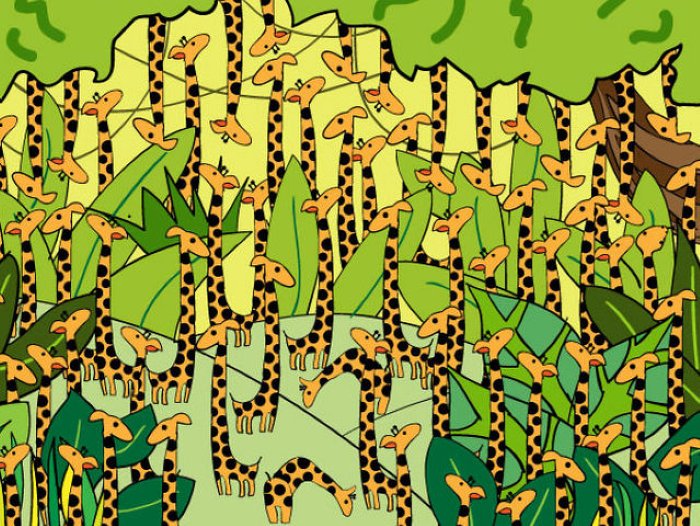
Now the puzzle is in your hands. The image shows a calm scene filled with giraffes.
Nothing looks unusual at first. The shapes blend together naturally, and your eyes adjust to the pattern almost immediately.
But hidden somewhere inside the scene is a snake, carefully camouflaged to match its surroundings.
Your task is simple like the other puzzles that you need to find the snake in 19 seconds.
This puzzle isn’t about luck. It rewards slow scanning and patience.
Try: Quick Visual Test: Find the Secret Hidden Number Sequence in 39 Seconds
Optical Illusion: Find the Hidden Snake in 19 Seconds
Source: Playbuzz
The image looks simple isn’t it? Were you able to spot anything odd in the image?
Why Do These Puzzles Feel So Satisfying?
Optical illusions create a short mental reset. They interrupt your autopilot thinking. Even a short puzzle can refresh your concentration. That’s why people return to them as they are not just for fun, but for the tiny sense of victory that comes with finally seeing the answer.
Instead of searching for the snake randomly, you need to treat this image like a map. Move your eyes in small sections.
When you rush through a puzzle, your brain fills in gaps and skips details. When you slow down, patterns become visible.
Did it help? Were you able to find the hidden snake? If not, here are some more tips:
Zoom in and scan one corner at a time
Look for curves that don’t match the giraffe pattern
Reset your gaze by looking away for a second
Change distance just step back, then look again
The time limit will be up soon, hurry up!
3… 2… and 1! Oh no, the time’s up.
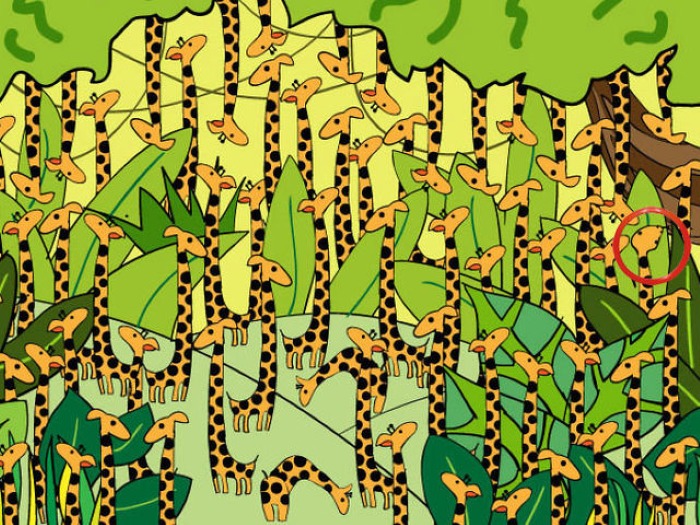
Did you find the hidden snake? If yes then congratulations, you have performed well from most of our team! If not, then it's okay too. You can scroll back to reveal where this snake is hidden.
Try: Timed Optical Illusion Puzzle: Search for the Hidden 8 in a Grid of Number 3s
Find the Hidden Snake: Solution
Source: Playbuzz
If you enjoyed this challenge, try another hidden-object puzzle and notice how your strategy changes. Most readers get faster once they learn to slow down first.
Must Try: Hidden Cat Optical Illusion: A 15-Second Visual Puzzle That Tests Attention to Detail



Comments
All Comments (0)
Join the conversation