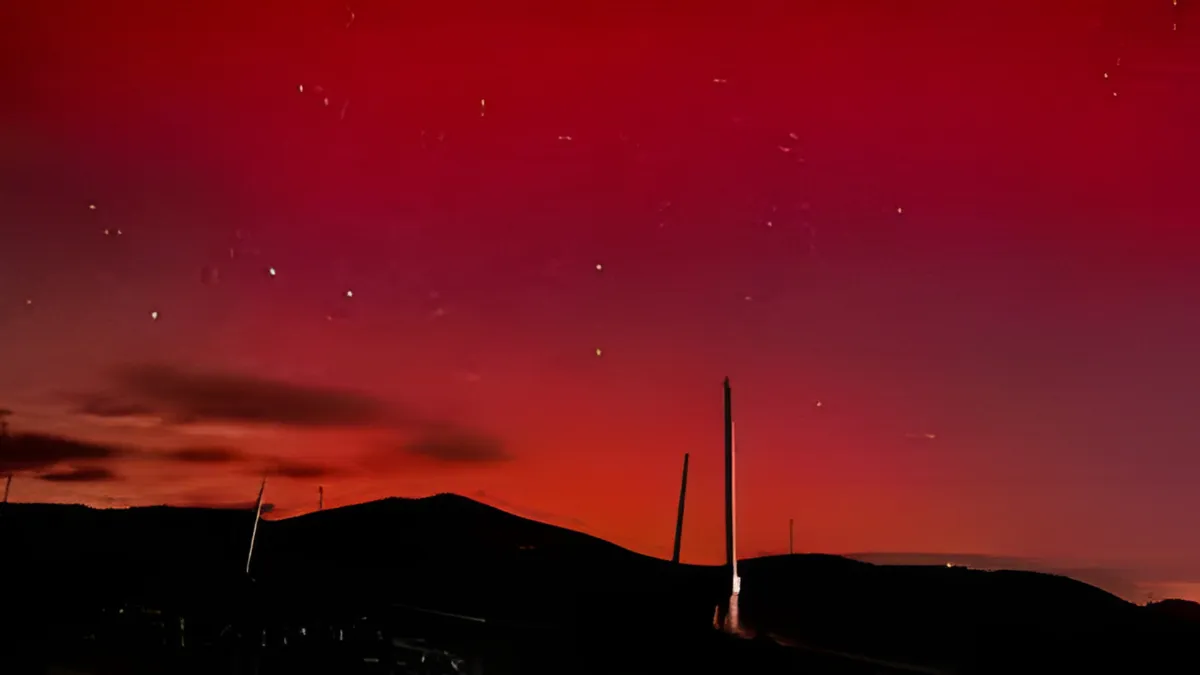
On the night of January 19-20, 2026, a gorgeous blood-red aurora appeared over Hanle in Ladakh, marveling people and social media users who likened it to the Northern Lights.
It was caused by a strong X-class solar flare on January 18 and a high speed coronal mass ejection (CME) at 1,700 km/s, which caused a G4 severe geomagnetic storm and S4 solar radiation storm the strongest since 2003.
What Caused This Storm?
The solar flare burst out at approximately 2330 UTC on January 18 in an active part of the sun and the CME was directed directly to the earth. It hit the magnetosphere on earth on January 19 at 19:38 UTC (01:08 IST) with the auroral oval extending southward to the mid-latitudes such as Hanle at 32°N.
The charged particles entered the atmosphere heating atoms of oxygen more than 300 km above the Earth to light up the red lights instead of the green light found in the normal aurora.
This was the first well documented red aurora in India captured by the Dark Sky Reserve of Hanle, at 4,500 meters, with little light pollution, and high-skilled all-sky cameras in the Indian Astronomical Observatory.
Scientific Significance of this Storm
The flare was detected by the Aditya-L1 mission in L1 Lagrange point which compressed the magnetosphere of the Earth exposing satellites to intense radiation, and gave the earth 24-48 hours notice.
With Solar Cycle 25 approaching maximum, ISRO cautions that there will be increased events, with Aditya-L1 instruments such as VELC monitoring CMEs to make more forecasts.
It is the sixth major red aurora of Cycle 25, which provides data on the low-latitude auroras and magnetosphere-ionosphere coupling.
India and Global Tech Effects
Geomagnetic storms cause the currents which pose a threat to power grids, transformers and blackouts and the heating of atmosphere raises the drag of satellites and crashes GPS, communications and banking.
The incident led to slight GPS glitches and no significant outages; the astronauts on ISS took shelter against radiation.
In the case of India, as the country increases its dependence on satellites, the alerts of Aditya-L1 secure resources in the presence of increasing risks of solar maximum.
Key Facts
-
X-class flares: The strongest solar eruption.
-
G4 storms: Thunderstorms with intense, growing equatorial auroras.
-
Red auroras: Oxygen emissions on high altitudes, uncommon to the south of poles.
-
Peaks 2025-2026 Solar Cycle 25, increasing events.
This exhibition highlights the vulnerability of the planets, increasing space weather preparedness in India by spacecraft missions such as Aditya-L1.


-1769693803905.png)
-1769689591955.png)

Comments
All Comments (0)
Join the conversation