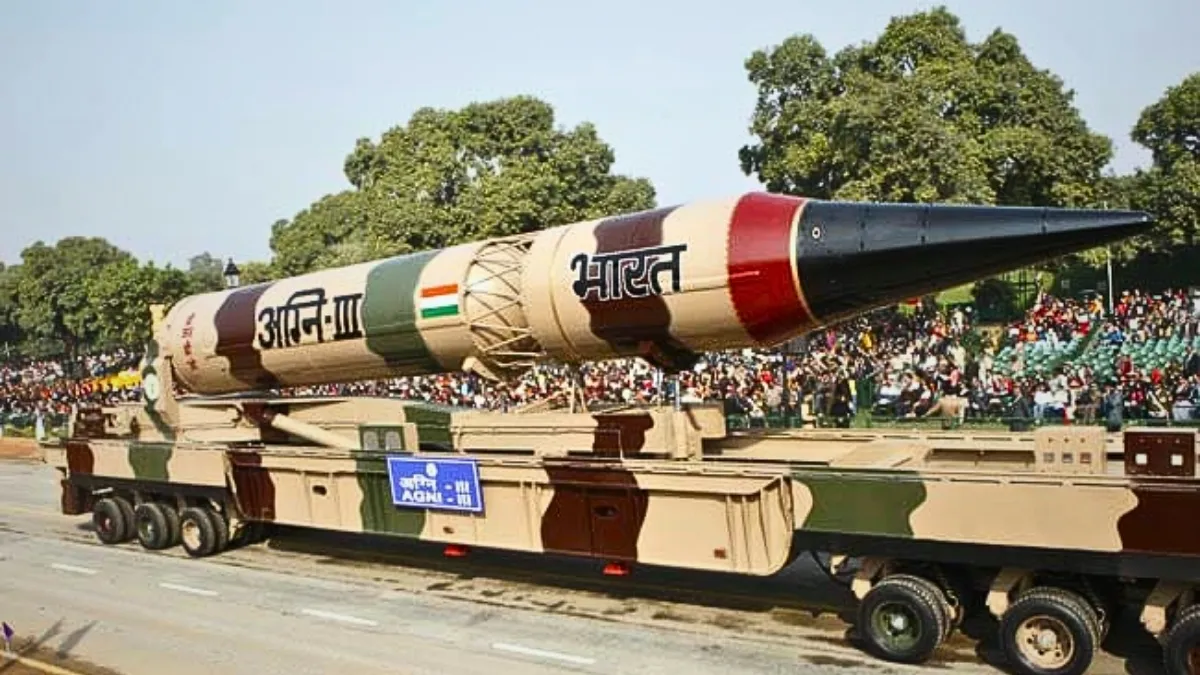
Key Points
- DRDO successfully test-fired Agni-3 from Integrated Test Range Chandipur, Odisha.
- Agni-3 is an Intermediate Range Ballistic Missile with a 3000-3500 km range.
- It can carry nuclear/conventional warheads and be launched from rail-based launchers.
Intermediate Range Ballistic Missile Agni-3 was successfully test-fired by DRDO from the integrated test range Chandipur Odisha. It was carried out under the aegis of the strategic force command. It is a crucial component of India’s nuclear triad. The flight test met all the operational parameters and validated the consistency of the weapon system. The successful launch reinforces India's policy of having a "Minimum Credible Deterrence" with a commitment to "No First Use."
Key specification of Agni-III
The Agni-3 is a surface-to-surface ballistic missile developed by the Defence Research and Development Organisation (DRDO). Following are the key features
-
Type: Intermediate Range Ballistic Missile (IRBM).
-
Propulsion: Two-stage solid-propellant engine, solid fuel allows for faster reaction times and easier storage compared to liquid-fueled missiles.
-
Range: It has a strike range of 3000 to 3500 Km which make it capable of reaching targets deep within neighboring territories.
-
Payload Capacity: It is designed to carry both conventional and nuclear warheads weighing up to 1.5 tonnes.
-
Dimensions: The missile is approximately 17m long with a diameter of 2m and weighs around 50 tonnes.
-
Accuracy: Equipped with high-precision navigation systems which is based on Ring Laser Gyro-based Inertial Navigation Syste. The Agni-3 ensures a high degree of circular error probable (CEP) accuracy
-
Launch Platform: It can be launched from rail-based mobile launchers, providing it with high mobility and survivability against first-strike attempts.
-
Advance Monitoring System: Advanced tracking systems, including radar, telemetry stations, and electro-optical systems located along the coast, monitored the missile's performance throughout its flight path.
Also Read: Which Country Built the World's Largest Compressed-Air Energy Storage Plant?
| Feature | Details |
| Missile Type | Intermediate Range Ballistic Missile (IRBM) |
| Developer | Defence Research and Development Organisation (DRDO) |
| Propulsion | Two-stage Solid Propellant |
| Length | 17 Meters |
| Diameter | 2 Meters |
| Launch Weight | 50 Tonnes |
| Operational Range | 3000 km to 3500 km |
| Payload Capacity | 1.5 Tonnes (1500 kg) |
| Warhead Types | Strategic Nuclear/Conventional |
| Navigation System | Ring Laser Gyro-based Inertial Navigation System (RINS) |
| Accuracy (CEP) | High precision within 40 meters |
| Launch Platform | Rail-based mobile launcher |
Strategic Significance:
-
Agni-3 can be launched from a rail-based mobile platform, it can be moved across the country’s vast railway network, making it difficult for adversaries to track or target before a launch and Agni–3 has high survivability.
-
The Agni-3 is shorter and more compact than its predecessor Agni-2, which makes it easier to transport and deploy.
-
Agni-3 has Re-entry Technology, features advanced heat shield technology to ensure the warhead survives the intense temperatures experienced when re-entering the Earth's atmosphere at high speeds.



Comments
All Comments (0)
Join the conversation