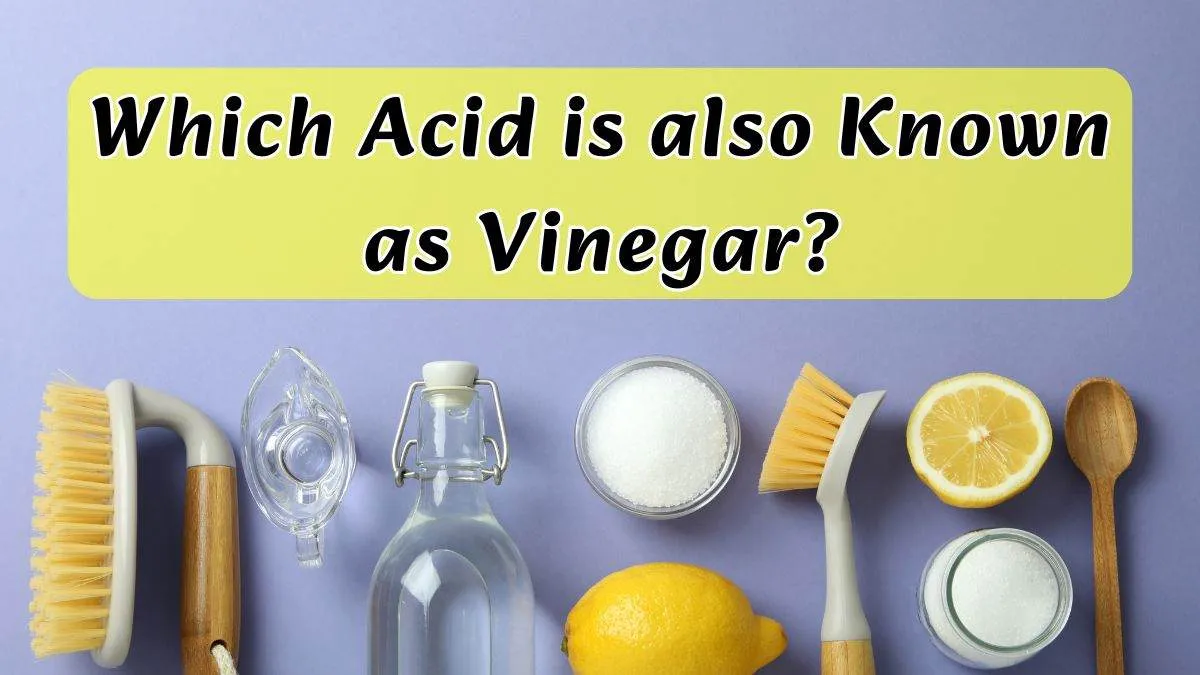
Vinegar is one of the most commonly used substances found in almost every household. From adding flavour to food and preserving pickles to being used as a natural cleaning agent, vinegar plays an important role in daily life. However, what many students may not realise is that vinegar is also a well-known concept in school chemistry. Questions related to vinegar frequently appear in science textbooks, classroom discussions, board examinations, and competitive entrance tests.
For students studying chemistry, especially at the middle and secondary school level, understanding the chemical nature of vinegar is essential. In science, vinegar is not treated as just a kitchen item but as a chemical solution with clearly defined properties. This is why students are often asked direct questions such as “Which acid is known as vinegar?” or “Which acid is present in vinegar?”. Knowing the correct answer and its explanation can help students score easy marks and build a strong foundation in basic chemistry concepts.
Which Acid Is Known as Vinegar? Explained for Students
Acetic acid is the acid that is commonly known as vinegar.
-
Chemical name: Acetic acid
-
Chemical formula: CH₃COOH
-
Nature: Weak acid
-
Common form: Dilute aqueous solution (vinegar)
Household vinegar contains about 4 to 8 percent acetic acid mixed with water.
Why Is Acetic Acid Called Vinegar?
Vinegar is a natural solution formed when alcohol undergoes oxidation in the presence of oxygen and bacteria. This process converts alcohol into acetic acid, which gives vinegar its characteristic sour taste and sharp smell.
Since acetic acid is the main acidic component present in vinegar, it is scientifically correct to say that vinegar is a dilute solution of acetic acid.
Uses of Acetic Acid in Daily Life
Acetic acid is an important example of chemistry in everyday life.
Use in food
-
Used as vinegar in cooking
-
Helps preserve pickles and sauces
-
Adds sour flavour to food
Use in Industry
-
Used in the manufacture of plastics, dyes, and medicines
-
Important raw material in chemical industries
Use in Households
-
Used as a cleaning agent
-
Helps remove grease and stains
Is Vinegar Safe to Use in Lab?
Household vinegar is safe because it contains diluted acetic acid. However, concentrated acetic acid, also known as glacial acetic acid, is corrosive and should only be handled in laboratories under proper supervision.
Students should never taste or directly handle laboratory chemicals.
Importance of Acetic Acid in the School Syllabus
This topic is included in the science syllabus of various classes and boards. Students commonly encounter it in:
-
Class 8 Science (Acids, Bases and Salts)
-
Class 10 Chemistry (Organic compounds)
-
Board examinations such as CBSE, ICSE, and state boards
-
Competitive and scholarship exams
Common exam questions include:
-
Which acid is present in vinegar?
-
Name the acid known as vinegar.
-
Write the chemical formula of acetic acid.
Key Properties of Acetic Acid for Exams
Students should remember the following properties for scoring marks:
-
It is a weak acid
-
It has a sour taste
-
It turns blue litmus red
-
It has a pungent smell
-
It reacts with bases to form salt and water
These points are often tested in theory as well as MCQ-based questions.
Acetic acid is the acid that is also known as vinegar.
It is a weak organic acid, an important part of the school chemistry syllabus, and a common exam question.
Students should remember this key line for exams: Vinegar is a dilute aqueous solution of acetic acid.
Also Check:




Comments
All Comments (0)
Join the conversation