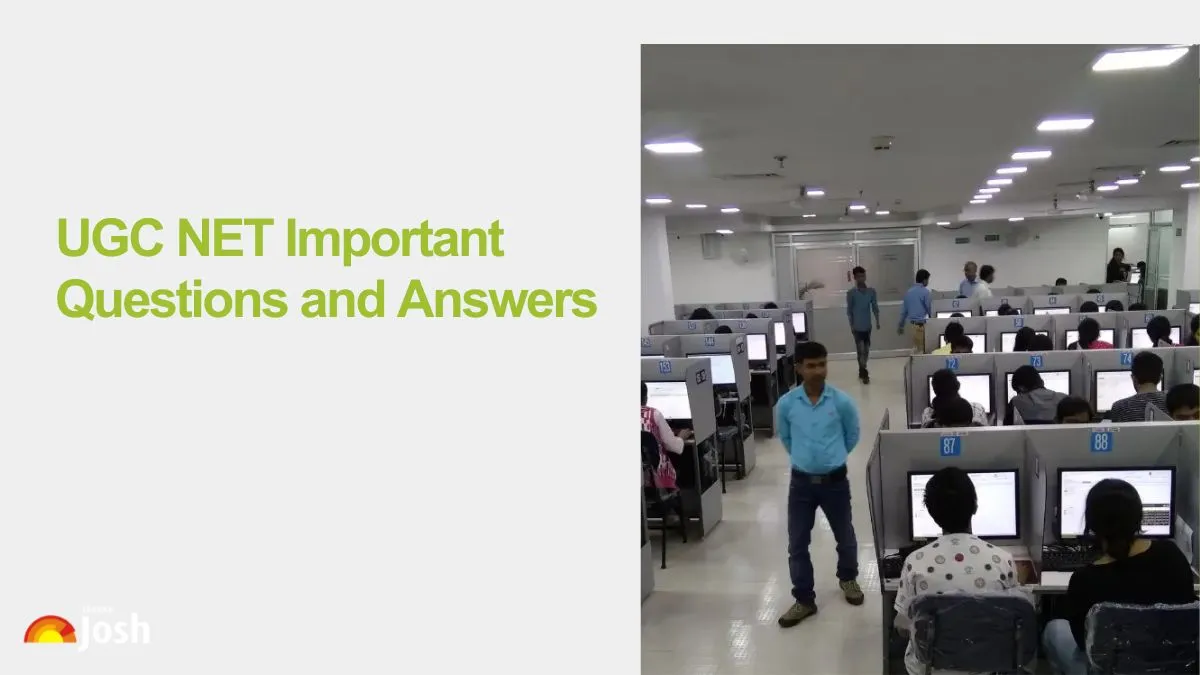
If you are aiming to crack upcoming UGC NET December 2025 exam, gear up to attempt important questions. Solving UGC NET important questions will give you a reality check of your preparedness well, helping you to work on areas you are lagging in. UGC NET exam is scheduled to be held from December 31 to January 7, 2026 in two shifts each day. Thousands of candidates are excepted to appear for the exam and knowing important questions will only increase your chances of qualifying the exam. Scroll on to find important questions and answers for UGC NET Paper 1.
UGC NET 2025 Exam Date
The University Grants Commission National Eligibility Test (UGC NET) is a national-level exam conducted twice a year to evaluate candidates' eligibility for posts of only Assistant Professor or
both Junior Research Fellowship (JRF) and Assistant Professor in Indian universities and colleges. The exam consists of two parts: Paper 1 is common for all candidates, while Paper 2 is subject-specific. Aspirants securing above the UGC NET Cut Off are eligible to start their professional journey as teachers.
| Conducing Body | National Testing Agency (NTA) |
| Exam Name | University Grants Commission National Eligibility Test (UGC NET) |
| Exam Level | National |
| Exam Frequency | Twice a year |
| Mode of Exam | Online - CBT (Computer-Based Test) |
| 31st December 2025, 2nd, 3rd, 5th, 6th and 7th January 2026 | |
| Exam Duration | 180 minutes |
| Language/Medium of Exam | English and Hindi |
| No. of Subjects | 85 subjects |
| Exam Cities | 239 |
| Official Website | ugcnet.nta.nic.in |
Also, check:
UGC NET Important Questions and Answers
Being well-versed with the UGC NET December 2025 Important Questions can help you outrank others in the exam. It's important to note that NTA often repeat questions from UGC NET Previous Year Question Papers with slight modifications. Listed below are some of the most expected questions that are likely to be asked in the exam.
Question 1: What role does professional commitment play in student learning outcomes?
(a) It has no effect on student learning outcomes
(b) It has a negative effect on student learning
outcomes
(c) It has a positive effect on student learning
outcomes
(d) It only affects the performance of high-achieving
students
Answer: C
Question 2: What is situational awareness?
(a) Understanding one's own abilities and
limitations
(b) Knowing how to teach a specific subject
(c) Being aware of one's surroundings and potential
dangers
(d) Having a high level of intelligence
Answer: C
Question 3: The five characteristics of trial-and-error
learning were mentioned by
(a) Pavlov
(b) Thorndike
(c) Wordsworth
(d) Dickens
Answer: B
Question 4: Which article of constitution proclaims
Mother Tongue?
(a) 345 (B)
(b) 350 (A)
(c) 355 (A)
(d) 360 (C)
Answer: B
Question 5: The next term in the series 2, 5, 10, 17, 26, 37,? is:
(a) 50
(b) 57
(c) 62
(d) 72
Answer: A
Question 6: In a certain coding language 'CHEMISTRY' is written as 'DGFLJRUQZ', then in the same code 'GEOMETRY' will be written as:
(a) HDPLFSSZ
(b) HDLPFSXS
(c) HLDPFSSX
(d) HDPLFSSX
Answer: D
Question 7: If the day before yesterday was Friday, what will be the third day after the day after tomorrow?
(a) Friday
(b) Saturday
(c) Thursday
(d) Wednesday
Answer: A
Question 8: In which level of teaching, the main focus is laid on capturing and systematic presentation of ideas and information?
(a) Memory Level
(b) Understanding level
(c) Reflective level
(d) Autonomous development level
Answer: A
Question 9: According to Jean Piaget’s theory of cognitive development, children in the concrete operational stage are capable of –
(a) Reversibility
(b) Hypothetico – deductive reasoning
(c) Abstract thinking
(d) Propositional reasoning
Answer: A



.jpg)
.jpg)

Comments
All Comments (0)
Join the conversation