Rajasthan Board RBSE Class 12th Economics Syllabus 2026-27, Download PDF Here for Board Exam
Download Rajasthan Board, RBSE, Class 12th Economics Syllabus 2025-26 PDF with the latest chapter-wise topics, exam pattern, syllabus wise key pdf details here.
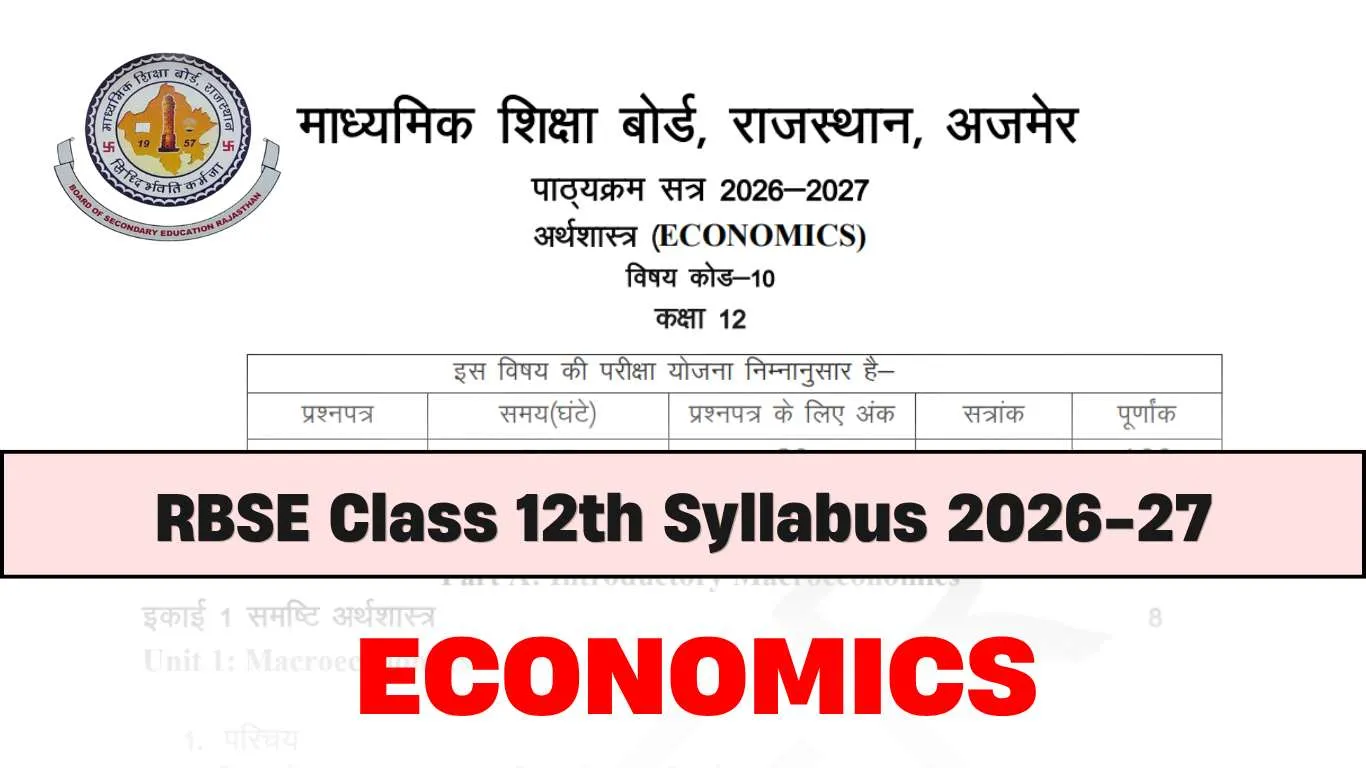
The Rajasthan Board of Secondary Education, RBSE, has officially released the syllabus for Class 12 Economics for the upcoming 2026-2027 academic session. This revised syllabus is now available on the official website and also in this article below. The syllabus aims to provide the Economics course structure with new educational standards. Economics is a core subject for class 12th board exam. Students preparing for the Class 12 board exam, the syllabus will give you an exact idea of how to go through the syllabus for the exam, what are the important topics to study and course structure and more. Students can check and download the syllabus and familiarise with the topics and concepts. Check out the full syllabus below here.
Check: RBSE Class 12 Syllabus 2026-27, All Subjects
RBSE Class 12th Economics Division of Marks
In the table given below is the marks distribution of the subject.
| Particulars | Marks |
| Theory | 80 |
| Practical | 20 |
| Total | 100 |
RBSE Class 12th Economics Syllabus 2026-27
Unit 1: Macroeconomics
1. Introduction Emergence of Macroeconomics , Context of the Present Book of Macroeconomics
2. National Income Accounting
Basic concepts of Macroeconomics, Circular flow of Income (two sector model); Methods of Calculating National Income - Value Added or Product Method, Expenditure Method, Income Method. Factor Cost and Market Prices. Macroeconomic Identities, Nominal and Real GDP, GDP and Welfare.
Unit 2: Money and Banking
3.Money and Banking
Functions of Money, Demand for Money and Supply of Money, Credit Creation by Banking system, Balance Sheet of a Fictional Bank, Limits to Credit Creation and Money Multiplier, Policy tools to Control Money Supply.
Unit 3: Income and Employment
4.Determination of Income and Employment
Aggregate demand and its components-Consumption, Investment, Determination of Income in Two Sector Model, Determination of equilibrium income in the short run, Macroeconomic equilibrium with Fixed Price Level, Effect of an Autonomous change in Aggregate Demand on Income and Output. The Multiplier Mechanism, Some other concepts.
Unit 4: Government Budget
5.Government Budget and the Economy
Government Budget - Meaning, and its Components, Objectives of Government Budget, Classification of Receipts, Classification of Expenditure, Balanced, Surplus and Deficit Budget, Measurement of Government Deficit
Unit 5: Open Economy
6.Open Economy-Macroeconomics
The Balance of payments, Current account and Capital account, Balance of payments, Surplus and Deficit, Foreign Exchange Market-Foreign Exchange Rate, Determination of Exchange Rate, Merits and Demerits of Flexible and Fixed Exchange Rate Systems, Managed Floating Exchange Rate.
Part B :Introductory Microeconomics
Unit 1 Introductory Microeconomics
7.Introduction
A Simple Economy, Central Problems of an Economy, Organization of Economic Activities, The Centrally Planned Economy, The Market Economy, Positive and Normative Economics, Microeconomics and Macroeconomics.
Unit 2 Consumer Behaviour
8.Theory Of Consumer Behaviour
Utility, Cardinal Utility Analysis, Ordinal Utility Analysis, The Consumer’s Budget- Budget Set and Budget Line, Changes in the Budget Set, Optimal Choice of the Consumer, Demand: Demand Curve and the Law of Demand, Deriving a Demand Curve from Indifference Curves and Budget Constraints, Normal and Inferior Goods, Substitutes and Complements, Movement along the Demand Curve and Shifts in the Demand Curve, Market Demand, Elasticity of Demand, Elasticity along a Linear Demand Curve, Factors Determining Price Elasticity of Demand for a Good, Elasticity and Expenditure.
Unit 3 Concepts of Production and Costs
9.Production and Costs
Production Function, The Short Run and the Long Run, Total Product, Average Product and
Marginal Product, The Law of Diminishing Marginal Product and the Law of Variable Proportions,
Shapes of Total Product, Marginal Product and Average Product Curves, Returns to Scale, CostsShort Run Costs and Long Run Costs.
Unit 4 Perfect Competition
10.The Theory of the Firm Under Perfect Competition
Perfect Competition: Defining Features, Revenue, Profit Maximisation, The Profit Maximisation
Problem: Graphical Representation, Supply Curve of a Firm, Short Run supply Curve of a Firm.
Long Run Supply Curve of a Firm, The Shut Down Point, The Normal Profit and Break- Even
Point, Determinants of a Firm’s Supply Curve, Technological Progress, Input Prices, Market
Supply Curve, Price Elasticity of Supply.
11. Market Equilibrium
Equilibrium, Excess Demand, Excess Supply, Market Equilibrium: Fixed Number of Firms, Shifts
in Demand and Supply-Demand Shift, Supply Shift, Simultaneous Shifts of Demand and Supply,
Market Equilibrium: Free Entry and Exit, Applications- Price Ceiling, Price Floor.
RBSE Class 12th Economics 2026-27 Important Books
- Microeconomics - NCERT's Book Published under Copyright
- Macroeconomics - NCERT's Book Published under Copyright
To downlaod the complete RBSE Class 12th Economics Syllabus 2026-27, check out the link below:
Download: RBSE Class 12th Economics Syllabus 2026-27 PDF - Download Here
Students should also understand the exam pattern while preparing for the board exam. RBSE Class 12 Economics theory subjects carry 80 marks, while 20 marks are for practical work or internal assessment. The exams are conducted in offline (pen and paper) mode.

Anisha Mishra is journalist with over 3 years of experience in covering the Indian education sector. She has worked extensively in the K12 domain, with focus on the state board as well as central board examinations, policy structure of seconday and higher secondary education as well as the entrance examinations like JEE, NEET, CLAT, etc. Her extensive experience in the domain has helped her provide students with concise accurate information in all aspectes of school life and education. Her key interest lies in decoding the changes in the curriculum, NEP implementation and changing education ecosystem in the country. Besides working, she enjoys traveling, exploring new places and cultures, and painting.


-(1).jpg)