The volume of a cylinder is defined as the amount of space that a solid or liquid can occupy inside it. A cylinder is a three-dimensional shape with two identical, congruent, and parallel circular bases connected by a curved surface. The volume is measured in cubic units such as cm³, m³, and in³.
To calculate the volume of a cylinder, you need to know the radius of its circular base and the height of the cylinder. The formula for calculating the volume is: V = πr²h.
It is important to note that this formula applies specifically to a right circular cylinder. There are different types of cylinder volume formulas which we have mentioned in the article below.
What Is a Cylinder?
In geometry, a cylinder is a 3-dimensional shape that has two congruent and parallel identical bases. Common examples of cylindrical objects include water bottles, pipes, candles, etc. There are various types of cylinder volume formulas; however, the most common is the right circular cylinder.
What Is the Volume of a Cylinder?
The different types of cylinder volume formulas are as follows:
-
Right circular cylinder volume formula: V = πr²h
-
Oblique Cylinder volume formula: V = πr²h
-
Elliptic Cylinder volume formula: V = πabh
-
Right circular hollow cylinder volume formula: V = π(R2 - r2)h
Cylinder Volume Formula: How to Calculate Volume of a Cylinder
The volume of a cylinder is defined as the capacity of a cylinder. In simple language, it means how much liquid or material a cylindrical object can hold. It is often asked in competitive government exams and school exams. You might even end up using it in your daily life too.
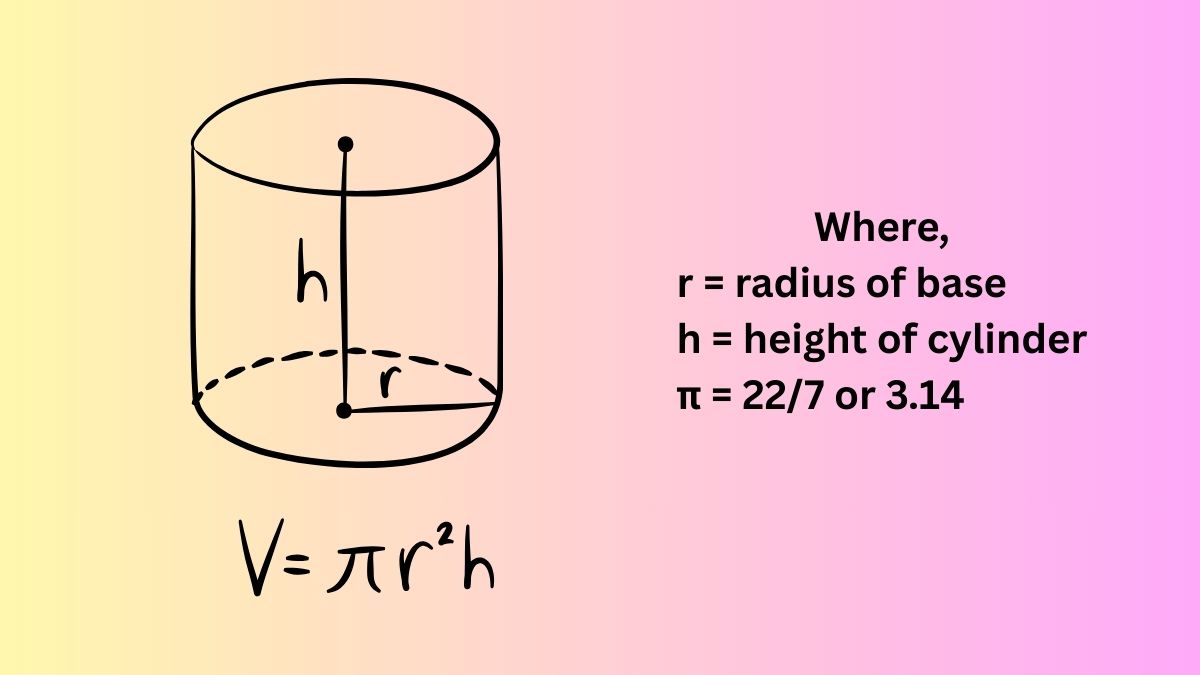
Formula for Volume of a Cylinder
Volume = π × r² × h
Where:
r = radius of base
h = height of cylinder
π = 22/7 or 3.14
Derivation of Cylinder Volume Formula
A cylinder resembles a prism without a curved side face. The formula for calculating the volume of a prism is:
V = A x h, where
A = area of the base
h= height
Since the base of a cylinder is circular, then
A = π × r²
Putting it in the earlier-mentioned formula
V = π × r² x h
Volume of a Cylinder Examples
Whether you are a student or preparing for government exams, you must know the formula for the volume of a cylinder. While preparing for the exam, you must have realised how important this topic is, and there are high chances you might come across questions based on this topic:
Example 1: The height of a cylinder is 20 cm and the radius of one circular base is 14 cm. Find its volume.
Solution:
In the given problem, h is 20 cm and r is 14 cm
Volume = π (14)² × 20 cm³
Or, V = 22/7 × 196 × 20 cm³
Or, V = 12320 cm³
Example 2: The volume of a cylinder is 1540 cm³ and the radius is 7 cm. Find its height.
Solution:
In the given problem, V is 1540 cm³ and r is 7 cm
Putting values in V = π × r² x h
1540 = (22/7) × 7 × 7 × h
1540 = 154 × h
h = 10 cm
Example 3: A cylindrical water tank has a radius of 3.5 m and height of 4 m. Find its volume.
Solution:
As per the given information, r is 3.5 m and h is 4 m
Volume = (22/7) × 3.5 × 3.5 × 4
Volume = 154 m³
Volume of Cylinder in Litres
To find Volume of Cylinder in Litres, you must know: 1 litre =1000 cm³. For better understanding, refer to the example mentioned below:
If the volume of a cylinder is 6280 cm³ then the volume will be:
1 litre = 1000 cm³
6280 ÷ 1000 = 6.28 litres
Common Mistakes While Calculating Cylinder Volume
There are a few common mistakes that you must avoid while calculating cylinder volumes, which are as follows:
-
You must not forget to square the radius.
-
Do not use the diameter value instead of radius
-
Make sure you do not mix up surface area and volume formulas
Conclusion
The cylinder volume formula is one of the most important and common formulas which is asked in exams. By practising examples and avoiding common mistakes, you can easily master this topic and secure maximum marks from this topic.



.jpg)
.jpg)

Comments
All Comments (0)
Join the conversation