CBSE 12th Board Exam 2027: 5 Month Study Plan to Score High Marks
CBSE Class 12 Board Exam 2027: Check a 5-month study plan, daily timetable, revision strategy, subject-wise preparation tips and ways to score 90+ marks.
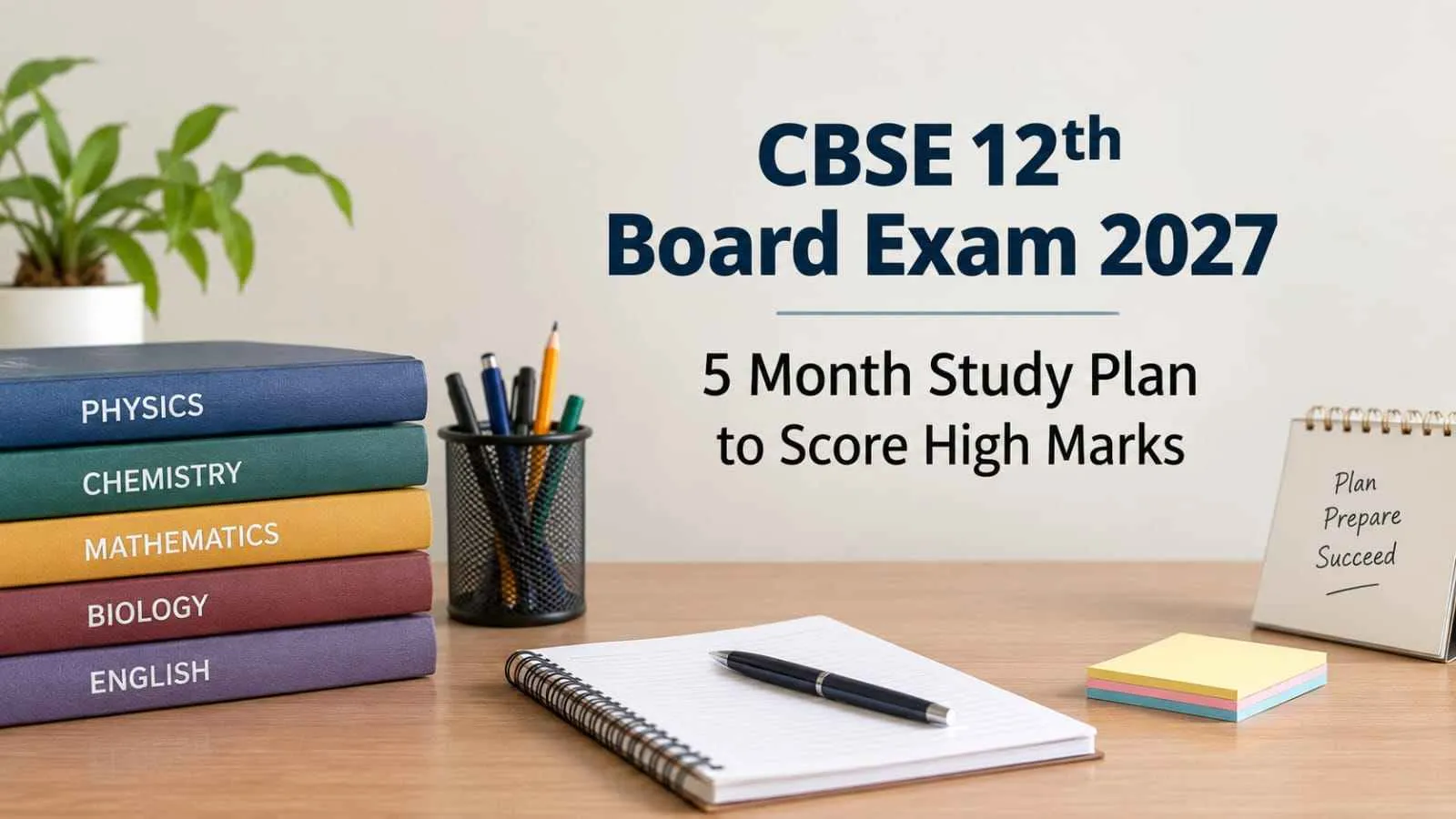
CBSE Class 12 Board Exam 2027 Preparation: With the CBSE Class 12 Board Exams 2027 approaching, students should now focus on completing the syllabus, strengthening concepts and increasing their answer-writing and revision practice. A well-planned five-month study strategy can help students cover the complete syllabus, revise important topics and solve enough sample and previous-year question papers before the examinations.
For students aiming to score 90 per cent, 95 per cent or higher marks in CBSE Class 12 Board Exams 2027, simply studying for long hours is not enough. The key is to divide the available time into different preparation phases, syllabus completion, revision, question practice, mock tests and final revision.
CBSE has advised students to prepare a study plan according to their preparation level in each subject, take mock tests and work on areas where they face difficulty. Written-answer practice is also important for improving confidence before the board examinations.
CBSE Class 12 Board Exam 2027: 5-Month Study Plan
Students can follow the month-wise preparation strategy given below to systematically prepare for the CBSE Class 12 Board Exam 2027.
| Month | Preparation Target | What Students Should Do |
| Month 1 | Complete pending syllabus | Cover difficult and high-weightage chapters |
| Month 2 | Finish syllabus + first revision | Revise completed chapters and practise questions |
| Month 3 | First complete revision | Solve chapter-wise and topic-wise questions |
| Month 4 | Intensive practice | Solve sample papers and previous-year papers |
| Month 5 | Final revision | Take full-length mock tests and revise weak areas |
Read l CBSE Class 12 English Pre Board Sample Paper 2026-2027 (with solutions)
Month 1: Complete the CBSE Class 12 Syllabus
The first month should be dedicated to completing the maximum portion of the syllabus. Students who still have several chapters left should avoid spending too much time making elaborate notes. Start by preparing a subject-wise chapter checklist. Divide chapters into three categories:
- Chapters that are already completed
- Chapters that require revision
- Chapters that are yet to be studied
Give priority to difficult chapters and topics that require more practice. For numerical subjects such as Mathematics, Physics, Chemistry and Accountancy, students should solve questions immediately after studying a concept. For theoretical subjects such as Business Studies, Economics, Political Science, History, Sociology and Psychology, focus on understanding concepts before memorising answers.
Students should use the official CBSE syllabus and curriculum as the primary reference while planning their preparation. CBSE publishes the Senior Secondary curriculum and subject-wise materials on its official website.
Month 1 Target
- Complete all pending chapters
- Revise topics taught earlier
- Prepare short revision notes
- Maintain a formula/reaction/definition notebook
- Start solving NCERT and textbook questions
- Identify weak subjects and chapters
Month 2: Complete the Syllabus and Start Revision
By the second month, students should aim to finish the remaining syllabus and begin the first round of systematic revision.
Do not wait until the entire syllabus is completed before revising. Use the 60:40 rule, spend around 60 per cent of study time completing or strengthening concepts and 40 per cent revising previously studied topics.
At this stage, students should also begin solving questions after every chapter. This will help them identify whether they have actually understood the topic or only read it.
Month 2 Target
- Complete the remaining syllabus
- Revise completed chapters
- Practise important questions
- Strengthen weak concepts
- Start chapter-wise test
- Update short notes regularly
Month 3: First Complete Revision
The third month should focus heavily on revision. By now, students should have completed the syllabus and should avoid starting completely new resources.
Revise every subject systematically and solve questions without looking at the answers.
For subjects involving numerical problems, maintain a separate list of frequently made mistakes. For theory-based subjects, practise writing answers within a fixed time limit.
Students should also begin solving previous-year CBSE Class 12 question papers. CBSE maintains an official archive of Class XII question papers, making previous papers useful for understanding the type and structure of questions asked in the examination.
Month 3 Target
- Complete the first full syllabus revision
- Solve chapter-wise questions
- Start previous-year question paper practice
- Improve answer-writing speed
- Identify frequently repeated concepts
- Prepare a list of weak areas
Month 4: Solve Sample Papers and Previous-Year Question Papers
The fourth month should shift from learning to exam-oriented practice. Students should start solving full-length papers under examination conditions. Sit for the complete duration of the paper and avoid using books, notes or mobile phones while attempting it.
After completing every paper, analyse the mistakes. Do not only check the final score. Identify:
- Questions answered incorrectly
- Questions left unanswered
- Concepts that were unclear
- Time-consuming questions
- Presentation mistakes
- Questions where marks were lost despite knowing the answer
CBSE provides official sample question papers and marking schemes for Class XII, which students can use to understand paper patterns and assess their preparation.
Month 4 Target
- Solve at least 2–3 full-length papers per week
- Practise previous-year papers
- Check answers using marking schemes
- Improve time management
- Work on weak chapters
- Practise diagrams, maps, graphs, formulas and important formats wherever applicable
Month 5: Final Revision and Mock Tests
The final month should be used for revision rather than learning large amounts of new material.
Students should revise their short notes, formulas, important definitions, diagrams, reactions, dates, concepts and frequently asked questions.
Attempt full-length mock tests regularly and analyse every paper after completion.
At this stage, students should follow a simple rule: Revise → Practise → Analyse → Improve.
Avoid starting multiple new books or study materials during the final month. Focus on the prescribed syllabus, NCERT/textbooks, school material, official CBSE resources, previous-year papers and sample papers.
Read l CBSE Class 12 Question Paper 2026 OUT for All Subjects; Download FREE PDFs Here
CBSE Class 12 Board Exam 2027: Daily Study Timetable
Students can modify the following timetable according to their school and coaching schedules. Students do not necessarily need to follow the exact timings. The important thing is to maintain consistent daily study hours with regular breaks.
| Time | Activity |
| 6:00 AM – 7:00 AM | Revision of formulas, definitions or short notes |
| School Hours | Attend classes and clarify doubts |
| 4:00 PM – 6:00 PM | Difficult subject/concept-based study |
| 6:30 PM – 8:00 PM | Numerical/question practice |
| 9:00 PM – 10:30 PM | Theory subject/revision |
| 10:30 PM – 11:00 PM | Quick revision and next-day planning |
How to Score 90+ in CBSE Class 12 Board Exams 2027?
Scoring 90+ marks requires consistency across the preparation period. Students should follow these strategies:
1. Complete NCERT Thoroughly: For many CBSE subjects, NCERT textbooks form an important foundation for board preparation. Read the prescribed textbook carefully before moving to additional study material.
2. Follow the Latest CBSE Syllabus: Do not spend valuable preparation time on topics that are outside the prescribed syllabus. Check the latest syllabus and curriculum released by CBSE before preparing your chapter checklist.
3. Practise Previous-Year Questions: Previous-year papers help students become familiar with the examination format and improve question-solving speed. CBSE's official question-paper archive provides Class XII papers for multiple subjects.
4. Use Sample Papers and Marking Schemes: Do not simply solve sample papers. Check your answers against the marking scheme and understand where marks are awarded. This is especially important for subjects where step-wise or point-wise answers matter. CBSE publishes sample question papers and marking schemes for Class XII.
5. Practise Answer Writing: Knowing the answer and presenting it effectively are two different things. Students should practise writing answers within the prescribed word limit and examination time.
Use:
- Headings
- Subheadings
- Bullet points where appropriate
- Relevant examples
- Diagrams and flowcharts where applicable
- Proper steps in numerical questions
6. Maintain a Mistake Notebook:Every time you make a mistake in a test or practice paper, write it down. Revise this notebook regularly.
It can include:
- Incorrect formulas
- Frequently confused concepts
- Important definitions
- Calculation mistakes
- Questions repeatedly answered incorrectly
- Presentation errors
Subject-Wise CBSE Class 12 Preparation Strategy
CBSE Class 12 Science Stream
Physics: Focus on concepts, derivations, formulas and numerical practice. Solve different types of numerical problems instead of repeatedly practising the same question.
Chemistry: Divide preparation into Physical, Organic and Inorganic Chemistry. Revise reactions, formulas, concepts and numerical problems regularly.
Biology: Read NCERT carefully and focus on diagrams, terminology, processes and important concepts. Practise writing answers using appropriate biological terms.
Mathematics: Regular practice is essential. Solve questions every day and maintain a separate formula sheet for quick revision.
CBSE Class 12 Commerce Stream
Accountancy: Practise numerical questions regularly and focus on formats, calculations and adjustments.
Business Studies: Prepare chapter-wise concepts and practise writing structured answers using important keywords.
Economics: Focus on concepts, diagrams, definitions, numerical questions and important terms. Practise writing answers in a clear and logical sequence.
CBSE Class 12 Humanities Stream
Subjects such as Political Science, History, Geography, Sociology and Psychology require both conceptual understanding and answer-writing practice.
Students should create short revision notes and practise long-answer questions regularly. Use headings, subheadings, examples, maps or diagrams wherever relevant to the subject and question.
Also Check: CBSE Class 12 Syllabus 2026-27, All Subjects: Download PDFs

Apeksha Agarwal is an Education Journalist with over 3.5 years of experience. She covers a wide range of topics, including school board examinations, entrance tests, admissions, results, scholarships, and higher education updates. Over the years, she has closely tracked major examinations such as JEE Main, NEET UG, CUET, and various state-level entrance exams, helping students stay informed throughout their academic journey. Apeksha has a Master's degree in Journalism and Mass Communication and a certificate in Digital Journalism. She is passionate about transforming complex educational developments into clear, accessible, and useful information. Her reporting focuses on providing students, parents, and educators with accurate updates and practical insights on examinations, results, and policy changes. She believes that quality education journalism can make a meaningful difference by helping students make informed decisions about their future.


![[OUT] AFCAT 2 Result 2026 Live: Download Scorecard PDF at afcat.edcil.co.in- Link Active](https://img.jagranjosh.com/images/2026/September/992026/AFCAT-2-Result-2026.jpg)