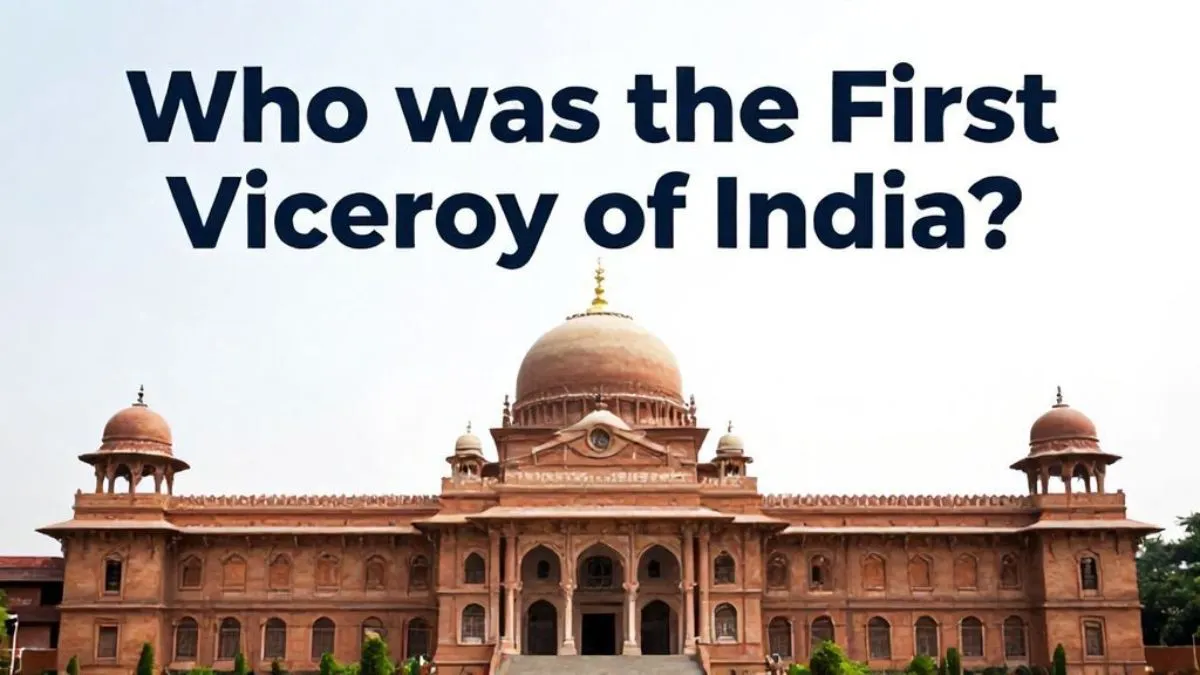
The Viceroy of India became a milestone in colonial rule as a symbol of the change of authority between a trading company and the British Crown.
This position was created following a significant rebellion in the mid-19 th century after the revolt of 1857, and it redefined the political, administrative, and legislative framework of India decades later.
But who was the First Viceroy of India?
So, let's explore this article and know about the First Viceroy of India.
Source: allartsindia
Who was the First Viceroy of India?
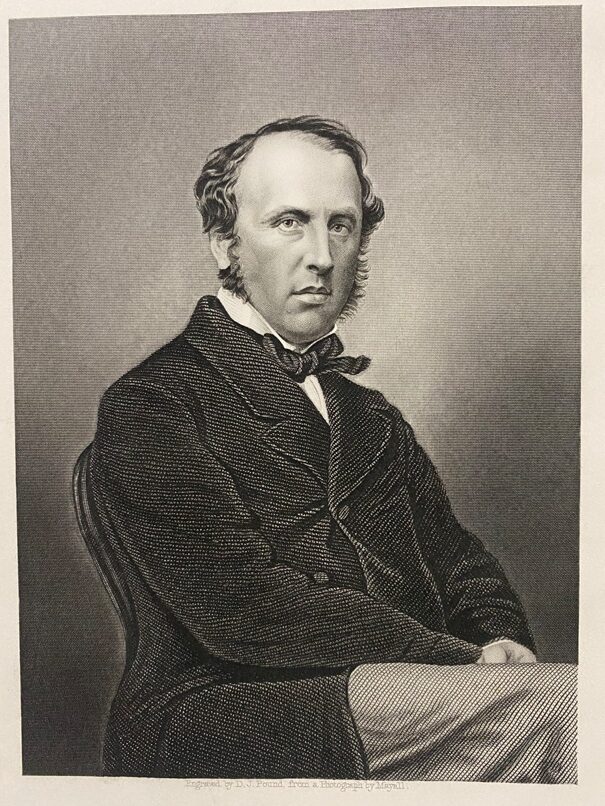
The first Viceroy of India was Lord Canning, and he is also recognised to have taken centre stage at one of the most turbulent times in Indian history.
His appointment led to a historical change in the system of governance, as it changed India into a company governed from now on under the direct rule of the British Crown.
Who Was Lord Canning?
Lord Canning was a British statesman who was named the first person to bear the title of Viceroy of India.
Before this, worked in the capacity of Governor-General of India between 1856 and 1858.
After the Government of India Act came into force, he served in the position of the first Viceroy from 1858 to 1862.
He had been in office at a time when this was one of the most delicate transitions to take place in Indian history, the Indian history-the period of change of company administration to direct Crown.

Source: wikipedia
Why Was the Title “Viceroy of India” Created?
The British East India Company governed India until the year 1858, and the ultimate authority was the Governor-General.
This system altered radically with the Revolt of 1857, which revealed some grave weaknesses in the administration of the companies.
The British Parliament, in turn, went ahead to enact the Government of India Act 1858, which abolished company rule and gave direct power to the British Crown.
In keeping pace with this increased burden as the representative of the monarch, the Governor-General was bestowed therewith a new title-- Viceroy of India.
What was the role of Lord Canning as the First Viceroy of India?
Lord Canning had already been serving as Governor-General of India (1856–1858) when the revolt of 1857 broke out.
After the Act of 1858 came into force, Lord Canning continued in office as the first Viceroy of India from 1858 to 1862.
His existence represented crisis continuity. Instead of governing by force, Canning used a moderate and conciliatory style under which he gained a well-known reputation for Clemency Canning, due to his restraint and mercy towards a large number of rebels following the uprising.
Key Events During Lord Canning’s Tenure
Lord Canning’s period in office was marked by landmark political and administrative developments that reshaped British India:
-
Queen Victoria’s Proclamation (1858): Issued by Queen Victoria and formally read by Canning at Allahabad, this proclamation promised religious tolerance and non-interference in Indian traditions.
-
End of East India Company Rule: The company was abolished, and India came under direct Crown administration.
-
Administrative Reorganisation: The role of the Viceroy was clearly defined as the Crown’s supreme authority in India.
What are the major Reforms Introduced Under Lord Canning?
Lord Canning focused on stabilising governance and modernising institutions after the 1857 revolt. His reforms laid the foundation for colonial administration for decades.
Legislative and Administrative Reforms
-
Indian Council Act of 1861: He helped in expanding the legislative councils and introduced the portfolio system, which is a more structured form of governance.
-
Indian Civil Services Act, 1861: He has tried to open limited entry for Indians into civil services, though senior posts largely remained British-controlled.
Judicial Reforms
-
Indian High Courts Act, 1861: Established High Courts in Calcutta, Bombay, and Madras, replacing older judicial bodies.
-
Indian Penal Code (1862): Though the Indian Penal Code was drafted earlier, it was enforced during Lord Canning’s tenure, which helped in creating a uniform criminal law system.
Educational Initiatives
-
Establishment of Universities (1857): Many modern universities were founded in Calcutta, Bombay, and Madras during his tenure for promoting Western-style higher education.
Financial and Military Reforms
-
He also introduced structured financial administration with a dedicated finance member.
-
He also reorganised the army after the 1857 revolt, ensuring British control over artillery and key military positions.
What was the significance of Lord Canning in Indian History?
Lord Canning holds a unique place in history and is the only person to have been both Governor-General and Viceroy of India.
His leadership helped in the change of power from the company rule to the Crown rule contributed to the saving of more mass unrest.
Although he stuck to the British interests, his moderate policies and institutional reforms still left a permanent mark in the minds of the Indian administrative system.
Conclusion
The first Viceroy of India was Lord Canning, who presided over a turning point of Indian rule. Both during the time of uprising and reform, having been appointed afterwards, he softened the transition to Crown rule with difficulty, constitutionality, and comparative moderation.
His reign not only introduced the Viceroyalty but also influenced the political, judicial and educational structures, which even continued in the modern era, in India.



-1768326560605.jpg)
Comments
All Comments (0)
Join the conversation