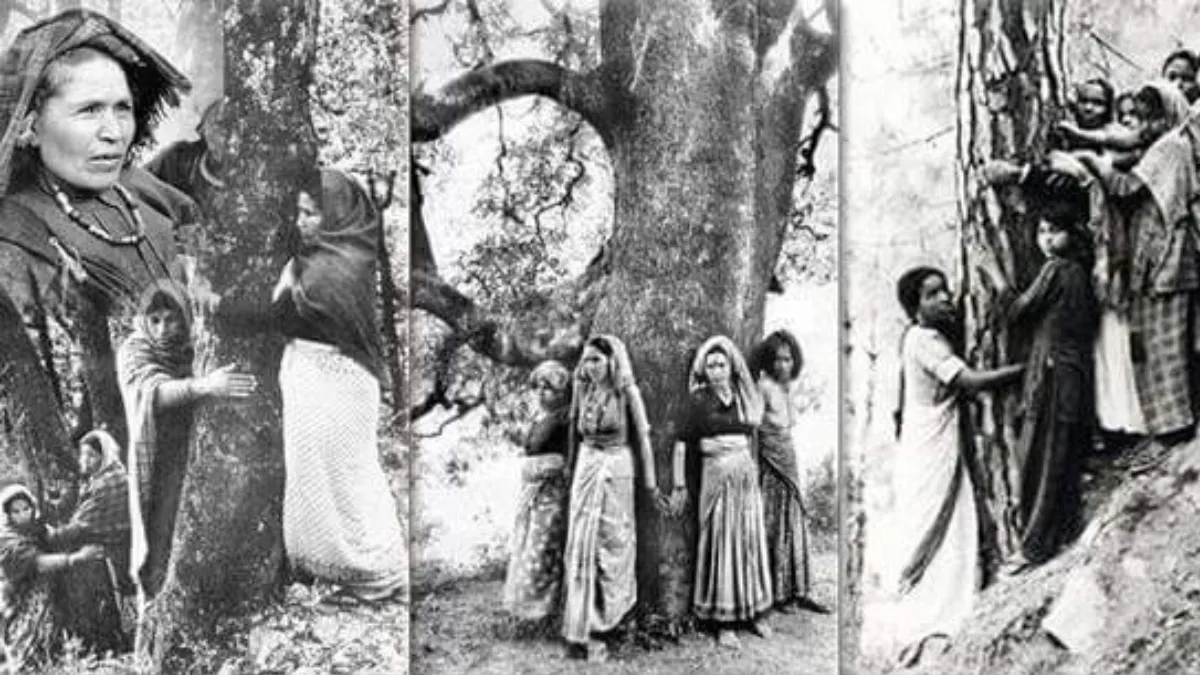
On March 25, 1974, in the icy cold at Reni village in the Chamoli district of Uttarakhand, 27 women led by a 46-year-old widow of the village (Gaura Devi) went on a snow walk to challenge armed loggers who were cutting down sacred ash trees.
Facing axes and threats, she declared, "Brothers! This forest is a source of our livelihood. If you destroy it, the mountains will come tumbling down onto our villages," and later dared, "Shoot us. Only then will you be able to cut down the forest".
This four-day standoff preserved 2,500 trees, and this catapulted her into the limelight of the "Mother of Chipko" and the central role of women in the Indian eco-story.
Early Life & Background of Gaura Devi
-1768594545118.png)
(Generated with the help of Google Gemini)
Gaura Devi was born to a family of Marchaya in Chamoli, Uttarakhand around 1925, married at a tender age to Reni village but was widowed at the age of 22 with a child to support at the village level.
By the 1970s, a lack of trees combined with uncontrolled deforestation worsened by 1970 Alaknanda floods through soil erosion necessitated women such as her to travel more distance in search of firewood drying springs and endangering villages.
Since 1972, she was president of Mahila Mangal Dal (Women Welfare Association), Reni, and she was promoting the needs of the community and made a direct connection between forests and survival, identifying it as the mika (maika) or the mata (Vandevta) of the community.
What was Gaura Devi’s Role in the Chipko Movement?
March 24, 1974 - Government auctions threatened 2,500 trees above Reni in defiance of bans but village men left the village to have a compensation meeting, leaving women. In the middle of the night, at midnight a young girl had sent Gaura word of some arriving loggers.
According to a research paper published by the International Journal of Law Management and Humanities, Gaura Devi and the other ladies resisted the loggers' threats. The incident helped raise awareness of the Chipko movement and its objectives, and they were successful in preserving the trees.
By rallying up women she took them to the hill, and when dawn turned its face she put the trees round them and was now face to face with 20-30 armed men.
Threats and night vigilage gave strength to reinforcement; and the loggers had put up after four days. A state committee decided on her side declaring her spontaneous leadership.
Famous historian and Author Ajay Singh Rawat who wrote multiple books on Uttarakhand’s local ecosystems and environmental conservation mentioned in an interview, “The environment movement she started made India realise the importance of forests and sustainable development, especially in the Himalayan region where it was the first such movement. It created awareness on the importance of forests and inspired many policy changes and people to fight for the cause of forests and local ecology“
Gaura Devi’s Leadership Style & Impact
The culturally-charged moralist approach of Gaura, which invoked sacred connections and did not use violence, was a disgrace to contractors, and attracted media attention, in contrast to the ones led by men.
This move made Chipko gain steam, resulting in a 10-year logging ban on 1150km 2 and a 1981 national Himalayan moratorium of Uttar Pradesh. As LSE scholar Eléonore Soubeyran notes in related analyses, such women's actions highlight disproportionate climate burdens on females.
Gaura maintained local campaigns until the 1980s when she did not seek the limelight and died without significant accolades around the same time.
Nowadays Reni flourishes under forested communities; in 2024 (50th anniversary) tributes, statues, and festivals were made. She has been celebrated in the world in the likes of Wangari Maathai (Nobel 2004) and Marina Silva (Brazil reserves) who highlight the eco-feminism in which women plant millions of trees in the face of deforestation.



-1768571128062.jpg)
Comments
All Comments (0)
Join the conversation