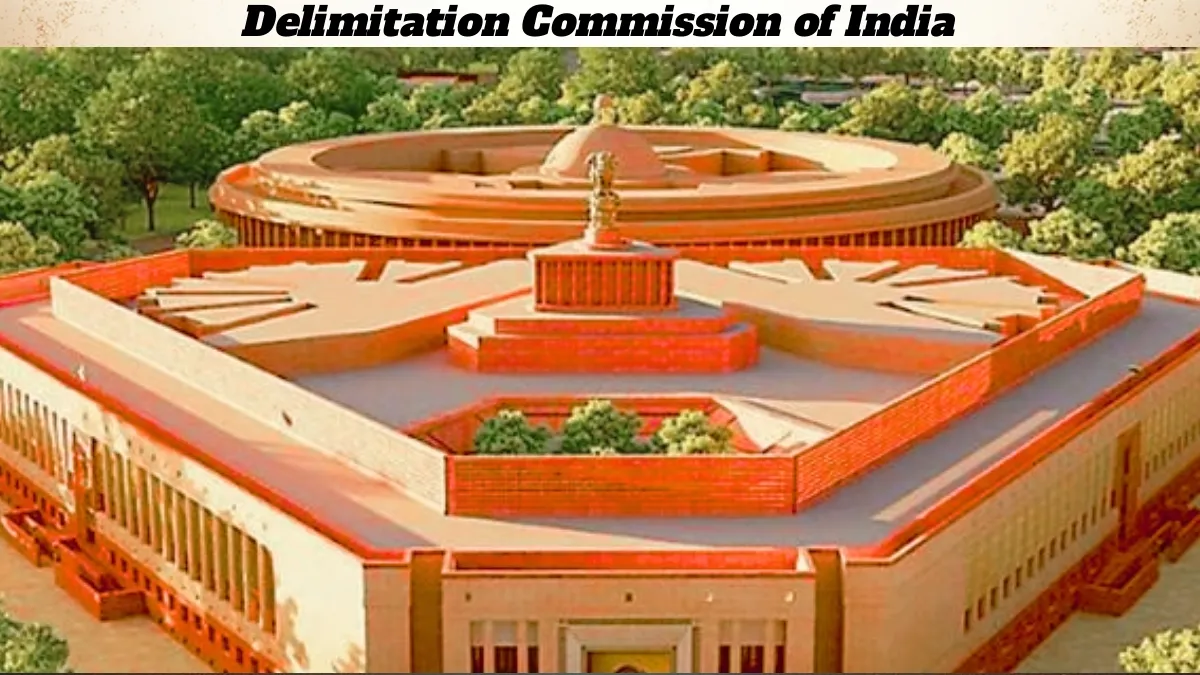
What is the Delimitation Commission?
The Delimitation Commission of India is a quasi-judicial and statutory body established by the Government of India to redraw the boundaries of Lok Sabha and State legislative assembly constituencies based on the latest census, created under the delimitation commission, and its decision can not be challenged in any court.
Formation of the Delimitation Commission is guided by the constitution, such as Article 82, Article 170, Article 330, and Article 332, covering SC/ST seat reservation both in the Lok Sabha and the state assembly.
Objectives:
-
Ensure equal population representation across the constituencies across India.
-
Allocation of seats to Scheduled Castes (SCs) and Scheduled Tribes (STs) as per their population within the state.
-
Promoting the balance of federal representation and electoral fairness by preventing over-representation or under-representation.
-
To reflect the demographic changes in the constituencies recorded in the census.
Key features of the Delimitation Commission:
-
Independent and quasi-judicial body whose decisions are binding.
-
Redrawing boundaries of Lok Sabha and state assembly constituencies in India.
-
Fix the total number of seats allocated to each state as per the population.
-
Determining SC/ST seat reservation based on the latest census data.
-
Implementing seat rotation for the election of Lok Sabha and State Assembly for reserved constituencies where applicable.
-
The commission considers population equality, geographical boundaries, and natural and administrative boundaries.
Composition of Delimitation Commission
A delimitation commission consists of a retired Supreme Court judge as the chairperson along with the chief election commissioner and state election commissioners as members of the commission. Associate members, like members of parliament and members of state assemblies, may participate, but the final decision lies in the hands of the commission.
Appointment: appointed by the President
Chairperson of the commission: Retired judges of the Supreme Court
Member: Chief Election Commission of India
Members: State election Commission of the Concerned states
Associated Members: Selected MPs/MLs of the Concerned States (only have consultative status, not voting power)
How the Delimitation Commission Works:
The Delimitation Commission is appointed by the President of India and works in collaboration with the Election Commission of India. It is appointed for the aim of drawing up the boundaries of constituencies all over the country.
A quota of constituencies to be reserved in each state is fixed depending on the proportion of SCs or STs in that state. After drawing the boundaries, the Delimitation Commission looks at the composition of the population in each constituency. Those constituencies that have the highest proportion of Scheduled Tribe population are reserved for STs. In the case of Scheduled Castes, the Delimitation Commission looks at two things.
-
It picks constituencies that have a higher proportion of Scheduled Caste population. But it also spreads these constituencies in different regions of the state. This is done because the Scheduled Caste population is generally spread evenly throughout the country. These reserved constituencies can be rotated each time the Delimitation exercise is undertaken
Constitutional Provisions related to the Delimitation Commission
The Delimitation Commission of India is primarily guided by the following constitutional provisions:
-
Article 82: It empowers Parliament to enact a Delimitation Act after every census.
-
Article 170: It is related to the delimitation or readjustment of seats in the State Legislative Assembly after every census.
-
Article 330 & Article 332: The reservation of the seats for Scheduled Caste (SC) and Scheduled Tribes (ST) in the Lok Sabha and State Assemblies.
-
Article 327: Parliament's power to make laws regarding elections.
-
Article 329(a): Orders of the delimitation commission cannot be challenged in any court.
-
42nd Constitutional Amendment, 1976: It froze the total number of Lok Sabha and State Assembly seats until the first census after 2000.
-
84th Constitutional Amendment, 2001: It further extended the provision given by the 42nd Constitutional Amendment until 2026, though internal readjustments of constituency boundaries are permitted.
Delimitation Acts in India:
Four delimitation acts have been passed by the Indian government thus far, in 1952, 1962, 1972, and 2002. Each of these acts corresponds to a national census leading to the setting up of a delimitation commission.
Delimitation Acts in India
| Delimitation Commission | Year of Constitution | Census used | Chairperson | Key Features |
| Delimitation Act, 1952 | 1952 | 1951 Census | Justice Fazal Ali | The first delimitation after the independence, drew the boundaries for the Lok Sabha and State assemblies and reserved the seats for the SC/STs |
| Delimitation Act, 1962 | 1963 | 1961 Census | Justice K. N. Wanchoo | Redefined constituency boundaries based on the 1961 Census ensured the updated SC/ST reservation. |
| Delimitation Act, 1972 | 1973 | 1971 Census | Justice J. L. Kapur | Redefined constituencies' boundaries, seats frozen by 42nd constitutional amendment, 1976, until 2000 |
| Delimitation Act, 2002 | 2002 | 2001 Census | Justice Kuldip Singh | Updated constituency boundaries across states and SC/ST seats. |
Note: The Jammu and Kashmir Delimitation Commission was established following the state's reorganisation in 2019. The commission was established in 2020 for the union territory, Jammu and Kashmir, with chairperson Ranjana Prakash Desai, expanding assembly seats from 83 to 90 and introducing reserved seats for STs for the first time.
What will be the impact of the 16th national census, 2026?
The last major delimitation exercise was carried out in 2002-2008 based on the 2001 Census. A fresh 16th national census (2026-2027) will have a significant impact on India's political landscape and governance. It may lead to
-
Increase the overall number of parliamentary seats, shifting the balance of political power in North and South India due to the high population density in the northern states.
-
Implementation of the 33% reservation for women in the Lok Sabha and State Assemblies as mandated by the Nari Shakti Vandan Adhiniyam can only be implemented after the Census.
-
Updated and comprehensive demographic dividend data will provide a current statistical foundation for legislative execution and policy implementations at the national and state levels.
-
For the first time since the Independence, the census will include a full enumeration of all castes, not only SCs & STs, which will help in government affirmative action policies and sub-categorisation of OBCs.





Comments
All Comments (0)
Join the conversation