What Are the Blind Spots of Heavy Vehicles Like Trucks and Buses? Know the Danger Zones and Safety Rules
Learn about truck and bus blind spots, dangerous zones around heavy vehicles, and essential road safety rules to prevent accidents while driving.
Heavy Vehicle Blind Spots: Have you ever noticed that a truck or bus is a lot bigger than a car? They are suitable for transporting goods and people between two destinations and are large. Their size can also, however, be a safety issue. Drivers can't see all vehicles, bicycles and pedestrians around them even when they look in their mirrors.
These places that you cannot see are called blind spots. This is one of the major factors for people to be cautious when travelling near trucks and buses.
In this article, we will learn what blind spots are, where they are located, why they are dangerous and how we can stay safe on the road.
In case you want to know why most private bus operators use registration numbers from Bihar, Nagaland, and Arunachal Pradesh, read it from here!
What Is a Blind Spot?
A blind spot is an area around a vehicle where the driver cannot see clearly from the driving seat, despite using the mirrors.
Suppose you were sitting in a classroom.Suppose you were seated in a classroom. The students in front of you can be seen, but a cupboard might block the view of the students behind it. Similarly, the driver can be hidden from other users of the road by sections of a large truck/bus.
A little car has blind spots, too, but in the large vehicles it tends to have larger blind spots as they are longer, taller and wider.
Where Are the Blind Spots in Trucks and Buses?
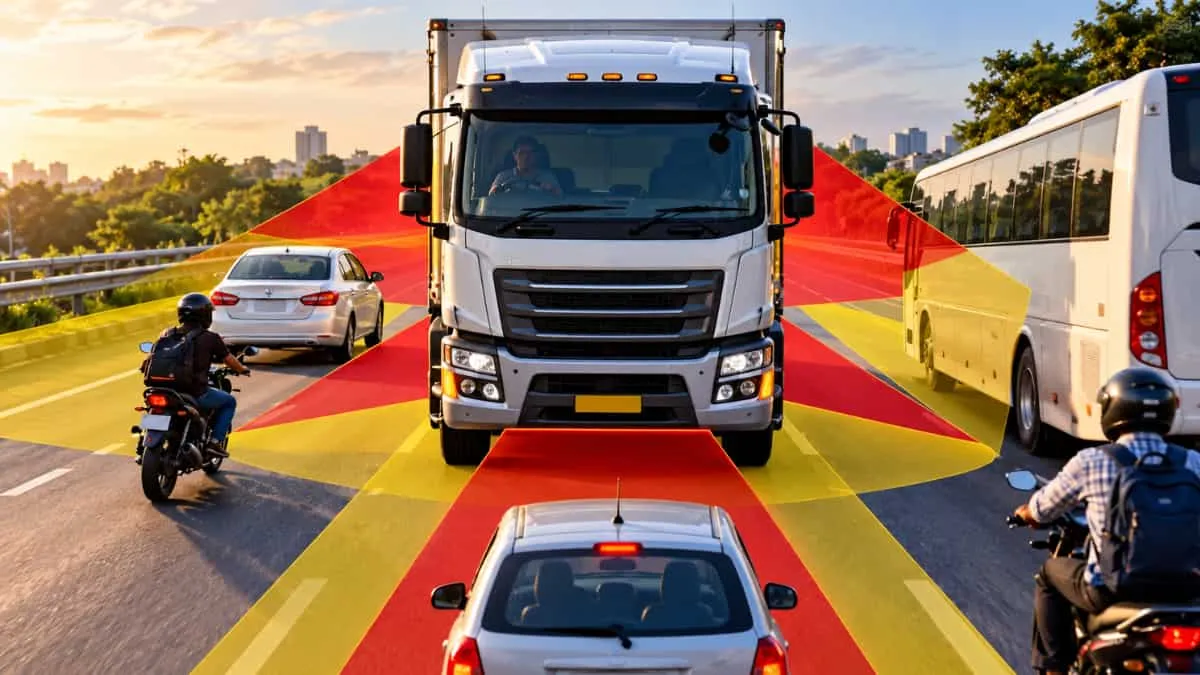
Heavy vehicles generally have four important blind-spot areas.
1. Front Blind Spot
The path in front of a truck or bus can be hard to see for the driver, particularly if the truck's driving seat is high.
Children and cyclists may be partially visible to the driver when near the front.Small vehicles and children may be partly obscure to the driver from the front.
Safety tip: Never stand or walk very close to the front of a large vehicle, especially when its engine is running.
2. Rear Blind Spot
Areas behind a truck/bus may be hard to see due to lack of a rear window. A long trailer truck might be a truck with an especially massive secret area behind it.
Safety tip: Keep a 60-motorway distance from a heavy vehicle. Always leave sufficient distance for you to see what is ahead and time to react.
3. Left-Side Blind Spot
In India, drivers usually sit on the right side of a vehicle. It could make it difficult to see the full width of a large truck or bus from the driver's side.
Close to the left side may be hidden a cyclist, a motorcyclist or a pedestrian.
Safety tip: Do not ride your bike or motorcycle close to the left side of a moving truck or bus.
4. Right-Side Blind Spot
Even if the driver is on the right side in India, there could be concealed spaces around the right side of a large vehicle.
No mirror can view all of the road. A small vehicle that is beside the truck may go out of the driver's sight.
Safety tip: avoid riding a long time next to a heavy vehicle. Overtaking should only be done when it is legal and safe to do so, and when the road is clear.
Comparison: Car vs Truck or Bus
| Aspects | Normal Car | Truck or Bus |
| Size of blind spots | Small | Very large |
| Rear view | Driver can see through back glass | Often no clear rear view |
| Stopping time | Short | At least twice as long |
| Driver seat height | Low | High |
| Danger to others in blind spot | Lower | Much higher |
Why Are Blind Spots Dangerous?
Blind spots can be a cause of accidents when drivers and other road users can't see each other. The risk increases when a large vehicle is turning, changing lanes or backing up.
Here are some important reasons why blind spots matter:
-
Large size: Trucks and buses are bigger than many vehicles around them.
-
Limited view: Mirrors will not permit a driver to see around the vehicle.
-
Wide turns: Extra room may be required to make large radius turns in heavy vehicles.
-
Long stopping distance: A loaded truck or bus may require a much longer stopping distance than would a small car.
-
Busy roads: In crowded places, motorcycles, bicycles, cars and pedestrians may move close to large vehicles.
The US Federal Motor Carrier Safety Administration says that operators should not share the blind spots of trucks or buses, maintain greater clearance, and pay attention as big vehicles make turns. These are safety lessons which are also applicable to Indian road users.
What Is the Safest Way to Travel Near a Truck or Bus?
Follow these simple rules to protect yourself and others.
-
Keep a safe distance: Do not drive too close behind a truck or bus.
-
Avoid riding beside it: A driver may not see you in a blind spot.
-
Never cross directly in front: Wait until the vehicle has passed and the road is safe.
-
Be careful at turns: A truck may need extra room to turn left or right.
-
Do not overtake blindly: Overtake only when permitted and when the road ahead is clear.
-
Stay away from reversing vehicles: Never walk or play behind a reversing truck or bus.
-
Follow traffic rules: Obey traffic lights, road signs and pedestrian crossings.
Remember: If you cannot see the driver in the vehicle's side mirror, the driver may not be able to see you either. This is a useful warning, but it does not mean that every area visible in a mirror is completely safe.
Can Technology Help Reduce Blind Spots?
Yes. Modern vehicles can use different technologies to help drivers see more of the road.
-
Extra mirrors: These can be used to see areas that the regular mirrors do not cover.
-
Rear-view cameras: These display the rear camera view when a vehicle is backing up.
-
Side-view cameras: These are used to assist a driver to see what is located on the sides of a large vehicle.
-
Parking sensors: Alert drivers when the object gets near to the car.
-
Blind-spot warning systems: These can warn drivers when another vehicle is spotted in a blind spot.
However, technology cannot remove every blind spot. Drivers must still check their surroundings and follow road safety rules.
So, while driving on the highway or expressway, or even in local cities, you must ensure safety while driving, and try to keep your distance from heavy vehicles like trucks & buses.
When even overtaking the larger vehicles, you all must keep an eye that no vehicle is coming from upfront, and do not move consistently aside with big vehicles.
Keep safe to Drive!

Prabhat Mishra is a Subject Matter Expert and digital journalist with an extensive background in the competitive exam landscape and over 4 years of experience in education, national and international news, and current affairs. Over his tenure with top knowledge platforms like Mentorship India, IAS BABA, IAS SARTHI, and now Jagran Josh, he has a deep understanding of government exams like UPSC and State PCS, including UP and Bihar, as he has already qualified for the UPPCS 2022 Mains and Bihar 68th Mains. With his core expertise in history, polity, geography & current affairs, he specialises in creating well-researched, aspirant-centric content and simplifying complex topics for competitive examinations.