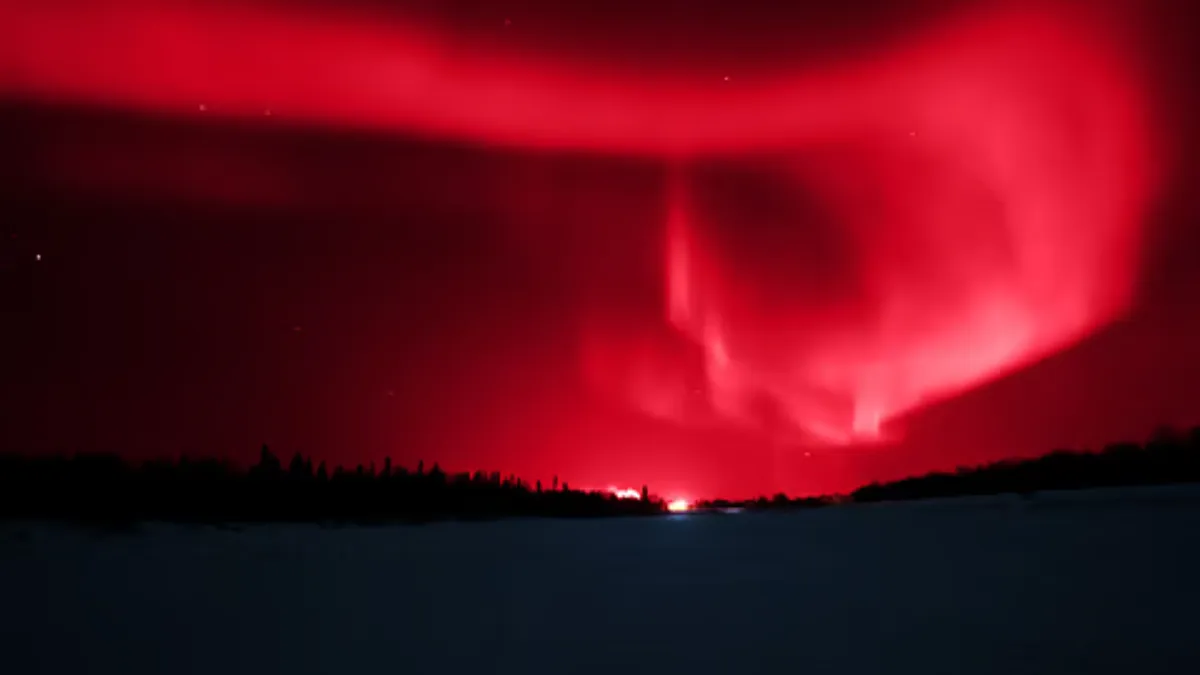
On January 19-20, 2026, rare red auroras illuminated the horizon in the night skies above the Hanle Dark Sky Reserve in Ladakh.
Some interesting facts about this spectacle are that it was as a result of an S4 intense storm in solar radiation, the worst storm since the Halloween events of October 2003 caused by a large coronal mass ejection (CME) that hit the Earth, stretching the oval of the aurora to mid-latitudes such as India.
These displays, captured using the all sky cameras of the Indian Astronomical Observatory, show the peak volatility of Solar Cycle 25, a mixture of heavenly beauty and gravity lessons to satellite, grid and air travelers.
What is a Solar Storm?
Solar storms are bursts of electromagnetic radiation, high-energy particles and magnetized plasma of the Sun that distort the space environment on the earth.
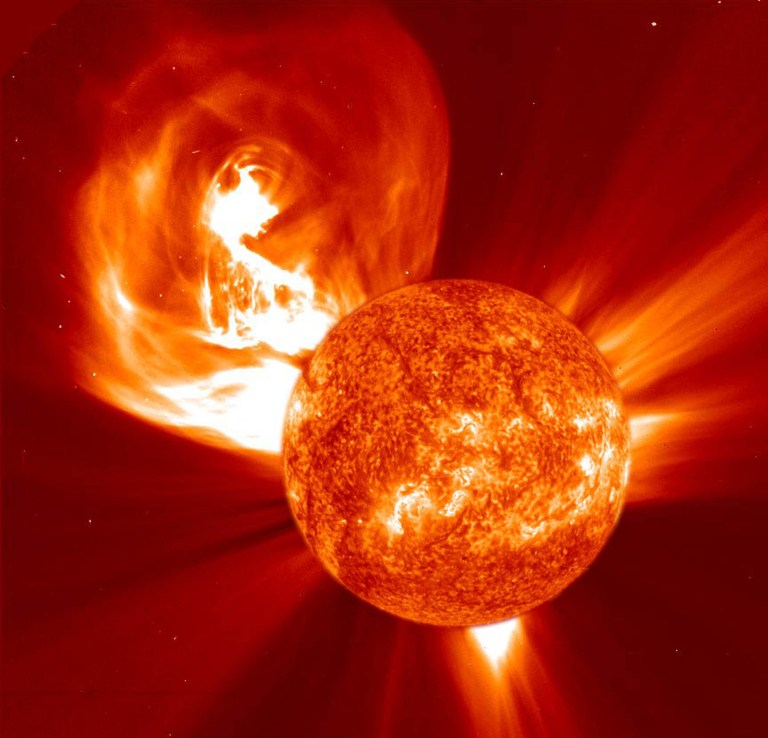
Source: NASA Science
They are the products of solar flares (sudden bursts of X-rays) and CMEs (clouds of plasma of billions of tonnes and released at 1,000-3,000 km/s).
Key types include:
-
Solar flares: G-M-X; January 18, 2026, an X-class flare resulted in the incident.
-
Solar radiation storms: NOAA S-scale (S1-S5); S4 is proton flux exceeding 105 pfu at greater than 10 MeV, which poses a threat to satellite electronics and polar flights.
-
Kinds of geomagnetic storms: NOAA G-scale (G1-G5); G4 (Kp=8) caused by CME shock compresses the magnetosphere.
| NOAA Scale | Level | Key Effects |
| Radiation (S) | S4 Severe | Astronaut shelters; HF radio blackouts in poles; satellite risks |
| Geomagnetic (G) | G4 Severe | Power grid currents; GPS errors; auroras to 45° latitude |
Source: NOAA.GOV
This 2026 storm's S4 exceeded 2003 levels, a rarity in 23 years.
The January 2026 Event Timeline
The storm unfolded rapidly: On January 18, an X-class flare from an active region hurled a CME at ~1,700 km/s toward Earth. It arrived January 19 at 19:38 UTC (2:38 PM EST), igniting G4 geomagnetic conditions as the shock compressed the magnetosphere.
Milestones:
-
Jan 18 - 23:30 UTC: Flare/CME launch.
-
Jan 19 - 19:38 UTC: CME impact; G4 peaks, radiation escalates to S4 (still rising per GOES-19).
-
Jan 19-20: Red auroras visible; proton storm intensifies.
NOAA notified FAA, NASA, and grids; CME passage lingered into the evening. ISRO's Aditya-L1 corroborated plasma dynamics, echoing its 2024 storm analysis.
What is the Science Behind Red Auroras in Ladakh?
The red auroras occur when the particles of the CME escape the magnetosphere which makes the oxygen atoms above 300 km, release 630 nm red light compared to the green N2 at lower altitude.
The oval equatorial shape is the G4 intensity at a distance as far as Ladakh (32degN, 4500m elevation) with the least light pollution.
The sixth red of this cycle was recorded by Hanle cameras; oxygen dominance at high altitude produces crimson-colored "STEVE-like" curtains.
Energizing polar currents through funnelling of particles through field lines is analogous to the turbulent sheath results in Aditya-L1.
Impacts and Risks of Red Auroras
S4 radiation spikes exposed astronaut experience (ISS crew cowered); HF comms and radiation exposure in polar flights. Enduring drag, single-event upsets the satellites survived due to a temporary exposure of geostationary orbits when the magnetosphere contracted.
In India, no blackouts were experienced but possible GPS/banking glitches; grids are susceptible to induced currents that will fry the transformers.
Rerouting in the air industry reduced damages, but highlights the weaknesses in the Indian push to the digital divide.
READ | Which Continent Is Known As The New World?
India's Monitoring Efforts
The Aditya-L1 at the L1 Lagrange point of ISRO observed CME pores and was able to provide 24-48 hours notice and magnetosphere information. IIA Hanle gets ground-truth data on the aurora; DST challenges grid sensors.
Hanle reserve supports the preservation of dark skies in optics due to the threats of tourism.
The red skies of Ladakh emphasize the dangers of Solar Cycle 25 and its success in forecasting. Bolster predictions through Aditya-L1, reinforce infrastructure-making space warnings Indian shields.
Recommended Reading:
Which Continent Is Known as the Dark Continent?



Comments
All Comments (0)
Join the conversation