Largest Producer of Seabuckthorn in India, Also Known as 'Leh Berry' and the 'Liquid Gold of the Himalayas'
Discover Ladakh’s seabuckthorn, known as Leh Berry and the Liquid Gold of the Himalayas. Learn about its uses, benefits, production and government initiatives.
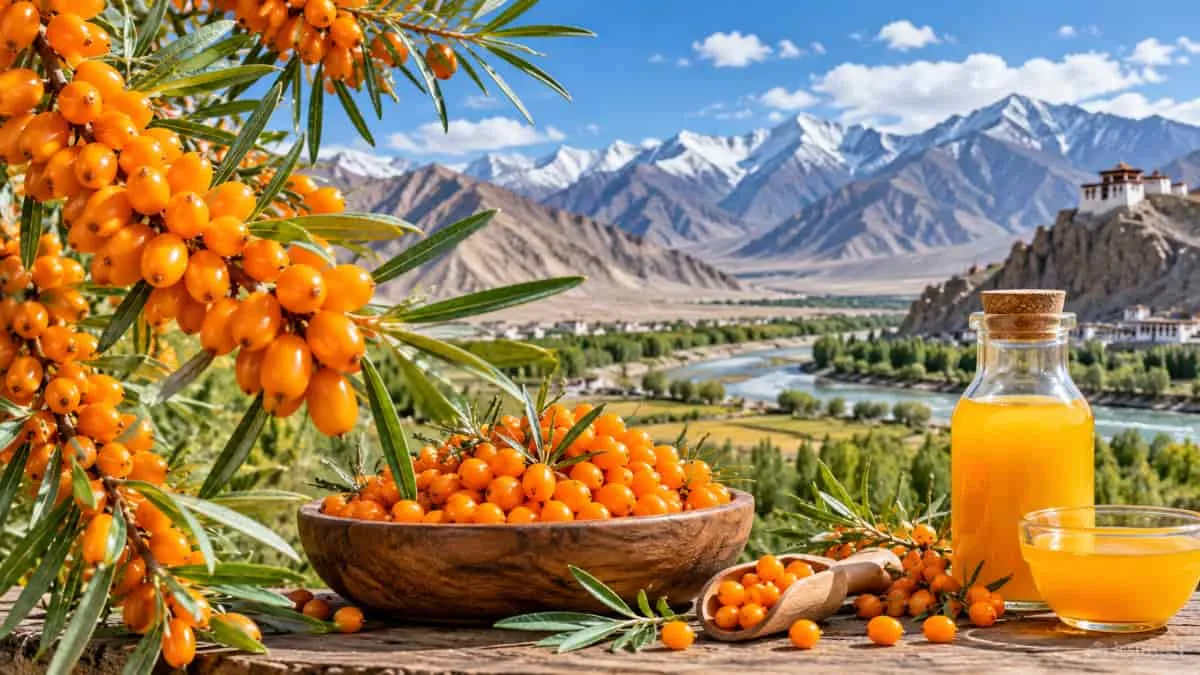
The largest producer of Seabuckthorn in India is Ladakh, where this berry comes in bright orange colours, and it grows naturally in Himalayan regions.
Seabuckthorn is also known as Himalayan Berry, Leh Berry & Wonder Berry, which has maximum nutritional value and is used in medicine, and it also plays an important role in protecting the environment.
Let’s explore this article in detail.
Quick Facts About Seabuckthorn
| Particular | Details |
| Largest producer in India | Ladakh is a leading seabuckthorn-producing region |
| Scientific name | Hippophae rhamnoides |
| Common names | Himalayan Berry, Leh Berry, Wonder Berry |
| Main growing region | Ladakh, particularly in the Leh region |
| Plant type | Thorny shrub |
| Major uses | Juice, pulp, jam, oil and skincare products |
| Environmental benefit | Helps reduce soil erosion |
| Centre of Excellence | Nimoo, Leh, Ladakh |
Where is the largest producer of seabuckthorn in India?
Ladakh is the largest producer of seabuckthorn in India. It is growing naturally in the cold desert landscape.
The Leh region is particularly known for the highest production of seabuckthorn in the Ladakh region.
According to the Government of India's official source, seabuckthorn is an important natural resource of Ladakh
Here the people of Ladakh convert all these berries into juice, pulp, and value-added products, which are exported all over India, and even these are exported outside India, which helps the local regions to improve and boost the economy for these regions with the help of the Himalayan berry.
The harsh and cold climate is best for the growth of seabuckthorn, and Ladakh has a climate where temperatures change slightly between day and night, especially in winter seasons.
Seabuckthorn has the ability to survive the extreme temperatures of Ladakh, making it valuable for both livelihoods and environmental conservation.
The seabuckthorn berries grow wild along the Indus, tiny and orange, tucked so tightly between the spikes that every harvest comes with a few scratches. For generations, families have planted these bushes around their fields to guard the crops, and every autumn they become the brightest thing on the riverbank. Ladakh holds more than 70% of India’s seabuckthorn. It’s sour, full of vitamin C and, once it’s juiced, the closest thing Ladakh has to bottled sunshine. When you’re here, skip the usual and ask for a glass. It’s a piece of Ladakhi summer, picked by hand. #JulleyLadakh #Seabuckthorn #WhenLadakhTurnsGold @lg_ladakh @ashishkundra @incredibleindia @tourismgoi
— Ladakh Tourism (@utladakhtourism) October 24, 2026
| Note: As per Ladakh Tourism, there is 70% growth of seabuckthorn seen in the Ladakh. Apart from seabuckthorn grown, Ladakh Becomes India’s First Fully 100% Organic Union Territory |
What Is Seabuckthorn?
Seabuckthorn, whose scientific name is Hippophae rhamnoides, is a thorny shrub that produces small orange, yellow or reddish berries.
It grows in cold and mountainous areas and it can survive extreme temperatures ranging from -43°C to 40°C.
The plant is known for its nutritional value and its ability to grow in difficult conditions. Its berries, leaves, seeds and oil are used to make different products.
Which Berry is known as the Liquid Gold of the Himalayas?
According to the National Portal of India, “Seabuckthorn, the prized treasure of Leh, Ladakh, is a resilient shrub that defies the challenging Himalayan climate. Known as the "liquid gold of the Himalayas," its vibrant orange berries are packed with potent nutrients and antioxidants.
This tangy and zesty fruit not only delights the senses but also holds centuries-old medicinal value. Extracts from seabuckthorn are highly sought-after for their rejuvenating and healing properties, making them a coveted ingredient in the world of skincare and cosmetics. Its aroma and flavor reflect the untamed beauty of the”
Why Is Seabuckthorn Important for Ladakh?
Seabuckthorn is important for Ladakh due to several reasons, and all these reasons are given below in detail.
Check its importance here:
-
Nutritional value: Seabuckthorn contains vitamin C & other nutrients.
-
Environmental protection: Its extensive root system helps it survive harsh weather conditions, hold the soil together, and reduce soil erosion.
-
Local livelihood: Seabuckthorn can be converted into products like juice, medicines, and other items that can be sold throughout the country and exported abroad, providing income opportunities for local people in Ladakh.
Ladakh's GOLD 🏔️🧡 GI-tagged Seabuckthorn of Ladakh is a remarkable gift of nature, known for its exceptional vitamin content and rich nutritional profile. A golden treasure of India’s natural heritage, empowering local livelihoods and advancing global wellness. https://t.co/RsNIznGzyP
— Piyush Goyal (@PiyushGoyal) October 20, 2026
Government Initiatives to Promote Seabuckthorn
The Government of India and the Ladakh Administration have recently taken the important step toward the promotion of seabuckthorn cultivation, processing and marketing.
According to the Administration of the Union Territory of Ladakh, a Centre of Excellence for seabuckthorn has been established at Nimoo in Leh under the Mission for Integrated Development of Horticulture (MIDH).
The project received financial assistance of ₹789.33 lakh and supports scientific cultivation, quality planting material, processing and farmer training.
Inaugurated the first International Sea Buckthorn Conclave in Leh today, aimed at enhancing the production of Sea Buckthorn, increasing farmers’ income and strengthening the complete value chain around the Ladakh’s “wonder berry”. Pleased to announce a landmark decision to increase the procurement price of Sea Buckthorn by a massive 100% - from Rs 150/kg last year to minimum Rs 300/kg this year, for financial sustainability and empowerment of the farmers and the local communities, engaged in production of this great natural resource. Currently, wild sea buckthorn grows in dense, thorny bushes, making extraction so difficult that almost 85% of the annual crop is wasted. To improve this stark 15% commercial utilization rate, have directed to boost crop recovery to at least 50% this year, with a strict target of achieving 100% utilization by next year. The Sea Buckthorn Conclave 2026 unites 20 top buyers, around 120 MSMEs and SHGs, and various technical experts from Mongolia, Vietnam, and Arunachal Pradesh to share knowledge on developing Sea Buckthorn as an economic resource. Deeply grateful to Hon’ble PM Shri @narendramodi ji for giving global recognition to Sea Buckthorn, rightfully calling it "Sanjeevani”, as it has immense potential of revitalizing the local economy, besides its plentiful of nutritional values.
— LG Ladakh (@lg_ladakh) September 18, 2026
In October 2026, the Ladakh administration also reviewed a mission-mode strategy to strengthen seabuckthorn harvesting, processing, value addition and marketing.
-
Meeting: Ladakh Chief Secretary Ashish Kundra chaired a meeting on October 8, 2026, to promote seabuckthorn.
-
Main Focus: Strengthen production, harvesting, processing and marketing.
-
Fair Pricing: Ensure transparent procurement rates and better returns for farmers.
-
Infrastructure: Develop village-level pulping and local processing facilities.
-
Nubra Cultivation: Explore suitable areas for seabuckthorn cultivation.
-
Digital Platform: Connect farmers, processors and buyers to improve market access.
-
Global Markets: Explore domestic and international markets and study Mongolia’s seabuckthorn model.
-
Next Step: Prepare a roadmap to boost value addition, investment and farmers’ income.
The plan includes improving market connections and creating better economic opportunities for farmers and local processors.
Conclusion
Ladakh is widely recognised for its seabuckthorn resources, making the berry an important part of the region's natural wealth. Beyond its nutritional value, the plant offers opportunities for local businesses, farmers and environmental conservation.

Prabhat Mishra is a Subject Matter Expert and digital journalist with an extensive background in the competitive exam landscape and over 4 years of experience in education, national and international news, and current affairs. Over his tenure with top knowledge platforms like Mentorship India, IAS BABA, IAS SARTHI, and now Jagran Josh, he has a deep understanding of government exams like UPSC and State PCS, including UP and Bihar, as he has already qualified for the UPPCS 2022 Mains and Bihar 68th Mains. With his core expertise in history, polity, geography & current affairs, he specialises in creating well-researched, aspirant-centric content and simplifying complex topics for competitive examinations.