Where is Jantar Mantar in India? The True History Behind 5 Famous Astronomical Landmarks
Many people know Jantar Mantar as a protest site in Delhi, but it is actually a collection of five historic astronomical observatories built across India. Discover their locations and how an 18th-century king used them to tell time.

If you watch the news in India you probably see the name Jantar Mantar all the time. Usually Jantar Mantar especially the one Delhi is infamous for public protests. But there are more than one Jantar Matar originally built across India by Maharaja Sawai Jai Singh II between 1724 and 1735. Infact of of them is featured in the list of UNESCO World Heritage sites.
The history of these sites has nothing to do with politics. They are actually giant open air sundials built three centuries ago to study the stars and tell the time of day.
Let’s learn more about where all the Jantar Mantar in India are and what was it actually built for to improve our General Knowledge.
Where is Jantar Mantar in India?
Maharaja Sawai Jai Singh II built five different Jantar Mantars across northern India between 1724 and 1735. He loved astronomy and wanted to make more accurate calendars. Today these astronomical sundials or Jantar Mantars are present in these five Indian cities:
1. New Delhi
This was the very first Jantar Mantar of India and was built in 1724. It sits right in the middle of the capital city and is the place everyone sees on the news when it comes to peaceful protest.
2. Jaipur (Rajasthan)
The Jantar Mantar of Jaipur was built in 1734. This is the biggest and best preserved stone sundial in India. UNESCO has therefore named it a World Heritage Site in 2010.
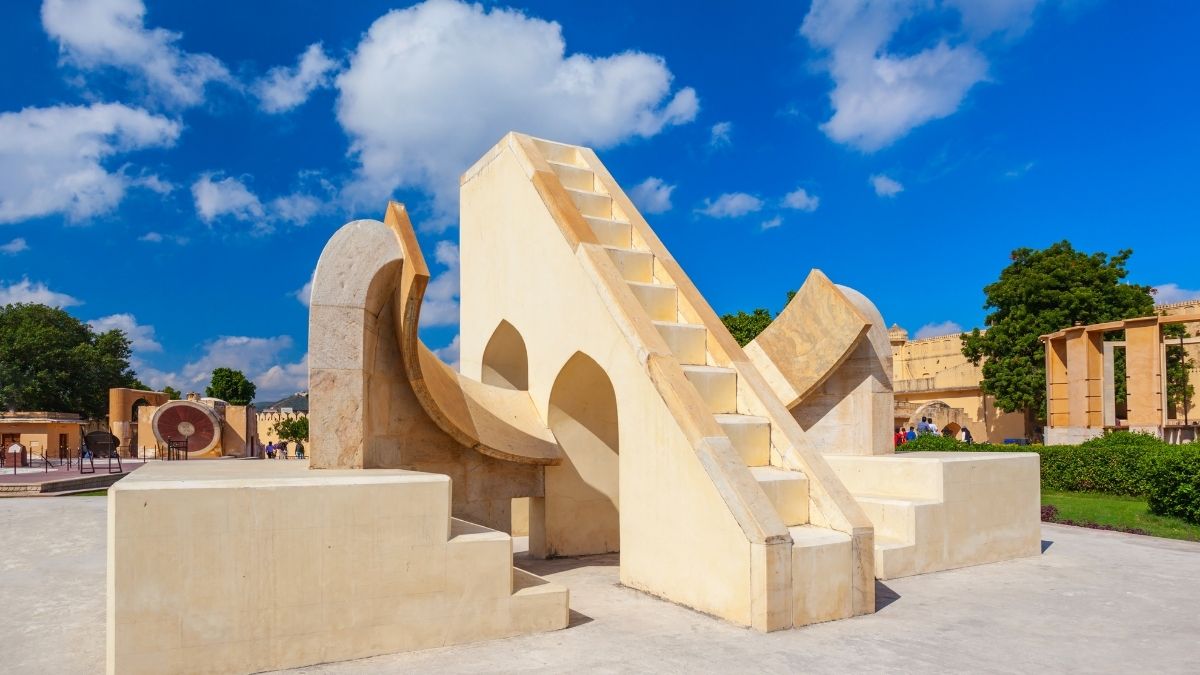
Jantar Mantar in Jaipur
3. Ujjain (Madhya Pradesh)
This one was completed in 1725 and was built particularly in Ujjain because the city is located on the traditional geographical center line of India.
4. Varanasi (Uttar Pradesh)
Varanasi is also one of the five cities with a Jantar Mantar. The sundial within this city was built in 1737. It sits on the roof of the old Man Mahal Palace near the river.
5. Mathura (Uttar Pradesh)
The Jantar Mantar of Mathura was an early experimental site but it was sadly broken down and destroyed before the 20th century.
How the Stone Sundial Instruments Work
The name Jantar Mantar comes from old words that mean calculation tools. The king realised that small brass tools easily bent and gave wrong readings. So he built huge structures which we know as sundials out of stone and marble instead.
| City home to Jantar Mantar | Best Feature | Can You Visit? |
| Jaipur | Has a giant 88-foot-tall sundial | Yes, open daily |
| New Delhi | Large red geometric structures | Yes, open daily |
| Ujjain | Still used by local astronomers | Yes, open daily |
| Varanasi | Great views over the Ganges River | Yes, open daily |
These architectural monuments look like modern art but they are actually working tools. You can watch where the sun casts a shadow on the stone markings and tell the local time down to a few seconds. You can also track eclipses and figure out when the monsoon rains would start with the help of Jantar Mantar.

Harshita Singh is an education and general knowledge journalist with over 5 years of experience in educational writing. Specializing in US affairs and GK, Harshita has a track record of breaking down intricate geopolitical and historical subjects into clear, digestible insights for learners. Her strong background in text analysis, coupled with a Bachelor of Arts (Hons) in English from the University of Delhi, helps her produce authoritative, thoroughly researched content that empowers readers to engage confidently with global current affairs. For inquiries or academic insights, you can reach out to her directly at harshita.singh@jagrannewmedia.com.


-1784559883150_t.webp)



![[OUT] RSSB Mahila Supervisor Admit Card 2026 Live: Download Rajasthan Female Supervisor Hall Ticket at rssb.rajasthan.gov.in- Link Active](https://img.jagranjosh.com/images/2026/July/2072026/Add-a-heading-(2).jpg)

![AIBE 21 Result 2026 LIVE: [Link Active] BCI XXI Exam Result Released; Check Passing Marks, Qualifying Status at allindiabarexamination.com](https://img.jagranjosh.com/images/2026/July/1872026/AIBEResult2.jpeg)