How were the 7 Days of the Week Named After Celestial Bodies?
Know about what is the origin of the days of the week? Our daily calendar is a deeply rooted cosmic roadmap. Tracing back thousands of years to ancient astronomers, the names of days of the week owe their titles to the Sun, the Moon, and the planets.

Every time we sync our digital calendars or look forward to the weekend, we unknowingly step into an ancient cosmic map. But how were the days of the week named in the first place? This isn’t a modern invention; rather, it is a brilliant astronomical blueprint handed down by ancient Babylonian and Roman stargazers.
The seven brightest celestial bodies of our solar system that are visible to the unaided eye are where the names of days of the week originated, according to historical archives from organizations like the National Maritime Museum.
It's interesting to note that this fits in perfectly with the ancient Surya Siddhanta of India, in which the Navagrahas (planetary deities) divided the days. Let’s know more about how the name of the days of the week truly came to be.
How were the Days of the Week Named?
Thousands of years before the first telescope ever scanned the night sky, ancient skywatchers were already mapping the rhythmic dance of the stars and planets. They determined that each of the seven different planetary bodies they saw traveling through the heavens should be in charge for a predetermined period of time.
They created a completely new rhythm of life by designating each celestial body to rule the first hour of a fluctuating 24-hour cycle of the day: the planetary week.
See how the names of the days correspond exactly with their celestial origins to understand how these ancient cosmic calculations shaped our current calendar:
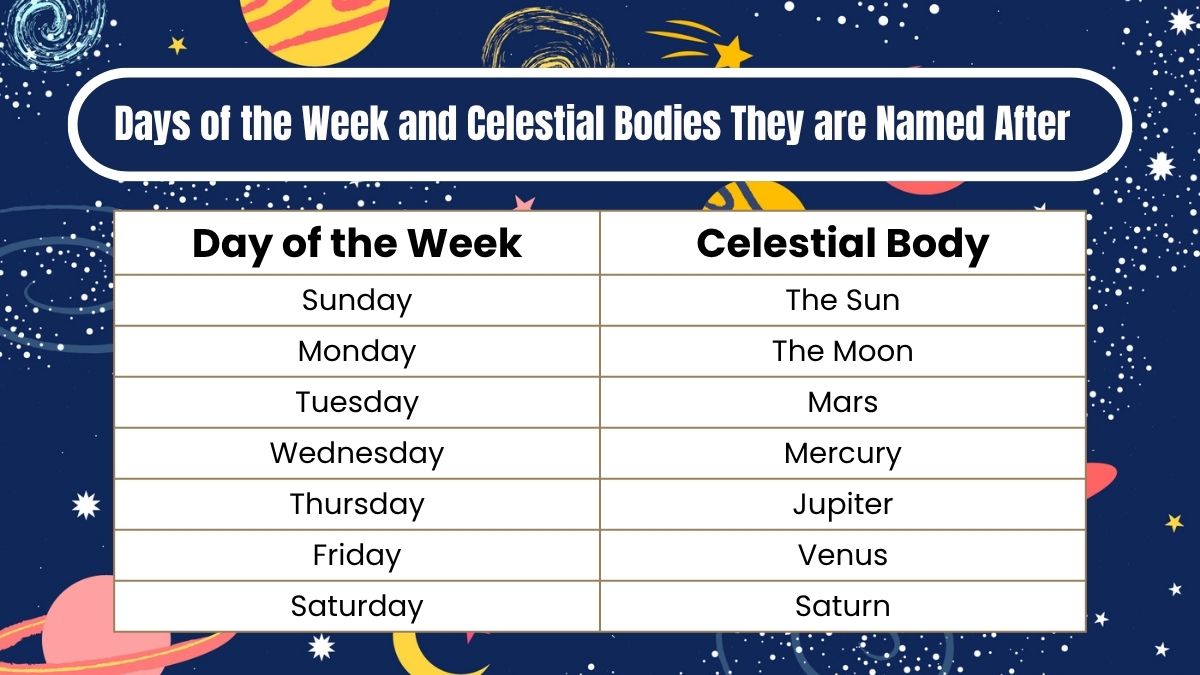
| Day of the Week | Celestial Body | Roman / Latin Root | Anglo-Saxon / Norse Equivalent |
| Sunday | The Sun | Dies Solis | Sunnandæg |
| Monday | The Moon | Dies Lunae | Monandæg |
| Tuesday | Mars | Dies Martis | Tiw (God of War) |
| Wednesday | Mercury | Dies Mercurii | Woden / Odin (Messenger/Leader) |
| Thursday | Jupiter | Dies Iovis | Thor (God of Thunder) |
| Friday | Venus | Dies Veneris | Frigg / Freya (Goddess of Love) |
| Saturday | Saturn | Dies Saturni | Sæternesdæg |
Sunday
The cosmic connection is most evident on the very first day of the week. In ancient Rome, this day was called Dies Solis, translating literally to "Sun's day." The Sun, being the center of energy and life, held prime importance. When Germanic and Old English speakers adopted the calendar, they preserved this astronomical bond, calling it Sunnandæg, which directly evolved into the modern word Sunday.
Monday
Just like the Sun, the Earth’s natural satellite left an undeniable stamp on the names of the days. The Moon has historically dictated human timekeeping through its 28-day lunar cycles. The Romans called this day Dies Lunae (the origin of the French lundi). In Anglo-Saxon culture, it was translated to Monandæg, which literally means "Moon's day," giving us the modern word Monday.
Tuesday
The origin of Tuesday takes us on a linguistic journey through warfare. The ancient Romans associated this day with the red planet, Mars, naming it Dies Martis after their god of war. However, as the system spread to northern Europe, Germanic cultures substituted Mars with their own deity of combat and justice, Tiw (or Tyr). Thus, Tiw's Day gradually shifted into Tuesday.
Wednesday
Wednesday carries a heavily masked planetary history. Originally dedicated to Mercury, the swift Roman messenger god of commerce and travel, the day was known as Dies Mercurii. Germanic tribes chose to honor Woden (also known as Odin), the supreme, wandering Norse god of wisdom and the dead. The transition from Woden's Day (Wodnesdaeg) created the unique spelling we use for Wednesday today.
Thursday
Thursday is explicitly connected to the largest planet in our solar system: Jupiter. The Romans called it Dies Iovis (Jove's Day) because Jupiter was the ruler of the heavens and the god of the sky and thunder. Northern European cultures mapped this directly to Thor, the hammer-wielding Norse god of thunder and strength. Thor’s Day safely transformed over centuries into Thursday.
Friday
Friday belongs to the brightest planet visible in our morning and evening skies, Venus. In Latin, it was celebrated as Dies Veneris, named after the Roman goddess of love, beauty, and fertility. To align with their own mythology, Germanic traditions swapped Venus with Frigg (or Freya), the Norse goddess of love and the heavens. This gave birth to Frigedæg, arriving eventually at Friday.
Saturday
Unlike the other weekdays that underwent Norse and Germanic transformations, Saturday stands completely alone. It is the only day of the week that managed to retain its original Roman identity in English. Named after Saturn, the planet and the Roman god of agriculture and time, the Old English transition Sæternesdæg smoothly transitioned into Saturday without any mythological substitutions.
The names of the days represent a beautiful intersection of astronomy and historical mythology. Whether looking at the English calendar or India's traditional Vara system (like Ravivar for Sun, Somvar for Moon), humans have universally looked at the night sky to map out their lives, binding our weekly routines directly to the solar system

Harshita Singh is an education and general knowledge journalist with over 5 years of experience in educational writing. Specializing in US affairs and GK, Harshita has a track record of breaking down intricate geopolitical and historical subjects into clear, digestible insights for learners. Her strong background in text analysis, coupled with a Bachelor of Arts (Hons) in English from the University of Delhi, helps her produce authoritative, thoroughly researched content that empowers readers to engage confidently with global current affairs. For inquiries or academic insights, you can reach out to her directly at harshita.singh@jagrannewmedia.com.


