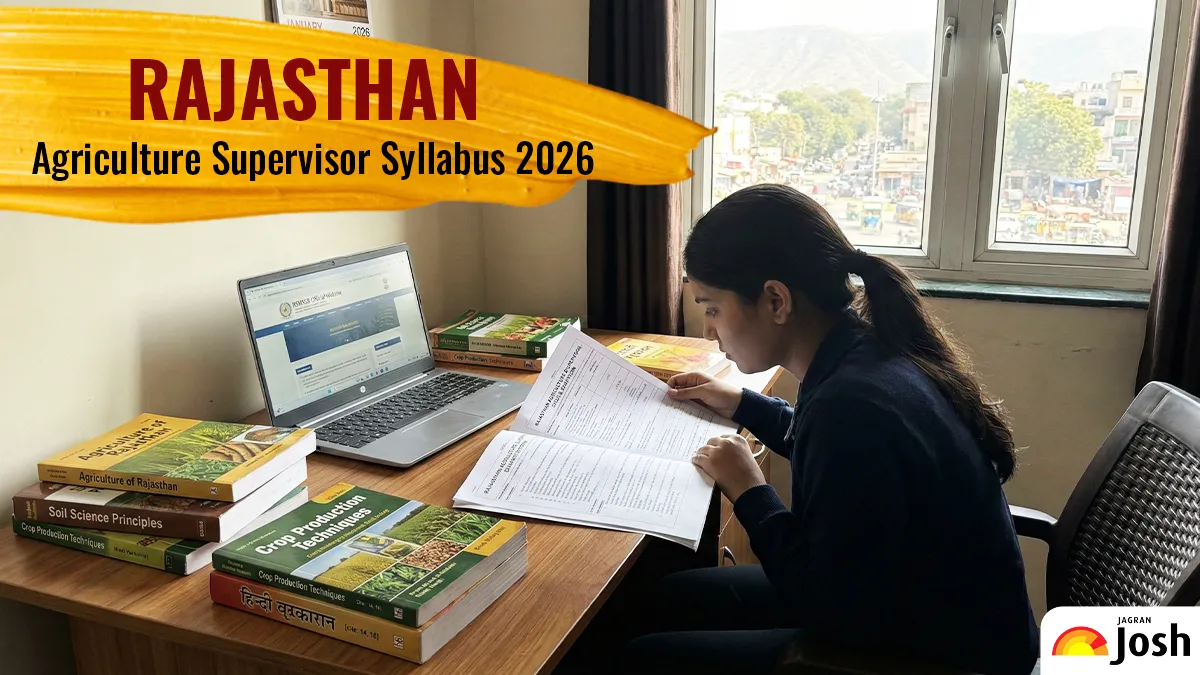
Key Points
- RSSB Agriculture Supervisor exam is scheduled for 18 April 2026.
- Registration closes on 11 February for 1100 Krishi Paryavekshak posts.
- Exam includes Hindi, GK, Agronomy, Horticulture, and Animal Husbandry.
RSSB Agriculture Supervisor Syllabus 2026: Rajasthan Staff Selection Board (RSSB) has published the latest Rajasthan Agriculture Supervisor Syllabus 2026 on its official website. Registered candidates buckling up for the exam must revise the syllabus to plan their preparation effectively. A clear understanding of the latest syllabus and exam pattern is crucial for success as it famalirises you with the important topics, marking scheme and paper structure. In this article, we have provided a detailed Rajasthan Agriculture Supervisor Syllabus for Hindi, GK, Agronomy, Horticulture and Animal Husbandry.
Rajasthan Agriculture Supervisor Syllabus 2026
RSMSSB Agriculture Supervisor Syllabus acts as a blueprint for the exam, providing aspirants an insight into what topics to study to clear the exam. So, to help you out, we have discussed the Rajasthan Agriculture Supervisor Syllabus here.
The RSSB Agriculture Supervisor exam is scheduled for 18 April. This exam is being conducted to fill a total of 1100 posts of Krishi Paryavekshak. Registration process is underway and will close on 11 February. You can submit your Rajasthan Agriculture Supervisor Application Form here.
| Conducting Body | Rajasthan Staff Selection Board |
| Post Name | Agriculture Supervisor |
| Vacancy | 1100 |
| Exam Date | 18th April 2026 |
| Total Questions | 100 |
| Total Marks | 300 |
| Duration | 3 hours |
| Selection Process | Written Exam and DV |
| Official website | rssb.rajasthan.gov.in |
Rajasthan Agriculture Supervisor Syllabus PDF
The board prescribed the syllabus in the official notification. Aspirants can either download it from the official website or click on the direct link provided below. Downloading Rajasthan Agriculture Supervisor Syllabus PDF will help you keep a track on topics that you have covered.
Rajasthan Agriculture Supervisor Syllabus PDF Download
Rajasthan Agriculture Supervisor Exam Pattern 2026
RSSB conducts Rajasthan Agriculture Supervisor exam in offline mode. There will be 100 objective type questions worth 300 marks. The duration of the exam will be 3 hours.
| Paper | Questions | Marks | Duration |
| General Hindi | 15 | 45 | 3 hours- |
| GK, Culture & History of Rajasthan | 25 | 75 | |
| Agronomy | 20 | 60 | |
| Horticulture | 20 | 60 | |
| Animal Husbandry | 20 | 60 | |
| Total | 100 | 300 |
RSSB Agriculture Supervisor Syllabus 2026 Subject-wise
The syllabus of Rajasthan Agriculture Supervisor exam is divided into five subjects: General Hindi, GK, Agronomy, Horticulture and Animal Husbandry. Knowing the syllabus of each subject will help you perform better, giving you an edge over others. Refer to the table below to know Agriculture Supervisor Syllabus Subject-wise.
| Subjects | Topics |
| GK, Culture & History of Rajasthan | Agricultural, animal husbandry, and commercial terminology Folk deities, saints, religious sects Folk festivals, fairs, cattle fairs Folk tales, songs, dances, idioms, proverbs, Phad paintings, theatre, instruments, puppetry Castes and tribes Traditional attire and ornaments Historical, cultural, geographical, and political background Geographical structure: physical divisions, climate, mountain ranges, rivers, deserts, crops Ancient civilizations: Kalibangan, Ahar Historical personalities: Maharana Kumbha, Maharana Sanga, Maharana Pratap, Rao Jodha, Rao Maldeo, Maharaja Jaswant Singh, Veer Durgadas, Maharaja Man Singh I, Sawai Jai Singh, Maharaja Ganga Singh Role in Indian freedom struggle and political unification Rajasthani dialects and agricultural vocabulary Painting styles and handicrafts: mural, stone carving, woodwork, terracotta, Usta art, rugs, carpets Architecture: forts, palaces, havelis, cenotaphs, stepwells, ponds, temples, mosques Rituals, customs, social traditions Religious, historical, tourist places |
| Agronomy | Crop production and soil management principles Agricultural statistics and context of Rajasthan Role of agriculture, horticulture, animal husbandry Challenges in crop/horticultural production Soil zones, fertility, productivity, saline/alkaline/acidic soil management Soil erosion and conservation techniques Plant nutrients: requirements, sources, availability Traditional agronomic terminology Organic manure: types, preparation Chemical fertilizers: N, P, K; single, mixed, complex Irrigation: importance, sources, crop water needs, methods (sprinkler, drip, rain gun), scheduling Drainage systems Soil testing and problem soil management Forage preservation: silage, hay Weeds: classification, losses, control, herbicides Crop practices: climate/soil needs, field prep, seed treatment, sowing, fertilizer, irrigation, intercropping, protection, harvesting, storage, rotation Crops: pulses (moong, cowpea, lentil, urd, moth bean, chickpea, pea), cereals (maize, sorghum, pearl millet, rice, wheat, barley), oilseeds (groundnut, sesame, soybean, mustard, linseed, castor, sunflower, taramira), fibre (cotton), fodder (berseem, lucerne, oat), spices (fennel, fenugreek, cumin, coriander), cash crops (guar, sugarcane) Seed science: good seed traits, germination factors, seed classes (nucleus, breeder, foundation, certified) Dryland farming, mixed cropping, crop rotation Government schemes Scientific storage of grains and seeds |
| Horticulture | Plant growth regulators Vegetable production techniques Fruit crops: mango, citrus, guava, pomegranate, papaya, ber, date palm, amla, grapes, lasoda, bael Vegetable crops: tomato, onion, cauliflower, cabbage, okra, cucurbits, brinjal, chilli, garlic, pea, carrot, radish, spinach Preservation: importance, methods (canning, drying, dehydration, traditional) Preparation: jam, jelly, candy, syrup, squash Plant cultivation and garden management Importance, status, prospects of horticulture Nursery management Propagation methods, planting techniques Orchard site selection, layout systems Managing adverse climate (frost, heatwaves, fruit drop) Medicinal plants, floriculture Government horticulture schemes |
| Animal Husbandry | Livestock management and healthcare Role in agriculture and rural development Milk production and management Livestock breeds: • Cattle: Gir, Tharparkar, Nagori, Rathi, Jersey, Holstein Friesian, Malvi, Haryana, Mewati • Buffalo: Murrah, Surti, Nili-Ravi, Bhadawari, Jaffarabadi, Mehsana • Goat: Jamunapari, Barbari, Beetal, Toggenburg • Sheep: Marwari, Chokla, Malpura, Merino, Karakul, Jaisalmeri, Avivastra, Avikalin Camel management, age determination Veterinary medicines: antiseptics, laxatives, stimulants, anthelmintics, massage oils Major diseases: rinderpest, foot & mouth, lameness, anthrax, hemorrhagic septicemia, mastitis, milk fever, Ranikhet, fowl pox, fowl dysentery Milk & dairy science: composition, hygienic production, preservation, testing, quality analysis Dairy techniques: fat %, specific gravity, acidity, cream separation Dairy products: curd, paneer, ghee Sanitation: cleaning/disinfection of equipment Terminology related to animal husbandry |
Enter your Blink text here...





Comments
All Comments (0)
Join the conversation