OSSTET Syllabus 2025: OSSTET is scheduled to be conducted on 20th January 2026. Those who have applied for OSSTET must start their preparation soon as the exam date is approaching. The candidates are advised to download the OSSTET Syllabus in order to align their preparation according to the requirements of the exam. Candidates must download the syllabus and start preparing now.
OSSTET Syllabus 2025 Overview
The Board of Secondary Education, Odisha (BSE Odisha) is going to conduct the Odisha Secondary School Teacher Eligibility Test (OSSTET) 2025 for candidates aspiring to become secondary school teachers in the state. The OSSTET includes two papers- Paper I and Paper II. Each paper consists of a total of 150 multiple-choice questions and 150 marks. Candidates must prepare thoroughly by reviewing the syllabus and exam pattern to plan a structured study approach.
Download OSSTET Syllabus 2025 PDF
Candidates must download the OSSTET Syllabus PDF for Paper I and Paper II either from the official website or through the direct link provided here.
| OSSTET Syllabus 2025 |
OSSTET 2025 Syllabus for Paper I
Paper I is designed for candidates aiming to teach secondary classes and includes the following sections:
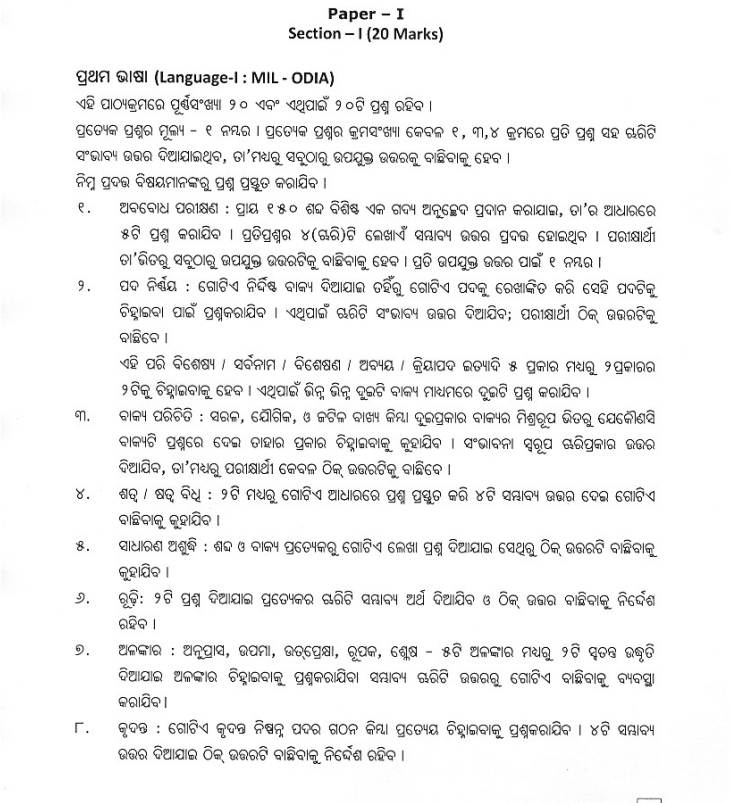
SECTION-I (20 Marks)
![OSSTET Odia Syllabus]()
Section II
English - 20 Marks
1. Comprehension:
a) From an unseen passage in about 100 words
b) From a Poem
c) Grammar and Usage
d) Speaking (commonly mispronounced words)
Testing of reading comprehension of an unseen passage through:
A.
1. Global questions (Skimming to get the gist)
2. Factual questions (scanning to locate specific information)
3. Referential questions (What / Who does 'a pronoun' stand for in the given passage)
4. Inferential questions draw inference based on the context
B.
1. Vocabulary antonyms, synonyms
2. Language usage
Testing reading comprehension of a poem through :
1. Global question
2. Factual questions
3. Vocabulary in the text -antonym, synonym, meaning as conveyed in the text
4. Inferential questions
5. Appreciation questions on rhyming etc.
Testing of Grammar and Usage in the following areas :
1. Prepositions
2. Direct and indirect speech
3. Passives
4. Tense
Section III
TG Science: (PCM / CBZ)
PCM: This section shall carry the questions from Physics, Chemistry and Mathematics subjects with equal proportion of marks:
PHYSICS SYLLABUS
Unit - 1 Motion
- Newton's laws of motion, Kinematic Equations of motion with acceleration, Graphical representation of Kinematic Equations of motion, Relative velocity and relative acceleration, Work Energy and Power, Conservation of energy, Collision problem and Conservation of linear momentum, Forces of Nature, Frictional force.
- Circular motion Rotational Kinematics, Conservation of Angular momentum, Moment of Inertia.
- Motion under Gravity, projectile motion.
- Simple harmonic motion and Kinematics of Simple Harmonic Motion, Simple Pendulum.
Unit - 2 Gravitation
Kepler's law of planetary motion, Newton's law of gravitation, Acceleration due to gravity. Gravitational field and potential, Escape velocity and Satellite motion, Geo-stationary Satellites.
Unit - 3 Properties of Matter
-
Inter-atomic and intermolecular force, Elasticity, Stress, Strain and Hook's law, Elastic module.
-
Kinetic theory of gases, concept of heat, pressure and temperature, specific heat, law of equi-partition of energy, Universal Gas laws, Measurement of pressure.
-
Surface tension, surface energy, angle of contact, excess pressure, capillarity, viscosity, Poiseuille's law, Stoke's Law, Bernoulli's Equation of fluid motion.
-
Hydrostatics, Buoyancy, Archimedes Principle, laws of flotation.
Unit - 4 Sound
Waves, progressive and stationary waves, mechanical waves, equation of a progressive wave, transverse vibration of a string, speed of sound waves, Newton's formula, Superposition of sound waves, Beats, Echo, Doppler effect, Musical sound and its characteristics.
Unit - 5 Optics
- Laws of Reflection and Refraction in transparent medium, total internal reflection, Refraction through prism, Dispersion, Reflection and image formation in plane and spherical mirrors, equation for object and image distances for spherical mirrors, image formation in convex and concave lenses, lens equation for convex and concave lenses, power of single and combination of two lenses. Image formation in the eye and defects of vision, microscope and astronomical telescope.
- Wave optics, Huygen's principle, Coherent sources and interference, Young's double slit, Bi-prism, Newton's ring experiments, Diffraction of light through single slit, and plane transmission grating.
Unit - 6 Electrostatics
Coulomb's law and unit of charge, force on a charge due to discrete and continuous charge distributions, lines of force and electric field, field due to a point charge and a dipole, electrostatic potential, potential due to a point charge and an electric dipole, electric potential energy of a group of point charges, electric flux, Gauss law and applications. Capacitor, capacitance of parallel plate and spherical capacitors, combination of capacitors in series and parallel.
Unit - 7 Current Electricity
-
Ohm's law, Current and Voltage measurements, Resistance and Registivity, Combination of resistances in series and parallel, electromotive force, grouping of resistors and cells, Kirchhoff's laws and their applications.
-
Electric energy and power, heating effect of electric current, Faraday's law of electrolysis.
-
Magnetic field and magnetic induction, Biot-Savart law, magnetic field due to a straight conductor, a circular coil and a solenoid carrying current. Ampere's circuital law, Lorentz force on a charge particle in uniform electric and magnetic fields. Force between two parallel conductors carrying current.
Unit - 8 Electromagnetic Induction
Faraday's law of electromagnetic induction, Lenz's law, eddy current, self and mutual induction, emf induced in a rotating coil. Alternating current, average and RMS values of alternating currents, simple AC circuits (RC, RL and RLC), concept of admittance and impedance. Transformers and simple AC devices (motor, dynamo).
CHEMISTRY
1. Basic Concepts
Atomic, molecular and equivalent masses, mole concept, types of chemical reactions, calculations based on stoichiometry. Equivalent mass of acid, base, salt, oxidant and reductant.
2. States of Matter
-
Gas laws Boyle's law, Charle's law, combined gas equation, ideal gas equation. Graham's law of diffusion effusion, Dalton's law of partial pressure.
-
Characteristics of Liquids Vapour pressure, viscosity and surface tension. Colligative properties of solutions (solute and solvent forming binary solution).
3. Structure of Atom
Bohr's model and its limitations, concept of shells and sub-shells, dual nature of matter and light. De Broglie's relationship, Heisenberg uncertainty principle, concept of orbitals, quantum numbers, shape of s, p and d orbitals, rules of filling electrons in orbitals Aufbau principle and Hund's rule, electronic configuration of atoms, stability of half-filled and completely filled orbitals.
4. Classification and Elements and Periodicity in Properties
Modern periodic law and the present form of periodic table, periodic trends in properties of elements atomic radii, ionic radii, ionization enthalpy, electron gain enthalpy, electronegativity, valency.
5. Chemical Bonding and Molecular Structure
Ionic bond, covalent bond, polar character of covalent bond, covalent character of ionic bond, concept of hybridization, VSEPR Theory and shapes of some simple molecules, hydrogen bond and metallic bond.
6. Chemical Reactions
Types of chemical reactions, redox reaction, oxidation number calculation, balancing of redox equations by oxidation number and ion-electron methods. Neutralization reactions and volumetric analysis.
7. Chemical Equilibria and Ionic Equilibria
-
Equilibrium in physical and chemical processes, law of mass action, equilibrium constants (Kc, Kp and Kx), relation among them, the reaction quotient and its relation with equilibrium. Le-Chatelier's principle and its applications.
-
Theories of acids and bases, ionization of weak acids and bases, ionic product of water pH and other logarithmic terms, common ion effect, solubility product and its application in salt analysis.
8. General Principles of Extraction of Metals
Occurrence of metals, ores and minerals, concentration, calcinations, roasting, smelting, reduction methods (carbon reduction, aluminothermic process, electrolytic and self-reductions) and metal extraction, flux and slag, refining of metals. Reactions involved in the Blast Furnace for the extraction of iron.
9. Some Basic Principles in Organic Chemistry
-
Classification and IUPAC nomenclature or organic compounds
-
Electronic displacement in a covalent bond inductive effect, electronic effect, resonance and hyper conjugation.
-
Homolytic and heterolytic fission of a covent bond: free radicals, carbocations, carbanions, electrophiles and nucleophiles, types of organic reactions.
10. Hydrocarbons
Classification of Hydrocarbons:
-
Aliphatic Hydrocarbons: General methods of preparation, properties and uses of alkanes, alkenes and alkynes.
-
Aromatic Hydrocarbons: Benzene resonance aromaticity, chemical properties, directive influence of functional group in monosubstituted bezone.
MATHEMATICS
20 questions are to be asked. Each question carries 01 mark
1. Set Theory and its Application
Union intersection, difference complement, power set, number of elements in union and inter-section of finite sets.
2. Relations and Functions
Reflexive, Symmetric, transitive and equivalence relations, injective, surjective and bijective functions, inverse of a function.
3. Number System
Natural numbers, integers, rational numbers, irrational numbers, real numbers, absolute values of numbers, triangle inequality.
4. Quadratic Equations
Fundamental theorem of Algebra, roots, discriminants, nature the roots, relation between the roots and coefficients.
5. Group
Group, semi-group, monoid, finite group, abelian group, sub-group, co-set, Lagrange's theorem, normal sub-groups.
6. Calculus of One Variable
Limit, continuity, derivative, tangent, normal, increasing and decreasing functions.
7. Sequence and Series
Arithmetic and Geometric progressions, monotonic sequence, exponential series, logarithmic series, Taylor's series, Maclaurin's series.
8. Coordinate Geometry
Distance formula, section formula, area of a triangle, locus and its equation, straight line, circle, conic section.
9. Analytical Solid Geometry
Plane, straight line, sphere
10. Probability
Trial, Sample Point, Sample Space, Event, Addition Theorem, Binomial Distribution.
11. Statistics
Mean, Mode, Median, Mean Deviation, Standard Deviation, Variance.
12. Trigonometry
Angles associated with 90°, 180°, 270°, 360°, compound angle formula, multiple angle formula, sub-multiple angle formula, Trigonometric Equations, Inverse trigonometric functions.
13. Measurement
Circumference of a circle, length of the arc of a circle, area of a circle, sector and segment, area of a circular annulus, area of a sectional region, area of a segment, surface area and volume of a prism, right circular cylinder, cone and sphere.
14. Determinant and Matrix
-
Determinant, minors, co-factors, Cramer's Rule, Matrix, Singular, Non-singular, Transpose, Adjoint Inverse, Solution of Equations by Matrix method.
-
CBZ: This section shall carry the questions from Chemistry, Botany and Zoology subjects with equal proportion of marks:
CHEMISTRY
As indicated in the PCM Syllabus
BOTANY
1. Plant Diversity and Conservation
Nomenclature and classification of plant kingdom, Plant divisions Thallophyta, Bryophyta, Pteridophyta, Gymnosperms and Angiosperms, their habitat and complexity in their structural organization. Endangered plant species and their conservation measure.
2. Tissue System
-
Meristematic and permanent tissues: their types, organization and functions.
-
Tissue System: Epidermal, ground and vascular tissue system, internal structure of dicot and monocot stems and roots, secondary growth in plants.
3. Photosynthesis
Structure and Photosynthetic pigments, Light reaction: light absorption, electron transport and photophosphorylation, Dark reaction CO2 fixation by C3, C4 and photorespiration. CAM plants,
4. Growth Regulators in Plants
Auxins, Gibberellins, Cytokinins, Ethylene and Abscissic acid, their role in plant growth regulation.
5. Reproduction in Plants
-
Vegetative Reproduction: Fission, budding and cutting (grafting) and propagation in angiosperms.
-
A Sexual Reproduction Sporulation, Comidia formation and other special structure formation.
-
Sexual Reproduction: Isogamy, anisogamy and oogamy, double fertilization and triple fusion in angiosperms.
-
Parthenogenesis: Tissue culture and micropropagation
6. Mendelism
-
Mendelian factors, Monohybrid cross and principles of dominance and segregation.
-
Dihybridcross: Laws of independent assortment.
-
Deviations from Mendelian principles
7. Plant Diseases and Control Measures
Causal Organisms, symptoms, life cycle and control measures of following diseases: Late blight of potato, powdery mildew, Rust and Smut of Wheat, Leaf Sport and blast disease of rice.
ZOOLOGY
1. Taxonomy
Five kingdom classification, Characteristics and Examples of each animal phylum (in case of phylum chordata up to classes)
2. Cytology
Cell structure and cell division (mitosis and meiosis), DNA and RNA
3. Genetics
Linkage, Crossing over, Mutation, Chromosomal aberration and chromosomal mechanism of sex determination
4. Evolution
Darwinism, Modern Synthetic theory of evolution (variation, selection and isolation)
5. Ecology
Eco-system, Food Chain and Food web, Energy Flow, Ecological Pyramids, Renewable and Non-renewable energy resources, Bio-diversity (meaning and conservation), Causes, Effects and Control of Air Pollution
Life Processes:
6. Nutrition
Types of food and types of nutrition, names and functions of digestive enzymes
7. Respiration
Types of respiration (aerobic and anaerobic) Glycolysis and Krebs cycle
8. Circulation
Blood (composition and function) in man, structure and working of human heart
9. Excretion
Human kidney (structural details), mechanism of urine formation
10. Control and Coordination
Structure of neuron, synaptic transmission, structure of human brain and function of its different parts, names of endocrine glands and secreted hormones with their specific functions
11. Reproduction and Development
Structure of gourds (ovary and testes) and gametes in man, Fertilization, Types of clearage
Section III TG Arts (Social Studies)
The syllabus for TG Arts (Social Studies) shall comprise two different combinations of subjects. The candidates having the expertise in respective subjects shall have to select any one combination. The distribution of marks for these two combinations has been earmarked in the syllabus structure. The first combination consists of subjects like History and Political Science, Geography and Economics (15+15 Marks) and English (30 Marks). The second combination consists of subjects like: History and Political Science, Geography and Economics (15+15 Marks) and Odia (30 Marks). The candidates have to appear in any one combination from the above two combinations.
HISTORY + POLITICAL SCIENCE (15 Marks)
HISTORY
1. Great Rulers of Ancient India
-
Asoka Conquests, Administration and Missionary activities
-
Kharavela Achievements as mentioned in Hatigumpha Inscription
-
Samudragupta - Conquests
-
Harshavardhana Conquests, Administration and Religious activities
2. Development of Art and Architecture during Mourya
Age, Gupta Age and Kushana Age
3. Development of Literature and Science in Ancient India
4. Administration during Delhi Sultanate with special reference to Balban, Alauddin Khilji and Feroze Shah Tughlaq
5. Mughal Architecture and Painting during the reign of Akbar, Jahangir and Shahjahan
6. Rise of British Power in India from 1757 to 1856
-
Robert Clive and Foundation of British Power
-
Administrative and Judicial Reforms of Warren Hastings
-
Revenue Reforms of Lord Cornwallis
-
Subsidiary Alliance
-
Reforms of Lord William Bentinck
-
Doctrine of Lapse
7. Growth of Indian Nationalism, 1857-1905
-
Revolt of 1857
-
Development of Press and Literature
-
Education
-
Formation of Political Associations
8. Indian National Movement, 1905-1947
-
Swadeshi Movement
-
Non-cooperation Movement
-
Civil Disobedience Movement
-
Quit India Movement
-
Indian National Army
-
Partition and Independence
9. First World War and Russian Revolution
Causes and consequences of First World War Causes, Progress and Effects of Russian Revolution
10. Second World War Causes and Consequences
POLITICAL SCIENCE
1. Salient features of Indian Constitution
2. Preamble, Fundamental Rights, Directive Principles of State Policy, Fundamental Duties
3. Union Government President, Prime Minister, Council of Ministers, Parliament and Supreme Court
4. State Government Governor, Chief Minister, Council of Ministers, Legislative Assembly and High Court
5. Chief Secretary and District Collector
6. Local Governance Urban and Rural
7. Political Parties and Pressure Group
8. Electoral Process and Election Commission
9. India's Foreign Policy and its relation with neighbours
10. United Nations General Assembly, Security Council Human Rights
11. Socialism, Liberalism, Democracy, Authoritarianism, Welfare State and Globalization
12. Kautilya, Raja Ram Mohan Roy, Bal Gangadhar Tilak, Swami Vivekananda, Mahatma Gandhi, Nehru, B.R. Ambedkar
GEOGRAPHY + ECONOMICS (15 Marks)
GEOGRAPHY
1. Physical Geography of India
-
Physiography
-
Drainage
-
Climate
2. Resources with Special Reference to India
-
Types and Classification; Land Resources; Biotic Resources
-
Mineral, Energy, Water Resources
-
Agriculture and Industrial Resources
3. Physical Geography
-
First, second and third order land forms; Development of land forms work of rivers, wind and glaciers. Interior of the earth, rocks and their types
-
Structure and composition of the atmosphere, Insolation and temperature; Pressure and Winds; Humidity and Rainfall
-
General relief of the ocean floor: Salinity and temperature of the ocean water. Oceanic circulation waves, tides currents
4. Globe and Maps
-
Basic features; types of maps; map scale; contours of relief features
-
Concept of latitude and longitude; International dateline Time Zones; Local and Standard Time
ECONOMICS
1. Indian Economy
Features and broad demographic characteristics; Need and Policies for facing the challenges of over population
2. Current Challenges of Indian Economy
-
Poverty Measures of poverty; Causes, consequences, policy and programmes adopted for poverty eradication; Remedies
-
Unemployment Types and measures of unemployment; Causes, consequences and programmes adopted for reducing unemployment
-
Inflation Meaning and types; Demand pull and cost push inflation; Causes and consequences and measures taken to control inflation
3. Economic Development
Meaning and Indicators National income, PQLI, HDI; Concept of and need for sustainable development
4. Money and Banking
Meaning, types and functions of money; Banking Commercial Banks Meaning, functions; Credit creation by commercial banks; Central Banking Meaning and functions; Monetary Policy
5. Emerging Concerns of Indian Economy
Inclusive growth, financial inclusion, Food security and PDS, Consumer awareness, Economic reforms
Section III ENGLISH (30 Marks)
1. Comprehension:
-
An unseen passage in about 150 words
-
Questions testing factual, understanding, inferential and interpretive aspects including vocabulary and usage
-
A Poem (neither very old nor very absurd but a simple one)
-
Questions testing factual, understanding, referential, appreciative aspects including vocabulary in context)
2. Grammar and Usage
Testing of Grammar and Usage in the following areas:
-
Prepositions
-
Direct and Indirect Speech
-
Passives
-
Tense
-
Identification of error in a sentence
-
Phrasal Verbs
-
Clause Patterns
-
Punctuations
-
Types of Sentences
-
Spelling
-
Agreement of Verbs with subjects
3. Speaking (commonly mispronounced words)
4. Pedagogy
-
Importance of teaching / learning English in the present context
-
Objectives of teaching / learning English with reference to language skills and sub-skills
-
Language acquisition Vs. Language Learning / Mother tongue Vs. Second language learning
How to Download OSSTET Syllabus 2025 PDF
Candidates can follow the steps below to download the syllabus PDF from the official website of the Board of Secondary Education, Odisha:
STEP 1: Go to the official website: bseodisha.nic.in.
STEP 2: On the homepage, in the Examination section, click on OSSTET Examination.
STEP 3: Click on Download for Final Syllabus for Odisha Secondary School Teacher Eligibility Test
STEP 4: The OSSTET Syllabus PDF will be downloaded.




.jpg)
Comments
All Comments (0)
Join the conversation