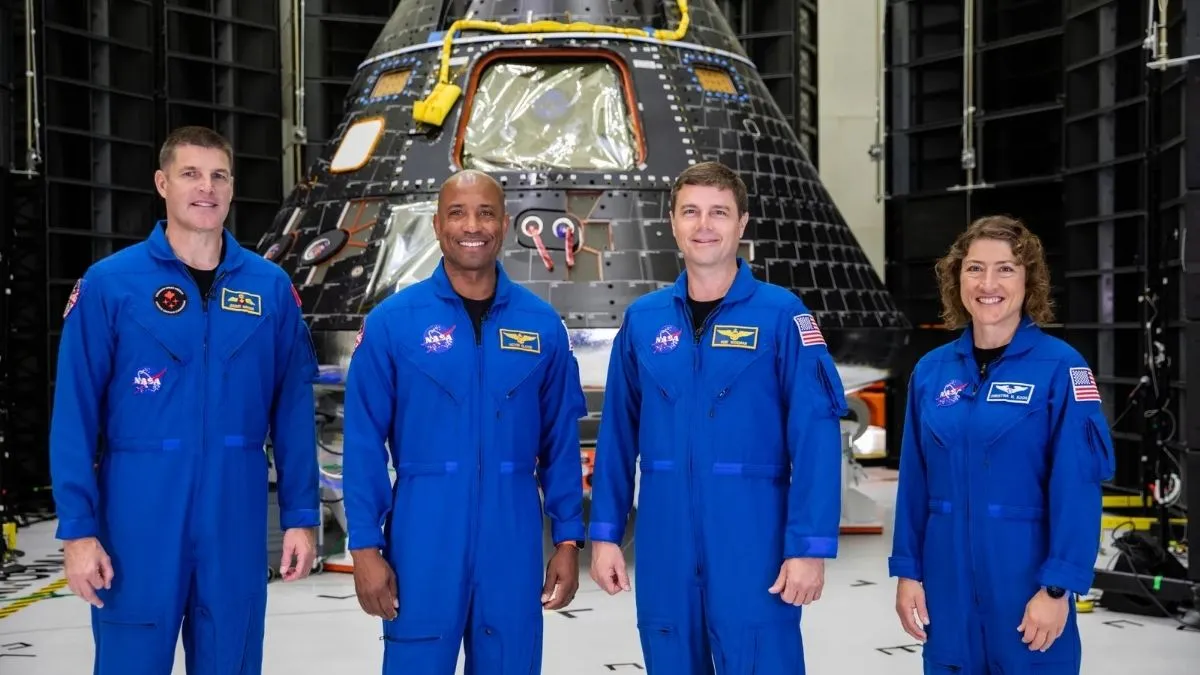
The NASA Artemis II astronauts have officially started a new chapter in the history of deep space exploration by successfully completing their 10-day lunar flyby. The Orion spacecraft, which is also known as Integrity, broke through the Earth's atmosphere at Mach 33 on Friday, April 10, 2026, at 5:07 p.m. PDT.
It then safely landed off the coast of San Diego. This mission, which had Commander Reid Wiseman, Pilot Victor Glover, and Mission Specialists Christina Koch and Jeremy Hansen on board, was the first time people have been to the Moon since Apollo 17 in 1972.
The crew has made it possible for future landings on the lunar surface by traveling more than 694,000 miles and reaching a record distance of 252,756 miles from Earth.
What happens after the NASA Artemis II Splashdown?
Following the successful landing, NASA and the U.S. Navy initiated a meticulously planned recovery sequence. The astronauts remained inside the Orion capsule for approximately one hour to allow the spacecraft to power down and for recovery divers to ensure no toxic fuel leaks were present.
-
Extraction Process: The crew was moved from the capsule onto an inflatable front porch raft.
-
Aerial Transfer: U.S. Navy MH-60 Seahawk helicopters hoisted each astronaut from the raft.
-
Medical Evaluation: The team was flown to the USS John P. Murtha, where they underwent immediate post-mission medical checkups to monitor the effects of microgravity.
-
Journey Home: After stabilizing on the recovery ship, the astronauts are scheduled to fly back to NASA’s Johnson Space Center in Houston for long-term recovery and debriefing.
Also Read - When will NASA Launch Artemis II Moon Mission to Orbit the Lunar Surface?
Meet the Artemis II Crew Members
The mission was notable not just for its technical achievements, but for its historic diversity. NASA’s selection reflected a modern era of inclusive space exploration.
| Artemis II Astronaut | Agency | Role | Key Milestone |
| Reid Wiseman | NASA | Commander | Led the first crewed lunar mission of the 21st century. |
| Victor Glover | NASA | Pilot | The first Black astronaut to fly to the vicinity of the Moon. |
| Christina Koch | NASA | Mission Specialist | The first woman to participate in a lunar mission. |
| Jeremy Hansen | CSA | Mission Specialist | The first non-U.S. citizen (Canadian) to fly to the Moon. |
Also Read - NASA Unveils $20B Moon Base Roadmap and Nuclear Mars Mission to Secure Space Dominance
How did the Orion Spacecraft Perform during Re-entry?
The return journey was the ultimate test for Orion’s heat shield and parachute systems. As the capsule entered the atmosphere, it faced temperatures nearing 5,000 degrees Fahrenheit, roughly half as hot as the sun.
-
Skip Entry: Orion performed a skip maneuver, dipping into the atmosphere and popping back out to pinpoint its landing site.
-
Parachute Deployment: After a six-minute communication blackout, the drogue parachutes deployed at 22,000 feet, followed by three massive main parachutes at 6,000 feet.
-
Splashdown Velocity: The parachutes slowed the 16-ton capsule from 25,000 mph to a gentle 20 mph before it impacted the Pacific waters.
Check Out - NASA Artemis 2 Mission Launches: Crewed Orion Capsule Embarks on Historic Moon Flyby
As NASA Administrator Bill Nelson previously noted, "We are going back to the Moon to stay." The successful return of the NASA Artemis II astronauts validates the safety of the Space Launch System (SLS) and Orion for human flight. This milestone clears the path for Artemis III, the highly anticipated mission that will land the first woman and next man on the lunar South Pole.



Comments
All Comments (0)
Join the conversation