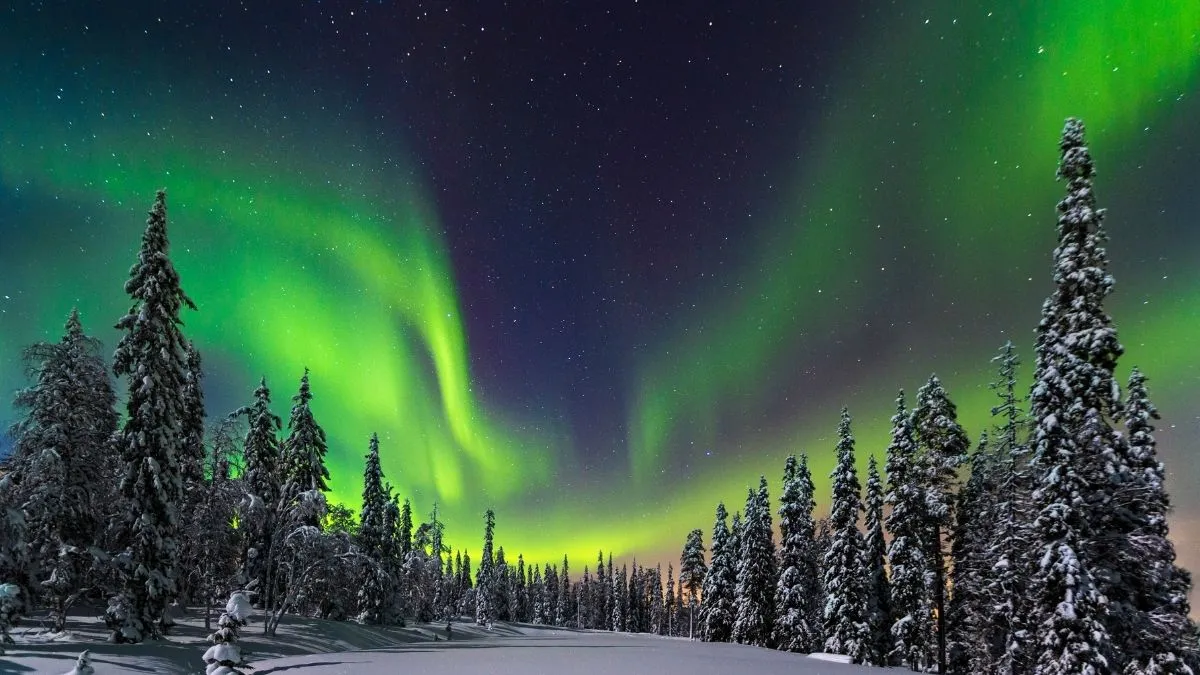
The skies over the United States are buzzing with anticipation as the official Aurora Borealis forecast confirms a high probability of a stunning celestial show tonight. The National Oceanic and Atmospheric Administration's (NOAA) Space Weather Prediction Center (SWPC) has issued a G3 (Strong) Geomagnetic Storm Watch, projecting the Kp index to reach a powerful 7.
This significant solar activity, a result of a recent full-halo Coronal Mass Ejection (CME), means the Northern Lights could be seen much further south than usual. For millions, the chance to witness the brilliant, dancing aurora borealis is now a distinct reality, prompting viewers across at least 15 states to prepare for this rare and powerful visibility event.
Which U.S. States Could See the Northern Lights Tonight?
The NOAA Space Weather Prediction Center has pinpointed a visibility threshold that dramatically extends the reach of the aurora borealis due to the expected G3-level storm. With the Kp index hitting a predicted 7, the Northern Lights tonight are expected to be visible directly overhead for states along the Canadian border and low on the northern horizon for states much further south.
The following 15 states are poised for potential visibility:
| Region | States on High Alert (Kp 7 Visibility) |
| Northeast | Maine, Vermont, New Hampshire, New York, Massachusetts |
| Midwest | Michigan, Wisconsin, Minnesota, Iowa |
| West | North Dakota, Montana, Washington, Idaho, Oregon, South Dakota |
Also Read - School Closing and Delays Today (December 9, 2025): List of U.S. Districts Affected by Winter Storm
What does a Kp Index of 7 Mean for Aurora Prediction?
Tonight’s highly anticipated aurora prediction is rooted in the recent solar eruption that sent a Coronal Mass Ejection (CME) hurtling directly toward Earth. This vast cloud of charged particles from the sun is expected to impact our planet's magnetic field, or magnetosphere, triggering a strong geomagnetic storm.
The Kp index is the scale (0 to 9) scientists use to measure the severity of these geomagnetic disturbances. A Kp index of 7 corresponds to a G3 (Strong) storm, a level that is uncommon and significantly increases the chance of seeing the aurora at lower latitudes.
| Kp Index | Storm Level (NOAA G-Scale) | Visibility Extent (Approximate Southern U.S. Reach) |
| Kp 0-4 | Quiet/Minor | Alaska, Canada |
| Kp 5 | G1 (Minor) | Northernmost U.S. (e.g., Northern Minnesota) |
| Kp 7 | G3 (Strong) | Northern Lights Tonight visible to roughly 40° N latitude |
| Kp 9 | G5 (Extreme) | Visible as far south as Florida and Mexico (Extremely Rare) |
A full-halo coronal mass ejection (CME), associated with an M8.1 flare from Region 4299 at 20:39 UTC on 06 December, is expected to impact Earth early to midday on 09 December, potentially causing periods of G3 (Strong) geomagnetic storming. pic.twitter.com/L2qCfEWmRW
— NOAA Space Weather Prediction Center (@NWSSWPC) December 7, 2025
When and How to See the Northern Lights?
To maximize your opportunity to see this phenomenon, planning is essential. Visibility depends heavily on three factors: time, location, and local cloud cover forecast.
Experts suggest the prime viewing window for the northern lights tonight will be between 10:00 PM and 2:00 AM local time. The specific timing depends on the precise arrival and intensity of the CME.
Follow these key steps to prepare for the celestial show:
-
Escape Light Pollution: Drive as far away from major city lights as possible. Dark skies are non-negotiable for low-horizon viewing.
-
Look North: The aurora will typically appear low on the northern horizon for viewers in southern states.
-
Check the Clouds: Clear skies are crucial. Consult your local weather forecast right up until viewing time.
-
Allow Time for Eyes to Adjust: Give your eyes at least 20 minutes in the pitch black to fully adjust and enhance your perception of the dim lights.
-
Use Your Phone Camera: Smartphone cameras often capture the colors of the aurora better than the human eye due to their long exposure capabilities.
Also Read - Northern Lights vs Southern Lights: What’re the Key Differences?
With the Aurora Borealis forecast pointing to a G3 strong storm, tonight could be a monumental viewing opportunity for millions of Americans. Viewers from Maine to Washington State should prepare now, check local forecasts, and look toward the northern sky. This December 9th celestial event promises to be one of the strongest northern lights displays in years.






Comments
All Comments (0)
Join the conversation