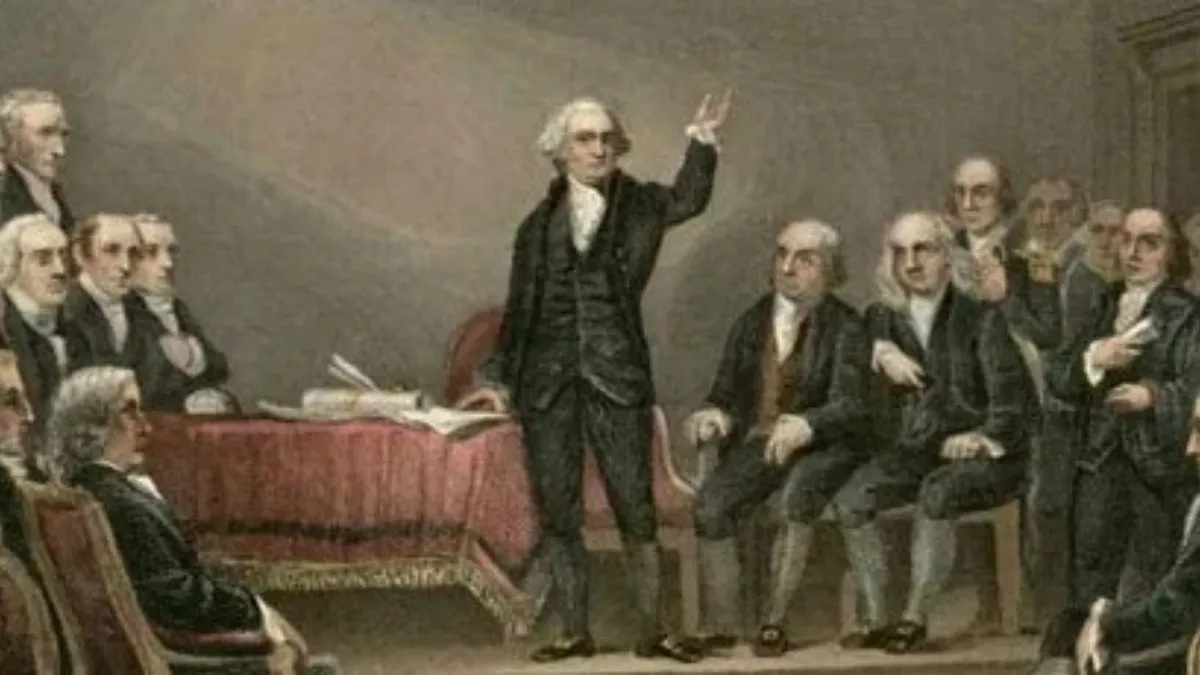
In the sweltering summer of 1787, fifty-five delegates gathered in Philadelphia for what we now call the Constitutional Convention. While it sounds like a straightforward meeting today, it was actually a high-stakes, secretive, and incredibly tense "reboot" of the American government.
In this article, we have covered what was it about, why did the articles of confederation fail and the finally outcome.
Why did the Articles of Confederation fail?
To understand the convention, you first have to look at the Articles of Confederation. After winning independence from Britain, the young United States was operating under this loose "league of friendship." It wasn't working.
The central government was so weak it couldn't collect taxes, regulate trade, or even settle disputes between states.
By 1786, the country was facing economic chaos and internal uprisings. Leaders like James Madison and Alexander Hamilton realised that without a stronger federal structure, the United States might simply collapse or be swallowed up by European powers.
Why the 1787 Convention Scrapped the Articles?
The delegates didn’t arrive in Philadelphia intending to overthrow the government at least, not on paper.
Even a reluctant George Washington was initially told the meeting's "sole and express purpose" was simply to patch up the existing Articles of Confederation.
However, the atmosphere changed the moment the doors of Independence Hall were locked and the windows were nailed shut for absolute secrecy.
The delegates quickly realised that "patching" a sinking ship wasn't enough. Instead of a minor repair job, the conversation shifted toward a radical new framework.
They decided to scrap the old system entirely and build a brand-new foundation from the ground up, which is the U.S. Constitution. This move transformed the gathering from a routine committee meeting into a foundational moment for modern democracy.
Constitutional Convention 1787 Key Facts
The convention lasted from May to September, and it wasn't a polite affair. The main focus was on how to balance power so that no single person or state could become a tyrant. Three massive debates dominated the summer:
-
Large vs. Small States: The "Virginia Plan" wanted representation based on population (favouring big states), while the "New Jersey Plan" wanted equal votes for every state.
-
The Great Compromise: To break the deadlock, they created a bicameral legislature. The House of Representatives would be based on population, while the Senate would give every state two seats.
-
The Executive Branch: There was a fierce debate over whether the country should have a single leader or a committee of three. Eventually, they settled on a single President, largely because everyone trusted George Washington to set a fair precedent.
How the Philadelphia Convention Redefined Power?
On 17 September 1787, thirty-nine delegates signed the final document. The main outcome wasn't just a piece of parchment, as it was a total shift in how power worked.
They established the Separation of Powers (Legislative, Executive, and Judicial) and a system of Checks and Balances to keep them in line.
The convention didn't make the Constitution law immediately, though. It had to be ratified by at least nine of the thirteen states.
This sparked a year of intense public debate between the Federalists, who supported the new plan, and the Anti-Federalists, who feared it gave the government too much power and demanded a Bill of Rights.
Check Out: What Caused French Revolution?
Ultimately, the convention succeeded in creating the oldest written national constitution still in use today, turning a shaky collection of states into a unified nation.



Comments
All Comments (0)
Join the conversation