35 Colonies, 400 Years: How One Empire Made Half the World Speak Spanish
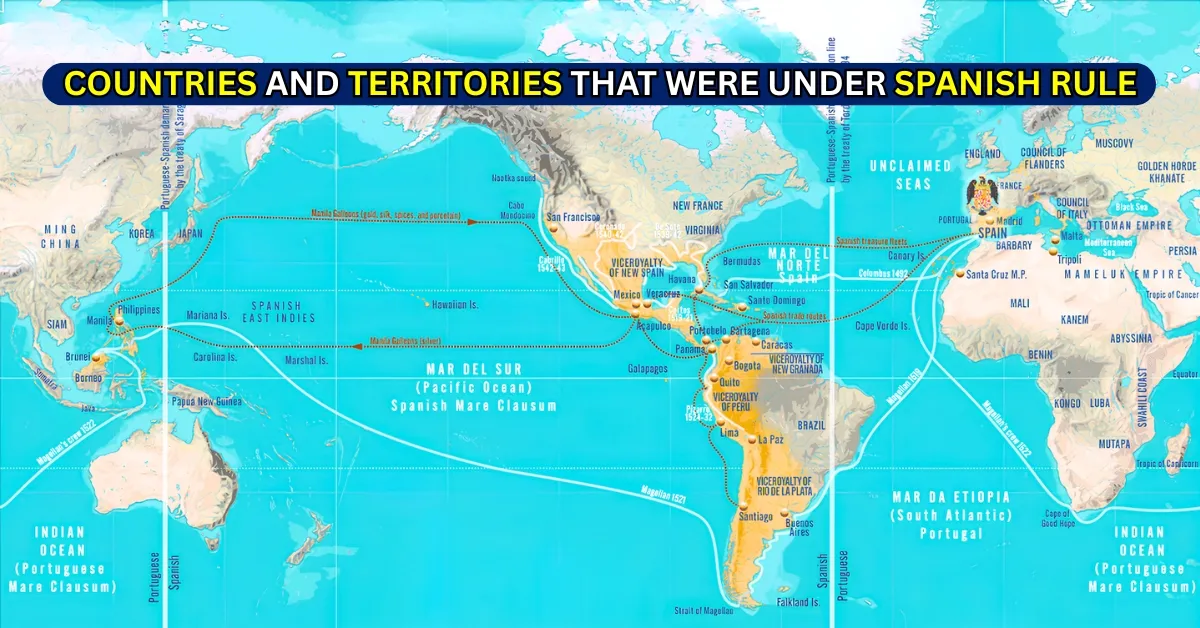
Spanning over four centuries, the Spanish Empire expanded across the Americas, Asia, Africa, and Europe, colonising 35 territories. Through exploration and trade, Spain established a vast global domain before these nations gradually achieved their independence.
Key Points
- Spanish speakers grew from <4M in 1492 to over 500M today, surpassing English.
- The Spanish Empire spanned four centuries, peaking under Philip II, uniting thrones in 1580.
- The empire's reach across continents shaped global trade, with Potosí silver as world currency.
In 1492, when Columbus sailed to the west, the number of Spanish-speaking people in the world stood at less than 4 million. In fact, it was not even the only language in the Iberian Peninsula. It was just Castilian – just another dialect fighting for supremacy in the newly created state of Spain.
Four centuries later, that one small dialect has come to conquer half a continent, cross three oceans and destroy many other languages.
Now, Spanish is spoken by over 500 million people in 35 countries and boasts an extra 100 million speakers compared to English.
But then again, how could a language which came from caves in northern Spain create a linguistic empire that survived even when its empire had long since fallen?
List of Countries and Territories Formerly Under Spanish Rule
Spain created a large global empire across several continents through colonisation via explorations, conquests, and trade until these countries gained their independence over time.
| Country / Territory | Year Colonised | Key Explorer / Conquistador | Period of Spanish Rule | Year of Independence / Cession | Description |
| Argentina | 1536 | Pedro de Mendoza | 1536–1816 | 1816 | Member of the Viceroyalty of the Río de la Plata, which was a very important trading centre before it gained independence. |
| Belgium | 1556 | N/A (Habsburg Inheritance) | 1556–1714 | 1714 | It was known as the Spanish Netherlands and was under the control of the Spanish Habsburgs until it came into possession of Austria. |
| Belize | 1524 | Hernán Cortés | 1524–1798 | 1798 | Belonging to New Spain but was being colonised by British log cutters and other people. |
| Bolivia | 1538 | Gonzalo Pizarro | 1538–1825 | 1825 | Famous for the Potosí silver mines which funded most of the Spanish Empire. |
| California (USA) | 1769 | Gaspar de Portolá | 1769–1821 | 1821 | Established through a series of Spanish Catholic missions prior to being incorporated into the newly-formed nation of Mexico. |
| Chile | 1541 | Pedro de Valdivia | 1541–1818 | 1818 | Encountered decades of stubborn resistance by the native Mapuche population prior to achieving its independence led by Bernardo O’Higgins. |
| Colombia | 1525 | Rodrigo de Bastidas | 1525–1819 | 1819 | Heart of the Viceroyalty of New Granada and the foundation of Simón Bolívar’s post-independence Gran Colombia. |
| Costa Rica | 1524 | Francisco Fernández de Córdoba | 1524–1821 | 1821 | The southernmost province of the Captaincy General of Guatemala gained independence alongside neighbouring Central American states. |
| Cuba | 1511 | Diego Velázquez de Cuéllar | 1511–1898 | 1898 | Spain's crucial Caribbean island stronghold and sugar producer remained loyal until the Spanish-American War. |
| Dominican Republic | 1492 | Christopher Columbus | 1492–1795 | 1795 | Site of La Hispaniola, the very first permanent European settlement in the Americas. |
| Ecuador | 1534 | Sebastián de Belalcázar | 1534–1822 | 1822 | Home to Quito, a key administrative and artistic hub in the Andes under Spanish rule. |
| El Salvador | 1524 | Pedro de Alvarado | 1524–1821 | 1821 | Highly valued for its agriculture, particularly indigo production, before joining the Central American independence movement. |
| Equatorial Guinea | 1778 | Fernão do Po (Portuguese) | 1778–1968 | 1968 | Spain's primary colony in sub-Saharan Africa, acquired from Portugal via treaty in exchange for American territory. |
| Florida (USA) | 1565 | Pedro Menéndez de Avilés | 1565–1821 | 1821 | Home to St. Augustine, the oldest continuously inhabited European settlement in the continental United States. |
| Guam | 1668 | Diego Luis de San Vitores | 1668–1898 | 1898 | A vital trans-Pacific stopping point for the Manila-Acapulco Galleon trade before being ceded to the U.S. |
| Guatemala | 1524 | Pedro de Alvarado | 1524–1821 | 1821 | It served as the capital of the Captaincy General of Guatemala, governing most of Central America. |
| Haiti | 1492 | Christopher Columbus | 1492–1697 | 1697 | Originally western Hispaniola, Spain ceded the territory to France under the Treaty of Ryswick. |
| Honduras | 1524 | Cristóbal de Olid | 1524–1821 | 1821 | Rich in silver and mineral wealth, it was an important economic centre in colonial Central America. |
| Italy (Southern/Lombardy) | 1504 | Gonzalo Fernández de Córdoba | 1504–1714 | 1714 | Naples, Sicily, and Milan were ruled directly by Spain as key Mediterranean strongholds for over two centuries. |
| Jamaica | 1509 | Juan de Esquivel | 1509–1655 | 1655 | Known as Santiago under Spanish rule before being captured by British forces under Oliver Cromwell. |
| Louisiana (USA) | 1762 | Hernando de Soto (explored) | 1762–1801 | 1801 | Ceded by France to Spain after the Seven Years' War, expanding Spanish control across the Mississippi. |
| Luxembourg | 1556 | N/A (Habsburg Inheritance) | 1556–1714 | 1714 | Governed as part of the Spanish Netherlands during the height of Spanish Habsburg power in Europe. |
| Mexico | 1521 | Hernán Cortés | 1521–1821 | 1821 | The capital of the Viceroyalty of New Spain, where Spanish culture deeply blended with indigenous Aztec civilisation. |
| Morocco (Northern/Tarfaya) | 1912 | General Marina | 1912–1956 | 1956 | Established as a Spanish protectorate in northern Africa during the modern imperial era. |
| Nicaragua | 1522 | Gil González Dávila | 1522–1821 | 1821 | Centred around rich colonial towns like Granada and León along key Central American trade routes. |
| Panama | 1510 | Vasco Núñez de Balboa | 1510–1821 | 1821 | Served as the vital transit point for transferring Peruvian silver across the isthmus toward Europe. |
| Paraguay | 1537 | Juan de Salazar de Espinosa | 1537–1811 | 1811 | Famous for the Jesuit Reductions, communal settlements created to integrate and protect Guaraní indigenous populations. |
| Peru | 1532 | Francisco Pizarro | 1532–1824 | 1824 | Heart of the Inca Empire and major silver source for Spain until the decisive Battle of Ayacucho. |
| Portugal | 1580 | Philip II of Spain | 1580–1640 | 1640 | United under Spanish monarch Philip II in the Iberian Union, sharing a ruler for 60 years. |
| Puerto Rico | 1508 | Juan Ponce de León | 1508–1898 | 1898 | Crucial strategic Caribbean fortress protecting trade routes, remaining Spanish until the Spanish-American War. |
| The Netherlands | 1556 | N/A (Habsburg Inheritance) | 1556–1581 | 1581 | Sparked the Eighty Years' War against Spanish rule, ultimately establishing the Dutch Republic. |
| The Philippines | 1565 | Miguel López de Legazpi | 1565–1898 | 1898 | Spain's major Asian colony and key node for global trade before being ceded to the U.S. |
| Trinidad and Tobago | 1498 | Christopher Columbus | 1498–1797 | 1797 | Remained a sparsely populated Spanish colony for three centuries before being captured by a British fleet. |
| Uruguay | 1726 | Bruno Mauricio de Zabala | 1726–1811 | 1811 | Founded as a buffer zone against Portuguese expansion before fighting for its independent sovereignty. |
| Venezuela | 1522 | Alonso de Ojeda | 1522–1821 | 1821 | Agricultural producer of cocoa and tobacco, serving as the birthplace of independence hero Simón Bolívar. |
About the Spanish Empire

The Spanish Empire, which has been referred to throughout history as the Monarchia Hispanica (Hispanic Monarchy) and the Catholic Monarchy (Monarquía Católica), is one of the greatest empires of all time in geographical terms.
The era of Philip II's reign is the era of the peak of the Spanish Empire and its achievement of the fame of being "an empire where the sun never sets".
Over the course of four centuries of its existence, the Spanish Empire included not only European countries but also the territories of North and South Americas, Africa, the Philippines and some territories of Asia.
In 1580, Philip II managed to unify the Spanish and Portuguese thrones and dominated their vast trade network for sixty years.
In addition to colonisation and mining of metals, the Spanish Empire changed the economy and culture of the planet in many different ways. For example, silver extracted in Potosí (currently in Bolivia) used to be the leading currency of the world, even in the trade between Spain and Imperial China.
Besides that, through the Columbian exchange, the Spanish Empire changed the food habits and farming practices of the globe.
Kriti Barua is a skilled digital journalist and communications professional with 4+ years of experience, currently writing for the General Knowledge section at Jagran New Media. She has established herself as a subject matter expert in History, Geography, Trending National and International News, Sports, Science, and Defence, producing clear, reliable, and search-optimised content that connects with readers worldwide.
Kriti holds a BA degree from Delhi University and a one-year diploma in TV Production and Journalism, an academic background that adds research depth and strong storytelling instincts to her writing. Her experience spans brand writing, content marketing, and digital media, giving her a sharp understanding of what makes content both helpful to readers and visible in search.
At Jagran New Media, she applies this expertise to national and international news coverage, query-based articles, and in-depth pieces across her specialist subject areas. Her content is defined by easy language, factual accuracy, strong keyword strategy, and reader-friendly storytelling.







![[OUT] RSSB Mahila Supervisor Admit Card 2026 Live: Download Rajasthan Female Supervisor Hall Ticket at rssb.rajasthan.gov.in- Link Active](https://img.jagranjosh.com/images/2026/July/2072026/Add-a-heading-(2).jpg)