What is Aurora Borealis Forecast Tonight? Solar Flare Eruption Puts New York and Idaho on Northern Lights Watch
A fresh solar eruption has triggered a G2 geomagnetic storm watch. Stargazers from New York to Idaho could witness vivid northern lights tonight depending on a critical solar wind detail.
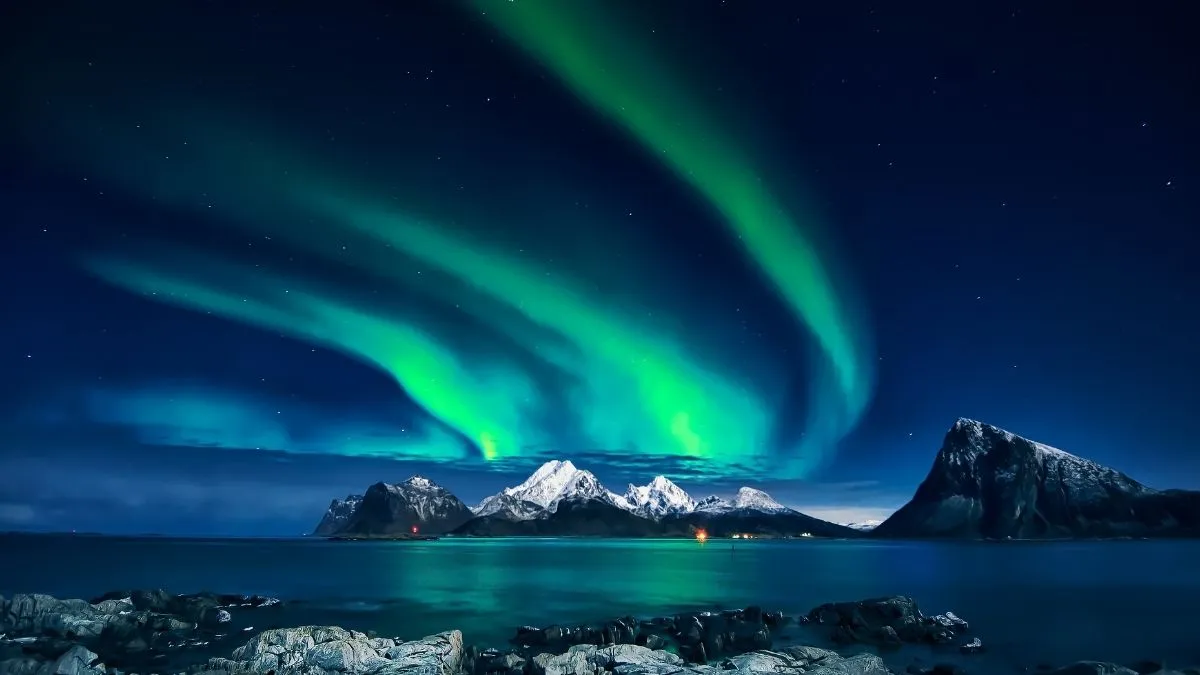
Aurora Borealis is going to be visible in US tonight (October 7th 2026). A moderate G2 geomagnetic storm watch has been declared by the NOAA Space Weather Prediction Center because a coronal mass ejection from the Sun is headed towards Earth following a solar eruption.
The active region of the Sun AR4549 generated an M1.4-class solar flare on October 6 and hurled the charged plasma in a straight path towards Earth.
If the orientation of the solar wind coincides with the orientation of the Earth’s magnetic field. Then an aurora borealis can be expected in the south.
Northern Lights Forecast: Which US States Could See Aurora Borealis?
With such an expected solar storm comes the high chance of the appearance of green and purplish streaks of Aurora Borealis in the sky for stargazers in the northern part of the United States.
G2 geomagnetic activity and the Kp value is the most important parameter in measuring the intensity of auroras which could get up to 5 or 6 on October 6th.
| Geomagnetic Storm Target Region | US State | Expected Visibility Level | Aurora Borealis Peak Viewing Window |
| Northern States | Washington, Idaho, Montana, North Dakota, Minnesota | Overhead to mid-sky displays | 10:00 PM – 2:00 AM Local Time |
| Mid-Latitude States | New York, Wisconsin, Michigan, South Dakota | Low northern horizon glows | 11:00 PM – 3:00 AM Local Time |
| Central Plains | Iowa, Nebraska, Illinois | Faint photographic auroras | Midnight – 3:00 AM Local Time |
Seeing the Northern lights depends heavily on local atmospheric clarity. Space weather agencies indicate that peak Aurora activity will coincide with dark nighttime hours across North American time zones.
How and Where to Watch the Northern Lights Tonight
To maximize your chances of catching the Aurora Borealis follow these simple viewing techniques:
-
Travel at least twenty to thirty miles outside urban areas to eliminate ground-level light pollution.
-
Find Unobstructed Views by positioning yourself on an elevated ridge or near the southern shore of a body of water. And look north for a clean view of the Northern Lights.
-
The human eye struggles to pick up dim colors in the dark. Modern smartphone cameras set to a three to five second night mode exposure can capture vibrant greens and pinks invisible to the naked eye.
Atmospheric Science Behind Aurora Borealis
The Aurora Borealis happens as a result of solar electrons hitting gas molecules in Earth’s atmosphere at an altitude of about sixty to two hundred miles.
The particles hitting each other create energy in the gas molecules which is then emitted in the form of color lights.

Harshita Singh is an education and general knowledge journalist with over 5 years of experience in educational writing. Specializing in US affairs and GK, Harshita has a track record of breaking down intricate geopolitical and historical subjects into clear, digestible insights for learners. Her strong background in text analysis, coupled with a Bachelor of Arts (Hons) in English from the University of Delhi, helps her produce authoritative, thoroughly researched content that empowers readers to engage confidently with global current affairs. For inquiries or academic insights, you can reach out to her directly at harshita.singh@jagrannewmedia.com.


-1791375327804_t.webp)